 Add to Chrome
 Add to Firefox
 Add to Edge
DuoBench: A Reproducible Benchmark for Bimanual Manipulation in Simulation and the Real World
Jun 10, 2026
Bimanual robot systems substantially expand manipulation capabilities, but coordinating two arms introduces additional control complexity and failure modes that are not well captured by existing benchmarks. We introduce DuoBench, an extensible benchmarking framework for bimanual manipulation policies on the FR3 Duo platform. DuoBench comprises eleven tasks spanning four coordination categories, implemented in simulation and partially reproduced in the real world through reproducible task recipes with 3D-printable assets. In addition, we propose a stage-based evaluation scheme that supports fine-grained semantic failure analysis beyond binary success and provide human-teleoperated datasets for all benchmark tasks. We benchmark several dual-arm imitation-learning and vision-language-action policies in simulation and on real hardware. Our results show that current policies remain challenged by bimanual manipulation, particularly in early interaction stages, parallel arm execution, and transfer between simulation and real-world settings. DuoBench provides a reproducible testbed for diagnosing these failure modes and studying future methods for dual-arm policy learning. Code, datasets, and videos are available at https://duobench.github.io/

Rewarding DINO: Predicting Dense Rewards with Vision Foundation Models
Mar 17, 2026Well-designed dense reward functions in robot manipulation not only indicate whether a task is completed but also encode progress along the way. Generally, designing dense rewards is challenging and usually requires access to privileged state information available only in simulation, not in real-world experiments. This makes reward prediction models that infer task state information from camera images attractive. A common approach is to predict rewards from expert demonstrations based on visual similarity or sequential frame ordering. However, this biases the resulting reward function towards a specific solution and leaves it undefined in states not covered by the demonstrations. In this work, we introduce Rewarding DINO, a method for language-conditioned reward modeling that learns actual reward functions rather than specific trajectories. The model's compact size allows it to serve as a direct replacement for analytical reward functions with comparatively low computational overhead. We train our model on data sampled from 24 Meta-World+ tasks using a rank-based loss and evaluate pairwise accuracy, rank correlation, and calibration. Rewarding DINO achieves competitive performance in tasks from the training set and generalizes to new settings in simulation and the real world, indicating that it learns task semantics. We also test the model with off-the-shelf reinforcement learning algorithms to solve tasks from our Meta-World+ training set.
VLAgents: A Policy Server for Efficient VLA Inference
Jan 16, 2026The rapid emergence of Vision-Language-Action models (VLAs) has a significant impact on robotics. However, their deployment remains complex due to the fragmented interfaces and the inherent communication latency in distributed setups. To address this, we introduce VLAgents, a modular policy server that abstracts VLA inferencing behind a unified Gymnasium-style protocol. Crucially, its communication layer transparently adapts to the context by supporting both zero-copy shared memory for high-speed simulation and compressed streaming for remote hardware. In this work, we present the architecture of VLAgents and validate it by integrating seven policies -- including OpenVLA and Pi Zero. In a benchmark with both local and remote communication, we further demonstrate how it outperforms the default policy servers provided by OpenVLA, OpenPi, and LeRobot. VLAgents is available at https://github.com/RobotControlStack/vlagents
Robot Control Stack: A Lean Ecosystem for Robot Learning at Scale
Sep 18, 2025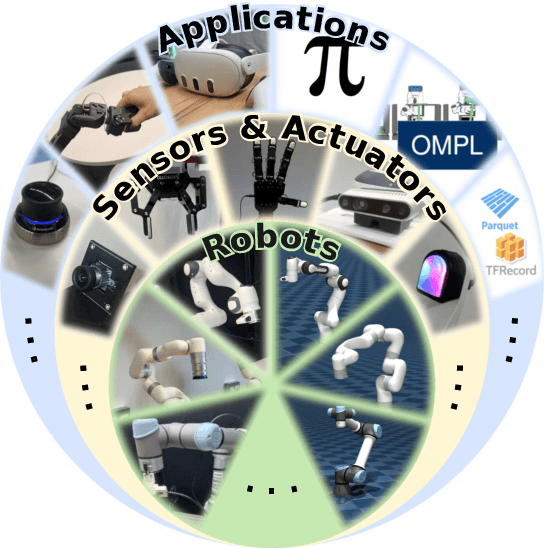
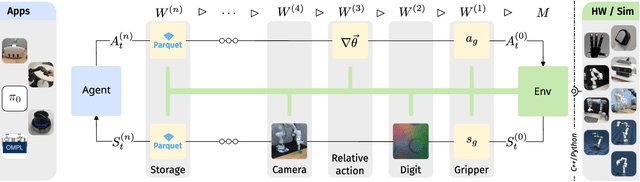
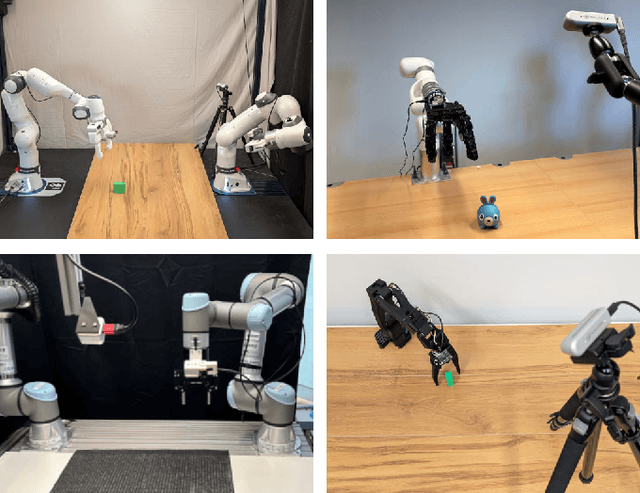
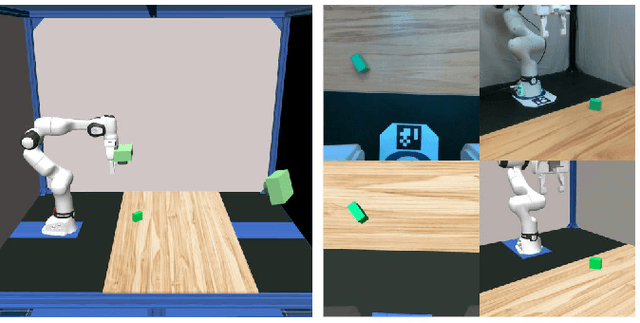
Vision-Language-Action models (VLAs) mark a major shift in robot learning. They replace specialized architectures and task-tailored components of expert policies with large-scale data collection and setup-specific fine-tuning. In this machine learning-focused workflow that is centered around models and scalable training, traditional robotics software frameworks become a bottleneck, while robot simulations offer only limited support for transitioning from and to real-world experiments. In this work, we close this gap by introducing Robot Control Stack (RCS), a lean ecosystem designed from the ground up to support research in robot learning with large-scale generalist policies. At its core, RCS features a modular and easily extensible layered architecture with a unified interface for simulated and physical robots, facilitating sim-to-real transfer. Despite its minimal footprint and dependencies, it offers a complete feature set, enabling both real-world experiments and large-scale training in simulation. Our contribution is twofold: First, we introduce the architecture of RCS and explain its design principles. Second, we evaluate its usability and performance along the development cycle of VLA and RL policies. Our experiments also provide an extensive evaluation of Octo, OpenVLA, and Pi Zero on multiple robots and shed light on how simulation data can improve real-world policy performance. Our code, datasets, weights, and videos are available at: https://robotcontrolstack.github.io/
LLM-Pack: Intuitive Grocery Handling for Logistics Applications
Mar 11, 2025Robotics and automation are increasingly influential in logistics but remain largely confined to traditional warehouses. In grocery retail, advancements such as cashier-less supermarkets exist, yet customers still manually pick and pack groceries. While there has been a substantial focus in robotics on the bin picking problem, the task of packing objects and groceries has remained largely untouched. However, packing grocery items in the right order is crucial for preventing product damage, e.g., heavy objects should not be placed on top of fragile ones. However, the exact criteria for the right packing order are hard to define, in particular given the huge variety of objects typically found in stores. In this paper, we introduce LLM-Pack, a novel approach for grocery packing. LLM-Pack leverages language and vision foundation models for identifying groceries and generating a packing sequence that mimics human packing strategy. LLM-Pack does not require dedicated training to handle new grocery items and its modularity allows easy upgrades of the underlying foundation models. We extensively evaluate our approach to demonstrate its performance. We will make the source code of LLMPack publicly available upon the publication of this manuscript.