 Add to Chrome
 Add to Firefox
 Add to Edge
VLAgents: A Policy Server for Efficient VLA Inference
Jan 16, 2026
The rapid emergence of Vision-Language-Action models (VLAs) has a significant impact on robotics. However, their deployment remains complex due to the fragmented interfaces and the inherent communication latency in distributed setups. To address this, we introduce VLAgents, a modular policy server that abstracts VLA inferencing behind a unified Gymnasium-style protocol. Crucially, its communication layer transparently adapts to the context by supporting both zero-copy shared memory for high-speed simulation and compressed streaming for remote hardware. In this work, we present the architecture of VLAgents and validate it by integrating seven policies -- including OpenVLA and Pi Zero. In a benchmark with both local and remote communication, we further demonstrate how it outperforms the default policy servers provided by OpenVLA, OpenPi, and LeRobot. VLAgents is available at https://github.com/RobotControlStack/vlagents

Robot Control Stack: A Lean Ecosystem for Robot Learning at Scale
Sep 18, 2025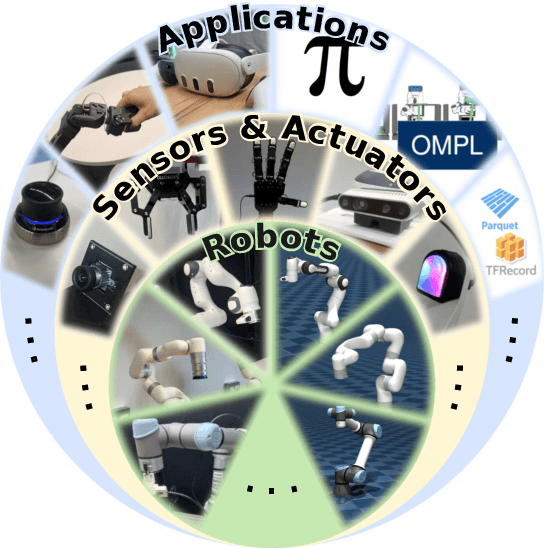
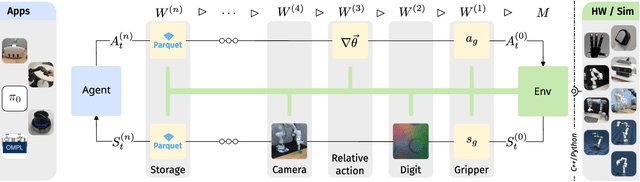
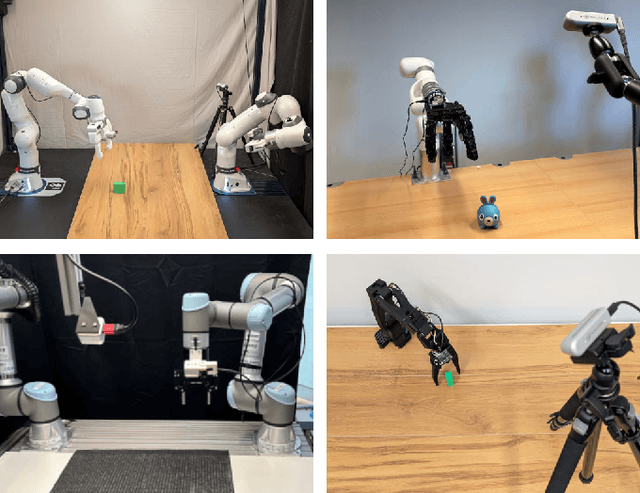
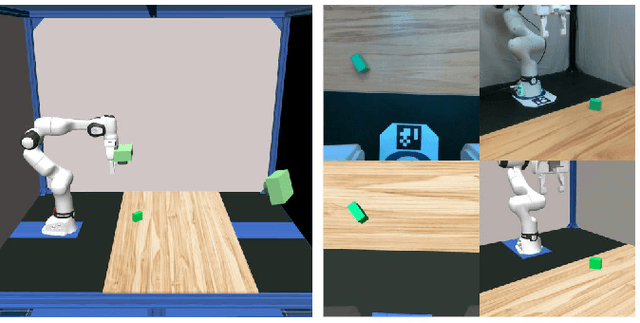
Vision-Language-Action models (VLAs) mark a major shift in robot learning. They replace specialized architectures and task-tailored components of expert policies with large-scale data collection and setup-specific fine-tuning. In this machine learning-focused workflow that is centered around models and scalable training, traditional robotics software frameworks become a bottleneck, while robot simulations offer only limited support for transitioning from and to real-world experiments. In this work, we close this gap by introducing Robot Control Stack (RCS), a lean ecosystem designed from the ground up to support research in robot learning with large-scale generalist policies. At its core, RCS features a modular and easily extensible layered architecture with a unified interface for simulated and physical robots, facilitating sim-to-real transfer. Despite its minimal footprint and dependencies, it offers a complete feature set, enabling both real-world experiments and large-scale training in simulation. Our contribution is twofold: First, we introduce the architecture of RCS and explain its design principles. Second, we evaluate its usability and performance along the development cycle of VLA and RL policies. Our experiments also provide an extensive evaluation of Octo, OpenVLA, and Pi Zero on multiple robots and shed light on how simulation data can improve real-world policy performance. Our code, datasets, weights, and videos are available at: https://robotcontrolstack.github.io/