 Add to Chrome
 Add to Firefox
 Add to Edge
Enabling Dynamic Tracking in Vision-Language-Action Models via Time-Discrete and Time-Continuous Velocity Feedforward
Mar 17, 2026
While vision-language-action (VLA) models have shown great promise for robot manipulation, their deployment on rigid industrial robots remains challenging due to the inherent trade-off between compliance and responsiveness. Standard Behavior Cloning (BC) approaches predict discrete poses at low frequencies, omitting the velocity and acceleration feedforward terms typically used by low-level compliant controllers. This requires to rely on high stiffness for accurate tracking, thereby sacrificing safe contact dynamics. In this paper, we demonstrate the importance of integrating velocity feedforward terms into VLA policies to resolve this trade-off. We propose two methods for extracting velocity targets from VLAs: a time-discrete finite-difference approximation that serves as a highly effective bridge for existing models, and a continuous Cubic B-Spline action space that natively yields $C^2$ continuous trajectories for high-frequency control. Crucially, both approaches are strictly model-agnostic and compatible with any standard action-chunking architecture, requiring modifications only to teleoperation, data processing, and the low-level controller. We fine-tune the $π_{0.5}$ model and evaluate both of our approaches on a demanding, contact-rich cube-in-hole task. Our results indicate that incorporating the velocity feedforward term via finite differences significantly improves task execution speed, while the continuous B-Spline approach maintains high overall success rates and provides a foundation for smoother higher-order derivatives without compromising compliance.

Robot Control Stack: A Lean Ecosystem for Robot Learning at Scale
Sep 18, 2025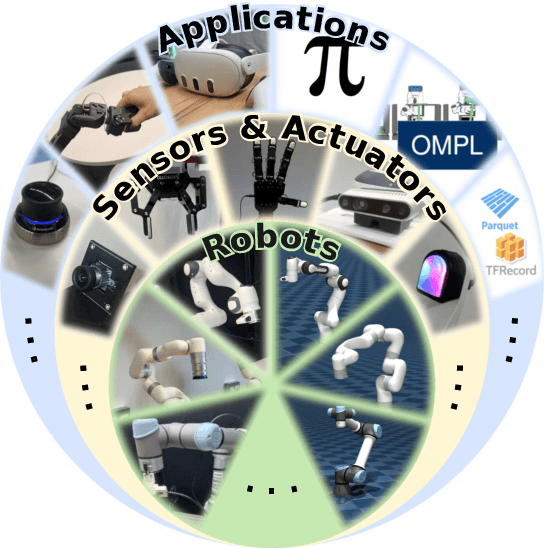
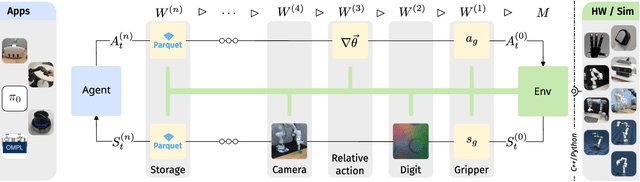
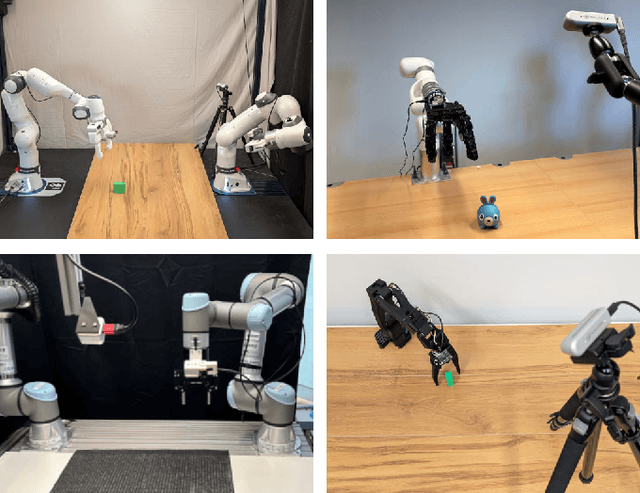
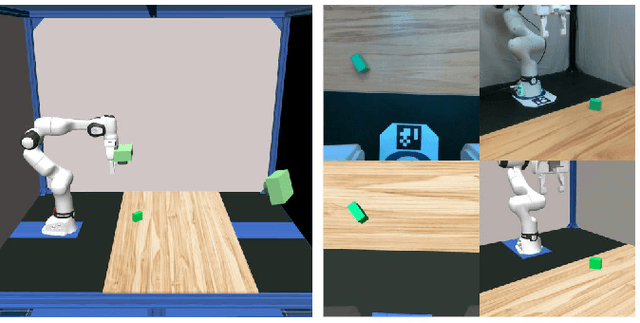
Vision-Language-Action models (VLAs) mark a major shift in robot learning. They replace specialized architectures and task-tailored components of expert policies with large-scale data collection and setup-specific fine-tuning. In this machine learning-focused workflow that is centered around models and scalable training, traditional robotics software frameworks become a bottleneck, while robot simulations offer only limited support for transitioning from and to real-world experiments. In this work, we close this gap by introducing Robot Control Stack (RCS), a lean ecosystem designed from the ground up to support research in robot learning with large-scale generalist policies. At its core, RCS features a modular and easily extensible layered architecture with a unified interface for simulated and physical robots, facilitating sim-to-real transfer. Despite its minimal footprint and dependencies, it offers a complete feature set, enabling both real-world experiments and large-scale training in simulation. Our contribution is twofold: First, we introduce the architecture of RCS and explain its design principles. Second, we evaluate its usability and performance along the development cycle of VLA and RL policies. Our experiments also provide an extensive evaluation of Octo, OpenVLA, and Pi Zero on multiple robots and shed light on how simulation data can improve real-world policy performance. Our code, datasets, weights, and videos are available at: https://robotcontrolstack.github.io/