 Add to Chrome
 Add to Firefox
 Add to Edge
Voxtral TTS
Mar 26, 2026
We introduce Voxtral TTS, an expressive multilingual text-to-speech model that generates natural speech from as little as 3 seconds of reference audio. Voxtral TTS adopts a hybrid architecture that combines auto-regressive generation of semantic speech tokens with flow-matching for acoustic tokens. These tokens are encoded and decoded with Voxtral Codec, a speech tokenizer trained from scratch with a hybrid VQ-FSQ quantization scheme. In human evaluations conducted by native speakers, Voxtral TTS is preferred for multilingual voice cloning due to its naturalness and expressivity, achieving a 68.4\% win rate over ElevenLabs Flash v2.5. We release the model weights under a CC BY-NC license.

Improving accuracy and power with transfer learning using a meta-analytic database
Sep 28, 2012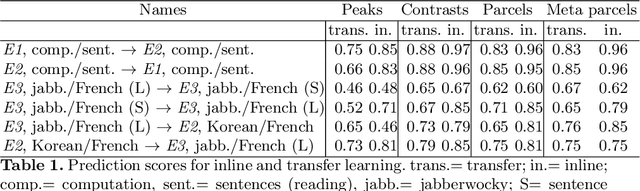
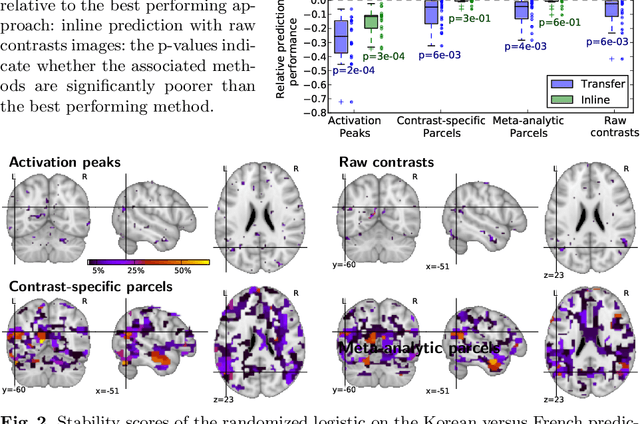
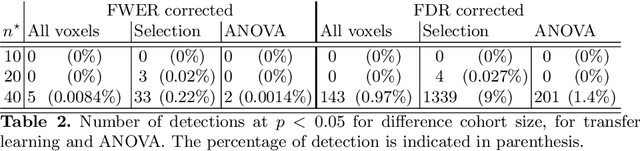
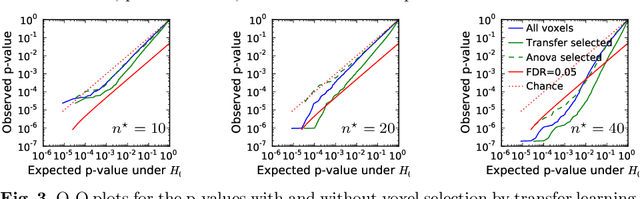
Typical cohorts in brain imaging studies are not large enough for systematic testing of all the information contained in the images. To build testable working hypotheses, investigators thus rely on analysis of previous work, sometimes formalized in a so-called meta-analysis. In brain imaging, this approach underlies the specification of regions of interest (ROIs) that are usually selected on the basis of the coordinates of previously detected effects. In this paper, we propose to use a database of images, rather than coordinates, and frame the problem as transfer learning: learning a discriminant model on a reference task to apply it to a different but related new task. To facilitate statistical analysis of small cohorts, we use a sparse discriminant model that selects predictive voxels on the reference task and thus provides a principled procedure to define ROIs. The benefits of our approach are twofold. First it uses the reference database for prediction, i.e. to provide potential biomarkers in a clinical setting. Second it increases statistical power on the new task. We demonstrate on a set of 18 pairs of functional MRI experimental conditions that our approach gives good prediction. In addition, on a specific transfer situation involving different scanners at different locations, we show that voxel selection based on transfer learning leads to higher detection power on small cohorts.