 Add to Chrome
 Add to Firefox
 Add to Edge
No-reference based automatic parameter optimization for iterative reconstruction using a novel search space aware crow search algorithm
Apr 06, 2026
Iterative reconstruction technique's ability to reduce radiation exposure by using fewer projections has attracted significant attention. However, these methods typically require a precise tuning of several hyperparameters, which can have a major impact on reconstruction quality. Manually setting these parameters is time-consuming and increases the workload for human operators. In this paper, we introduce a novel fully automatic parameter optimization framework that can be applied to a wide range of Cone-beam computed tomography (CBCT) iterative reconstruction algorithms to determine optimal parameters without requiring a reference reconstruction. The proposed method incorporates a modified crow search algorithm (CSA) featuring a superior set-dependent local search mechanism, a search-space-aware global search strategy, and an objective-driven balance between local and global search. Additionally, to ensure an effective initial population, we propose a chaotic diagonal linear uniform initialization scheme that accelerates algorithm convergence. The performance of the proposed framework was evaluated on three imaging machines and four real datasets, as well as three different iterative reconstruction methods with the highest number of tunable parameters, representing the most challenging senario. The results indicate that the proposed method could outperform manual settings and CSA, with an 4.19% improvement in average fitness and 4.89% and 3.82% improvements on CHILL@UK and RPI_AXIS, respectively, which are two benchmark no-reference learning-based quality metrics. In addition, the qualitative results clearly show the superiority of the proposed method by maintaining fine details sharply. The overall performance of the proposed framework across different comparison scenarios demonstrates its effectiveness and robustness across all cases.

Enhancing Synthetic CT from CBCT via Multimodal Fusion: A Study on the Impact of CBCT Quality and Alignment
Jun 10, 2025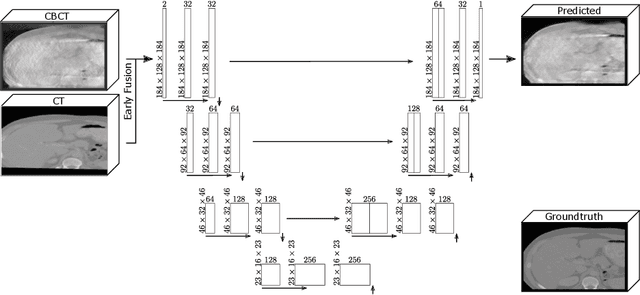
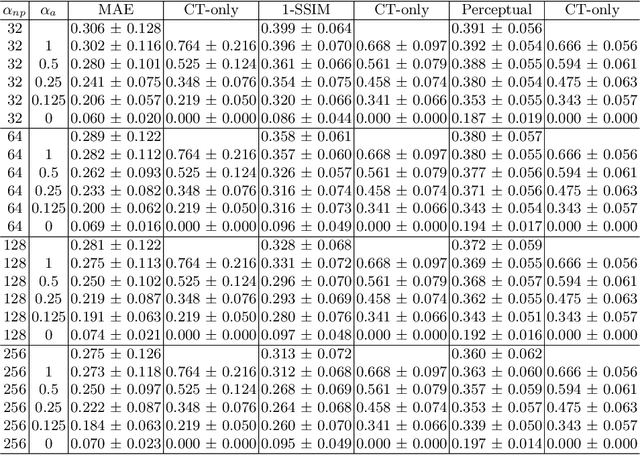
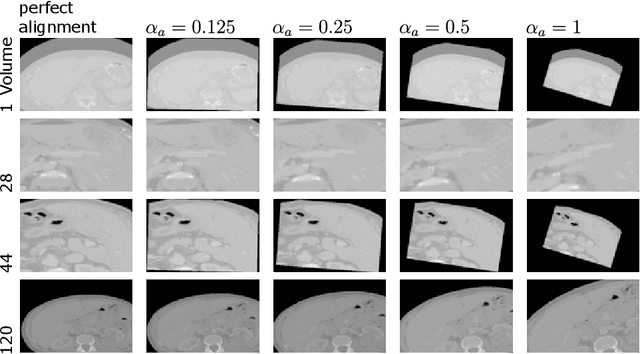
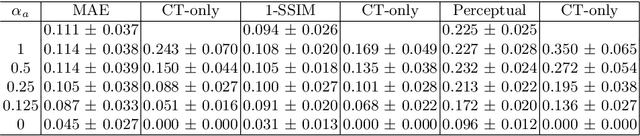
Cone-Beam Computed Tomography (CBCT) is widely used for real-time intraoperative imaging due to its low radiation dose and high acquisition speed. However, despite its high resolution, CBCT suffers from significant artifacts and thereby lower visual quality, compared to conventional Computed Tomography (CT). A recent approach to mitigate these artifacts is synthetic CT (sCT) generation, translating CBCT volumes into the CT domain. In this work, we enhance sCT generation through multimodal learning, integrating intraoperative CBCT with preoperative CT. Beyond validation on two real-world datasets, we use a versatile synthetic dataset, to analyze how CBCT-CT alignment and CBCT quality affect sCT quality. The results demonstrate that multimodal sCT consistently outperform unimodal baselines, with the most significant gains observed in well-aligned, low-quality CBCT-CT cases. Finally, we demonstrate that these findings are highly reproducible in real-world clinical datasets.
Initial Study On Improving Segmentation By Combining Preoperative CT And Intraoperative CBCT Using Synthetic Data
Dec 03, 2024


Computer-Assisted Interventions enable clinicians to perform precise, minimally invasive procedures, often relying on advanced imaging methods. Cone-beam computed tomography (CBCT) can be used to facilitate computer-assisted interventions, despite often suffering from artifacts that pose challenges for accurate interpretation. While the degraded image quality can affect image analysis, the availability of high quality, preoperative scans offers potential for improvements. Here we consider a setting where preoperative CT and intraoperative CBCT scans are available, however, the alignment (registration) between the scans is imperfect to simulate a real world scenario. We propose a multimodal learning method that fuses roughly aligned CBCT and CT scans and investigate the effect on segmentation performance. For this experiment we use synthetically generated data containing real CT and synthetic CBCT volumes with corresponding voxel annotations. We show that this fusion setup improves segmentation performance in $18$ out of $20$ investigated setups.
CBCTLiTS: A Synthetic, Paired CBCT/CT Dataset For Segmentation And Style Transfer
Jul 20, 2024


Medical imaging is vital in computer assisted intervention. Particularly cone beam computed tomography (CBCT) with defacto real time and mobility capabilities plays an important role. However, CBCT images often suffer from artifacts, which pose challenges for accurate interpretation, motivating research in advanced algorithms for more effective use in clinical practice. In this work we present CBCTLiTS, a synthetically generated, labelled CBCT dataset for segmentation with paired and aligned, high quality computed tomography data. The CBCT data is provided in 5 different levels of quality, reaching from a large number of projections with high visual quality and mild artifacts to a small number of projections with severe artifacts. This allows thorough investigations with the quality as a degree of freedom. We also provide baselines for several possible research scenarios like uni- and multimodal segmentation, multitask learning and style transfer followed by segmentation of relatively simple, liver to complex liver tumor segmentation. CBCTLiTS is accesssible via https://www.kaggle.com/datasets/maximiliantschuchnig/cbct-liver-and-liver-tumor-segmentation-train-data.
Multimodal Learning With Intraoperative CBCT & Variably Aligned Preoperative CT Data To Improve Segmentation
Jul 01, 2024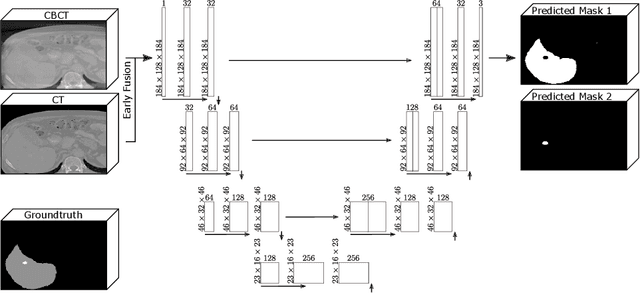


Cone-beam computed tomography (CBCT) is an important tool facilitating computer aided interventions, despite often suffering from artifacts that pose challenges for accurate interpretation. While the degraded image quality can affect downstream segmentation, the availability of high quality, preoperative scans represents potential for improvements. Here we consider a setting where preoperative CT and intraoperative CBCT scans are available, however, the alignment (registration) between the scans is imperfect. We propose a multimodal learning method that fuses roughly aligned CBCT and CT scans and investigate the effect of CBCT quality and misalignment on the final segmentation performance. For that purpose, we make use of a synthetically generated data set containing real CT and synthetic CBCT volumes. As an application scenario, we focus on liver and liver tumor segmentation. We show that the fusion of preoperative CT and simulated, intraoperative CBCT mostly improves segmentation performance (compared to using intraoperative CBCT only) and that even clearly misaligned preoperative data has the potential to improve segmentation performance.
Multimodal Learning To Improve Segmentation With Intraoperative CBCT & Preoperative CT
Jun 17, 2024Intraoperative medical imaging, particularly Cone-beam computed tomography (CBCT), is an important tool facilitating computer aided interventions, despite a lower visual quality. While this degraded image quality can affect downstream segmentation, the availability of high quality preoperative scans represents potential for improvements. Here we consider a setting where preoperative CT and intraoperative CBCT scans are available, however, the alignment (registration) between the scans is imperfect. We propose a multimodal learning method that fuses roughly aligned CBCT and CT scans and investigate the effect of CBCT quality and misalignment (affine and elastic transformations facilitating misalignment) on the final segmentation performance. As an application scenario, we focus on the segmentation of liver and liver tumor semantic segmentation and evaluate the effect of intraoperative image quality and misalignment on segmentation performance. To accomplish this, high quality, labelled CTs are defined as preoperative and used as a basis to simulate intraoperative CBCT. We show that the fusion of preoperative CT and simulated, intraoperative CBCT mostly improves segmentation performance and that even clearly misaligned preoperative data has the potential to improve segmentation performance.
Multi-task Learning To Improve Semantic Segmentation Of CBCT Scans Using Image Reconstruction
Dec 20, 2023Semantic segmentation is a crucial task in medical image processing, essential for segmenting organs or lesions such as tumors. In this study we aim to improve automated segmentation in CBCTs through multi-task learning. To evaluate effects on different volume qualities, a CBCT dataset is synthesised from the CT Liver Tumor Segmentation Benchmark (LiTS) dataset. To improve segmentation, two approaches are investigated. First, we perform multi-task learning to add morphology based regularization through a volume reconstruction task. Second, we use this reconstruction task to reconstruct the best quality CBCT (most similar to the original CT), facilitating denoising effects. We explore both holistic and patch-based approaches. Our findings reveal that, especially using a patch-based approach, multi-task learning improves segmentation in most cases and that these results can further be improved by our denoising approach.