 Add to Chrome
 Add to Firefox
 Add to Edge
No-reference based automatic parameter optimization for iterative reconstruction using a novel search space aware crow search algorithm
Apr 06, 2026
Iterative reconstruction technique's ability to reduce radiation exposure by using fewer projections has attracted significant attention. However, these methods typically require a precise tuning of several hyperparameters, which can have a major impact on reconstruction quality. Manually setting these parameters is time-consuming and increases the workload for human operators. In this paper, we introduce a novel fully automatic parameter optimization framework that can be applied to a wide range of Cone-beam computed tomography (CBCT) iterative reconstruction algorithms to determine optimal parameters without requiring a reference reconstruction. The proposed method incorporates a modified crow search algorithm (CSA) featuring a superior set-dependent local search mechanism, a search-space-aware global search strategy, and an objective-driven balance between local and global search. Additionally, to ensure an effective initial population, we propose a chaotic diagonal linear uniform initialization scheme that accelerates algorithm convergence. The performance of the proposed framework was evaluated on three imaging machines and four real datasets, as well as three different iterative reconstruction methods with the highest number of tunable parameters, representing the most challenging senario. The results indicate that the proposed method could outperform manual settings and CSA, with an 4.19% improvement in average fitness and 4.89% and 3.82% improvements on CHILL@UK and RPI_AXIS, respectively, which are two benchmark no-reference learning-based quality metrics. In addition, the qualitative results clearly show the superiority of the proposed method by maintaining fine details sharply. The overall performance of the proposed framework across different comparison scenarios demonstrates its effectiveness and robustness across all cases.

Enhancing Synthetic CT from CBCT via Multimodal Fusion: A Study on the Impact of CBCT Quality and Alignment
Jun 10, 2025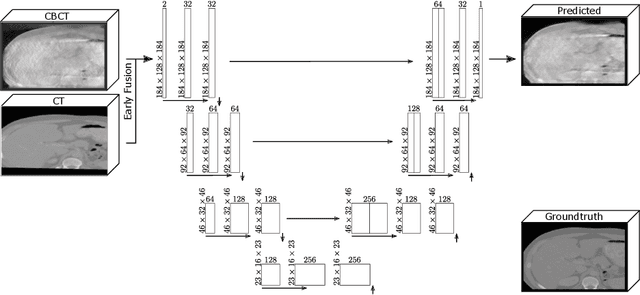
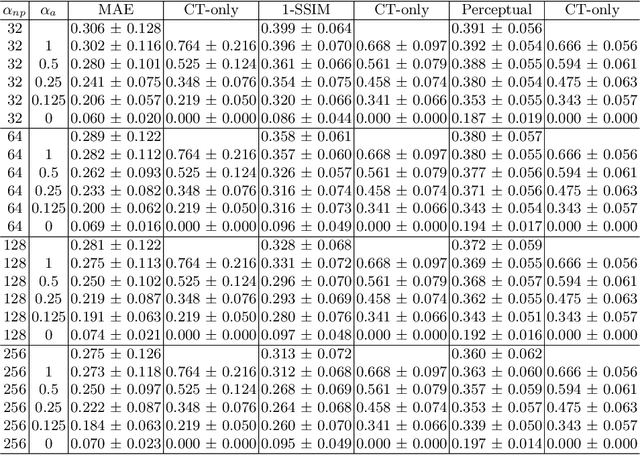
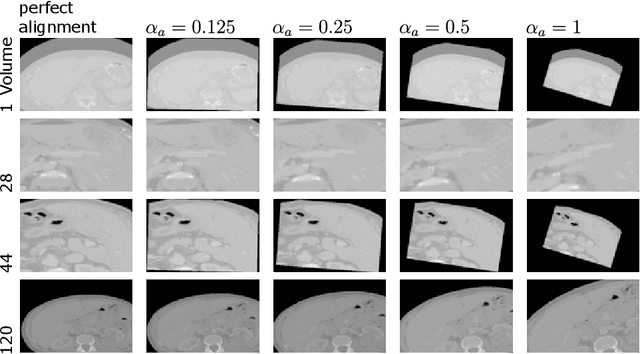
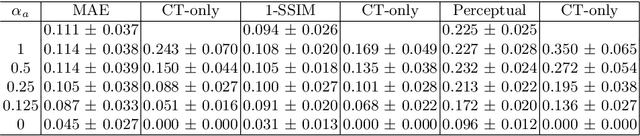
Cone-Beam Computed Tomography (CBCT) is widely used for real-time intraoperative imaging due to its low radiation dose and high acquisition speed. However, despite its high resolution, CBCT suffers from significant artifacts and thereby lower visual quality, compared to conventional Computed Tomography (CT). A recent approach to mitigate these artifacts is synthetic CT (sCT) generation, translating CBCT volumes into the CT domain. In this work, we enhance sCT generation through multimodal learning, integrating intraoperative CBCT with preoperative CT. Beyond validation on two real-world datasets, we use a versatile synthetic dataset, to analyze how CBCT-CT alignment and CBCT quality affect sCT quality. The results demonstrate that multimodal sCT consistently outperform unimodal baselines, with the most significant gains observed in well-aligned, low-quality CBCT-CT cases. Finally, we demonstrate that these findings are highly reproducible in real-world clinical datasets.