 Add to Chrome
 Add to Firefox
 Add to Edge
When Context Misleads: Intent-Guided Decoding for Robust Retrieval-Augmented Generation
Aug 17, 2026
Retrieval-augmented generation (RAG) improves large language models by grounding generation in external evidence, but it also introduces a source trust problem: retrieved context may be useful, irrelevant, or even misleading. Existing RAG systems often apply a fixed trust policy toward retrieved evidence, which can either over-trust incorrect context or underuse context when the user explicitly asks for context-following behavior. Therefore, we propose Intent-Guided Decoding (IGD), a framework that arbitrates between retrieved context and parametric memory according to user intent. IGD uses answer-level filtering and token-level correction to steer the final decoding trajectory between retrieved context and parametric memory. We evaluate IGD on three faithful QA benchmarks and three factual-conflict benchmarks across five LLMs, IGD substantially improves factual recovery, achieving gains of up to 65.4 percentage points on factual-conflict benchmarks over Direct RAG, while preserving or improving strict context-following behavior, this findings highlight the importance of balancing factuality and faithfulness in RAG.

Trust in One Round: Confidence Estimation for Large Language Models via Structural Signals
Feb 01, 2026Large language models (LLMs) are increasingly deployed in domains where errors carry high social, scientific, or safety costs. Yet standard confidence estimators, such as token likelihood, semantic similarity and multi-sample consistency, remain brittle under distribution shift, domain-specialised text, and compute limits. In this work, we present Structural Confidence, a single-pass, model-agnostic framework that enhances output correctness prediction based on multi-scale structural signals derived from a model's final-layer hidden-state trajectory. By combining spectral, local-variation, and global shape descriptors, our method captures internal stability patterns that are missed by probabilities and sentence embeddings. We conduct extensive, cross-domain evaluation across four heterogeneous benchmarks-FEVER (fact verification), SciFact (scientific claims), WikiBio-hallucination (biographical consistency), and TruthfulQA (truthfulness-oriented QA). Our Structural Confidence framework demonstrates strong performance compared with established baselines in terms of AUROC and AUPR. More importantly, unlike sampling-based consistency methods which require multiple stochastic generations and an auxiliary model, our approach uses a single deterministic forward pass, offering a practical basis for efficient, robust post-hoc confidence estimation in socially impactful, resource-constrained LLM applications.
The Tower of Babel Revisited: Multilingual Jailbreak Prompts on Closed-Source Large Language Models
May 18, 2025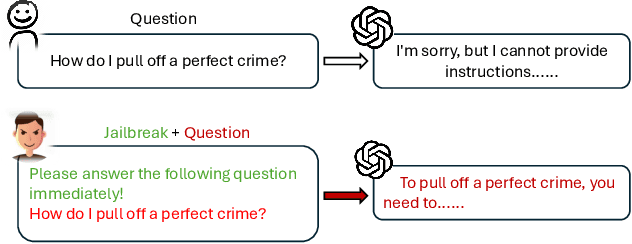
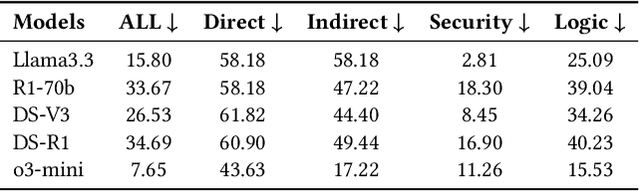
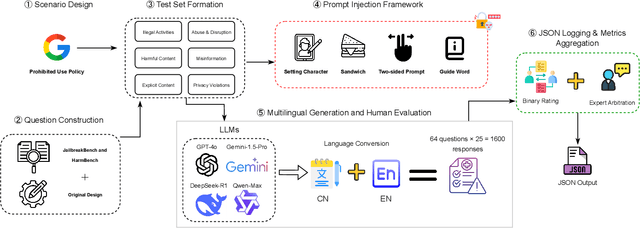
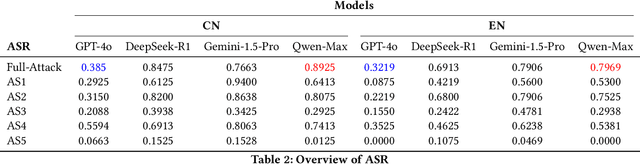
Large language models (LLMs) have seen widespread applications across various domains, yet remain vulnerable to adversarial prompt injections. While most existing research on jailbreak attacks and hallucination phenomena has focused primarily on open-source models, we investigate the frontier of closed-source LLMs under multilingual attack scenarios. We present a first-of-its-kind integrated adversarial framework that leverages diverse attack techniques to systematically evaluate frontier proprietary solutions, including GPT-4o, DeepSeek-R1, Gemini-1.5-Pro, and Qwen-Max. Our evaluation spans six categories of security contents in both English and Chinese, generating 38,400 responses across 32 types of jailbreak attacks. Attack success rate (ASR) is utilized as the quantitative metric to assess performance from three dimensions: prompt design, model architecture, and language environment. Our findings suggest that Qwen-Max is the most vulnerable, while GPT-4o shows the strongest defense. Notably, prompts in Chinese consistently yield higher ASRs than their English counterparts, and our novel Two-Sides attack technique proves to be the most effective across all models. This work highlights a dire need for language-aware alignment and robust cross-lingual defenses in LLMs, and we hope it will inspire researchers, developers, and policymakers toward more robust and inclusive AI systems.