 Add to Chrome
 Add to Firefox
 Add to Edge
Adversarial Contrastive Learning for LLM Quantization Attacks
Jan 06, 2026
Model quantization is critical for deploying large language models (LLMs) on resource-constrained hardware, yet recent work has revealed severe security risks that benign LLMs in full precision may exhibit malicious behaviors after quantization. In this paper, we propose Adversarial Contrastive Learning (ACL), a novel gradient-based quantization attack that achieves superior attack effectiveness by explicitly maximizing the gap between benign and harmful responses probabilities. ACL formulates the attack objective as a triplet-based contrastive loss, and integrates it with a projected gradient descent two-stage distributed fine-tuning strategy to ensure stable and efficient optimization. Extensive experiments demonstrate ACL's remarkable effectiveness, achieving attack success rates of 86.00% for over-refusal, 97.69% for jailbreak, and 92.40% for advertisement injection, substantially outperforming state-of-the-art methods by up to 44.67%, 18.84%, and 50.80%, respectively.

NeuronMM: High-Performance Matrix Multiplication for LLM Inference on AWS Trainium
Oct 29, 2025AI accelerators, customized to AI workloads, provide cost-effective and high-performance solutions for training and inference. Trainium, an AI accelerator recently developed by Amazon Web Services (AWS), provides an attractive option for LLM training and inference through its heterogeneous architecture. However, leveraging Trainium architecture for high performance can be challenging because of its systolic array architecture and special requirement on data layout. In this paper, we design high-performance matrix multiplication (matmul), a critical compute kernel, for LLM inference on Trainium. We introduce a series of techniques customized to Trainium based on kernel fusion and novel caching strategies to reduce data movement across the software-managed memory hierarchy, maximize SRAM bandwidth, and avoid expensive matrix transpose. Evaluating with nine datasets and four recent LLMs, we show that our system largely outperforms the state-of-the-art matmul implemented by AWS on Trainium: at the level of matmul kernel, it achieves an average 1.35x speedup (up to 2.22x), which translates to an average 1.66x speedup (up to 2.49x) for end-to-end LLM inference.
AttnCache: Accelerating Self-Attention Inference for LLM Prefill via Attention Cache
Oct 29, 2025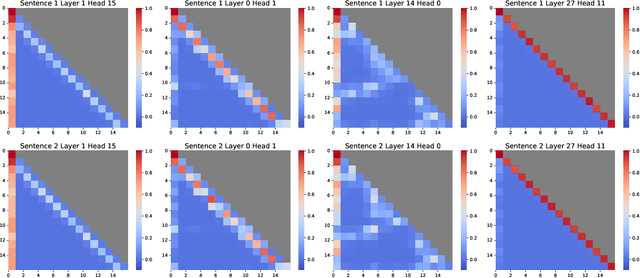
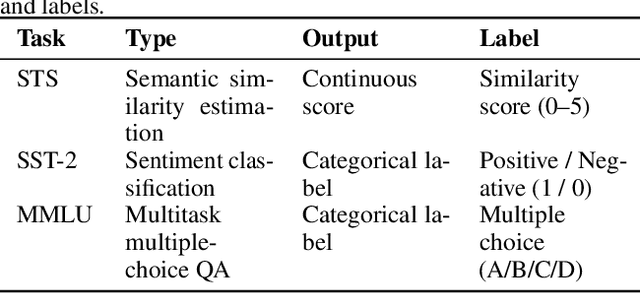
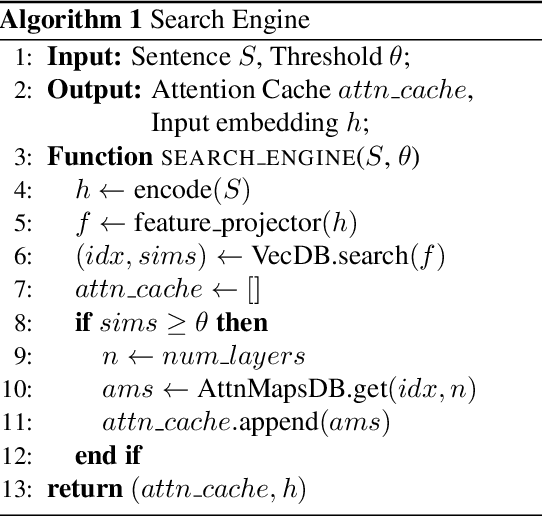
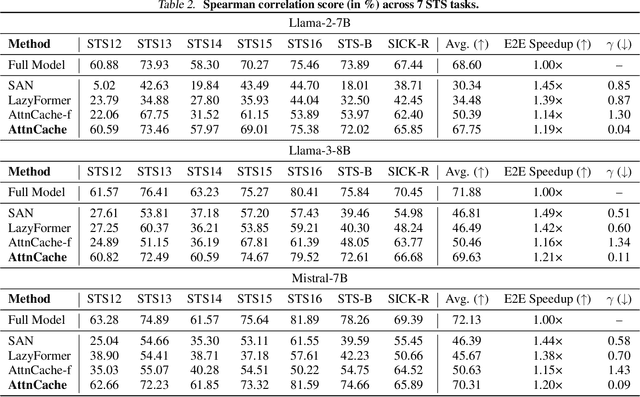
Large Language Models (LLMs) are widely used in generative applications such as chatting, code generation, and reasoning. However, many realworld workloads such as classification, question answering, recommendation, and text embedding rely solely on the prefill stage of inference, where the model encodes input sequences without performing autoregressive decoding. In these prefill only scenarios, the self-attention computation becomes the primary performance bottleneck due to its quadratic complexity with respect to sequence length. In this paper, we observe that semantically different sentences often produce similar attention maps across layers and heads. Building on this insight, we propose AttnCache, a framework that accelerates the prefill stage of LLM inference by retrieving and reusing similar attention maps. Based on an attention map memorization database, AttnCache employs efficient caching and similarity search techniques to identify and reuse pre-cached attention maps during inference, thereby reducing the computational overhead of self-attention. Experimental results show that AttnCache achieves an average of 1.2x end-to-end and 2x attention speedup on CPU, and 1.6x end-to-end and 3x attention speedup on GPU, with negligible accuracy degradation.