 Add to Chrome
 Add to Firefox
 Add to Edge
AdaCultureSafe: Adaptive Cultural Safety Grounded by Cultural Knowledge in Large Language Models
Mar 09, 2026
With the widespread adoption of Large Language Models (LLMs), respecting indigenous cultures becomes essential for models' culturally safety and responsible global applications. Existing studies separately consider cultural safety and cultural knowledge and neglect that the former should be grounded by the latter. This severely prevents LLMs from yielding culture-specific respectful responses. Consequently, adaptive cultural safety remains a formidable task. In this work, we propose to jointly model cultural safety and knowledge. First and foremost, cultural-safety and knowledge-paired data serve as the key prerequisite to conduct this research. However, the cultural diversity across regions and the subtlety of cultural differences pose significant challenges to the creation of such paired evaluation data. To address this issue, we propose a novel framework that integrates authoritative cultural knowledge descriptions curation, LLM-automated query generation, and heavy manual verification. Accordingly, we obtain a dataset named AdaCultureSafe containing 4.8K manually decomposed fine-grained cultural descriptions and the corresponding 48K manually verified safety- and knowledge-oriented queries. Upon the constructed dataset, we evaluate three families of popular LLMs on their cultural safety and knowledge proficiency, via which we make a critical discovery: no significant correlation exists between their cultural safety and knowledge proficiency. We then delve into the utility-related neuron activations within LLMs to investigate the potential cause of the absence of correlation, which can be attributed to the difference of the objectives of pre-training and post-alignment. We finally present a knowledge-grounded method, which significantly enhances cultural safety by enforcing the integration of knowledge into the LLM response generation process.

ICML Topological Deep Learning Challenge 2024: Beyond the Graph Domain
Sep 08, 2024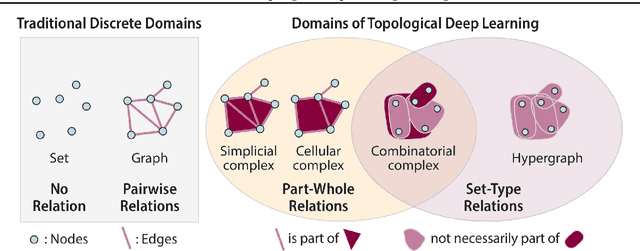
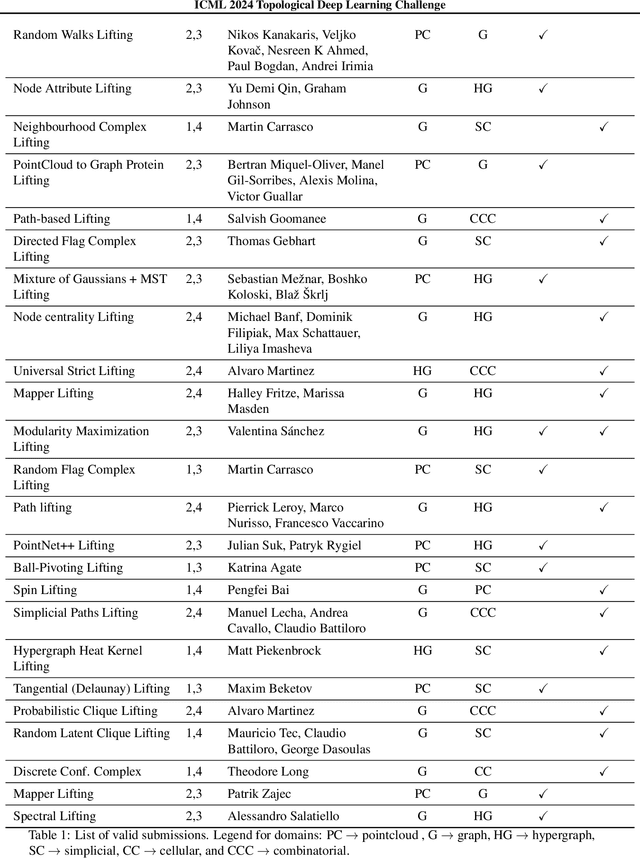
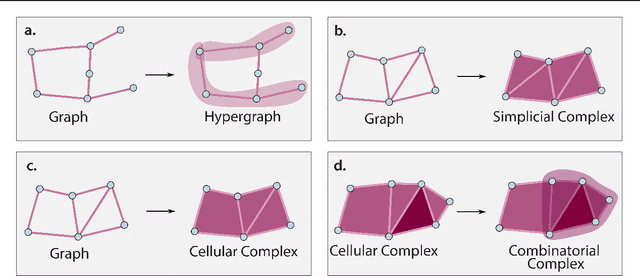
This paper describes the 2nd edition of the ICML Topological Deep Learning Challenge that was hosted within the ICML 2024 ELLIS Workshop on Geometry-grounded Representation Learning and Generative Modeling (GRaM). The challenge focused on the problem of representing data in different discrete topological domains in order to bridge the gap between Topological Deep Learning (TDL) and other types of structured datasets (e.g. point clouds, graphs). Specifically, participants were asked to design and implement topological liftings, i.e. mappings between different data structures and topological domains --like hypergraphs, or simplicial/cell/combinatorial complexes. The challenge received 52 submissions satisfying all the requirements. This paper introduces the main scope of the challenge, and summarizes the main results and findings.