 Add to Chrome
 Add to Firefox
 Add to Edge
TacSIm: A Dataset and Benchmark for Football Tactical Style Imitation
Mar 26, 2026
Current football imitation research primarily aims to opti mize reward-based objectives, such as goals scored or win rate proxies, paying less attention to accurately replicat ing real-world team tactical behaviors. We introduce Tac SIm, a large-scale dataset and benchmark for Tactical Style Imitation in football. TacSIm imitates the acitons of all 11 players in one team in the given broadcast footage of Pre mier League matches under a single broadcast view. Under a offensive or defensive broadcast footage, TacSIm projects the beginning positions and actions of all 22 players from both sides onto a standard pitch coordinate system. Tac SIm offers an explicit style imitation task and evaluation protocols. Tactics style imitation is measured by using spatial occupancy similarity and movement vector similarity in defined time, supporting the evaluation of spatial and tem poral similarities for one team. We run multiple baseline methods in a unified virtual environment to generate full team behaviors, enabling both quantitative and visual as sessment of tactical coordination. By using unified data and metrics from broadcast to simulation, TacSIm estab lishes a rigorous benchmark for measuring and modeling style-aligned tactical imitation task in football.

Derivative-free tree optimization for complex systems
Apr 05, 2024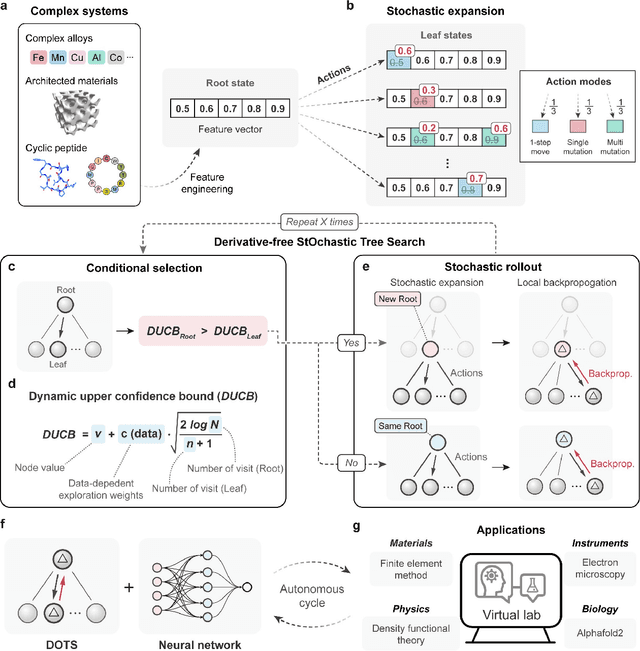

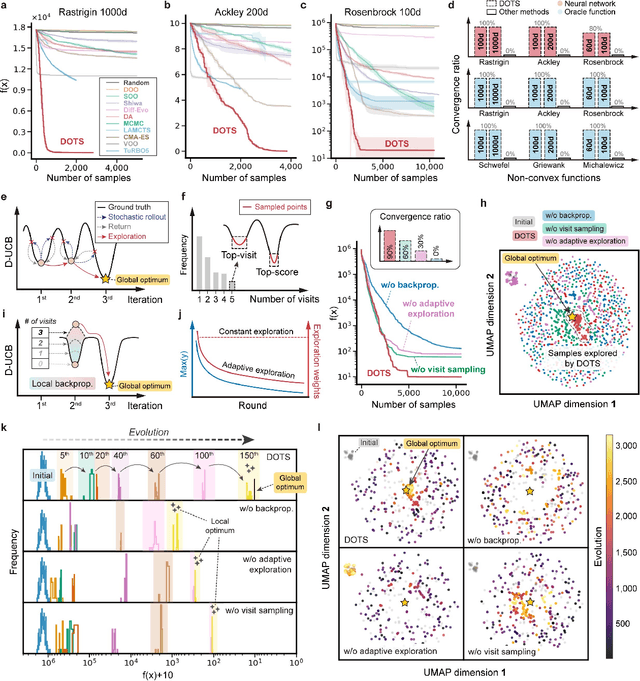

A tremendous range of design tasks in materials, physics, and biology can be formulated as finding the optimum of an objective function depending on many parameters without knowing its closed-form expression or the derivative. Traditional derivative-free optimization techniques often rely on strong assumptions about objective functions, thereby failing at optimizing non-convex systems beyond 100 dimensions. Here, we present a tree search method for derivative-free optimization that enables accelerated optimal design of high-dimensional complex systems. Specifically, we introduce stochastic tree expansion, dynamic upper confidence bound, and short-range backpropagation mechanism to evade local optimum, iteratively approximating the global optimum using machine learning models. This development effectively confronts the dimensionally challenging problems, achieving convergence to global optima across various benchmark functions up to 2,000 dimensions, surpassing the existing methods by 10- to 20-fold. Our method demonstrates wide applicability to a wide range of real-world complex systems spanning materials, physics, and biology, considerably outperforming state-of-the-art algorithms. This enables efficient autonomous knowledge discovery and facilitates self-driving virtual laboratories. Although we focus on problems within the realm of natural science, the advancements in optimization techniques achieved herein are applicable to a broader spectrum of challenges across all quantitative disciplines.
Mask wearing object detection algorithm based on improved YOLOv5
Oct 16, 2023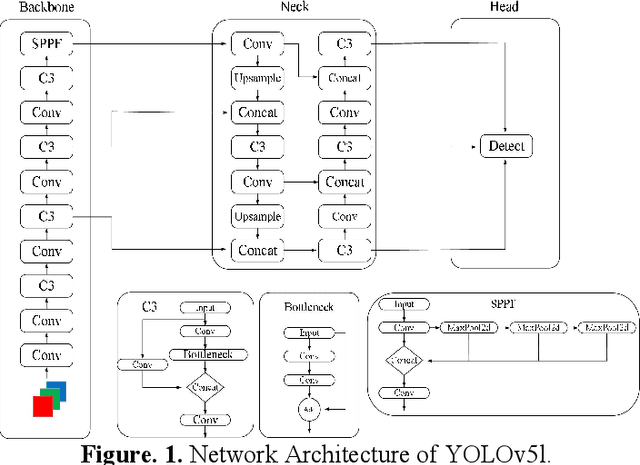
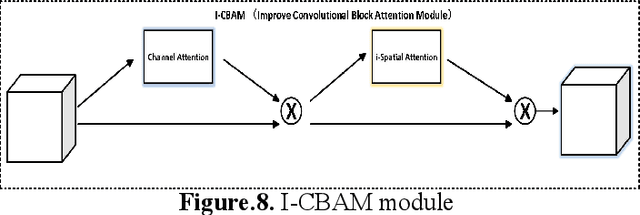
Wearing a mask is one of the important measures to prevent infectious diseases. However, it is difficult to detect people's mask-wearing situation in public places with high traffic flow. To address the above problem, this paper proposes a mask-wearing face detection model based on YOLOv5l. Firstly, Multi-Head Attentional Self-Convolution not only improves the convergence speed of the model but also enhances the accuracy of the model detection. Secondly, the introduction of Swin Transformer Block is able to extract more useful feature information, enhance the detection ability of small targets, and improve the overall accuracy of the model. Our designed I-CBAM module can improve target detection accuracy. In addition, using enhanced feature fusion enables the model to better adapt to object detection tasks of different scales. In the experimentation on the MASK dataset, the results show that the model proposed in this paper achieved a 1.1% improvement in mAP(0.5) and a 1.3% improvement in mAP(0.5:0.95) compared to the YOLOv5l model. Our proposed method significantly enhances the detection capability of mask-wearing.