 Add to Chrome
 Add to Firefox
 Add to Edge
TacSIm: A Dataset and Benchmark for Football Tactical Style Imitation
Mar 26, 2026
Current football imitation research primarily aims to opti mize reward-based objectives, such as goals scored or win rate proxies, paying less attention to accurately replicat ing real-world team tactical behaviors. We introduce Tac SIm, a large-scale dataset and benchmark for Tactical Style Imitation in football. TacSIm imitates the acitons of all 11 players in one team in the given broadcast footage of Pre mier League matches under a single broadcast view. Under a offensive or defensive broadcast footage, TacSIm projects the beginning positions and actions of all 22 players from both sides onto a standard pitch coordinate system. Tac SIm offers an explicit style imitation task and evaluation protocols. Tactics style imitation is measured by using spatial occupancy similarity and movement vector similarity in defined time, supporting the evaluation of spatial and tem poral similarities for one team. We run multiple baseline methods in a unified virtual environment to generate full team behaviors, enabling both quantitative and visual as sessment of tactical coordination. By using unified data and metrics from broadcast to simulation, TacSIm estab lishes a rigorous benchmark for measuring and modeling style-aligned tactical imitation task in football.

FMI-TAL: Few-shot Multiple Instances Temporal Action Localization by Probability Distribution Learning and Interval Cluster Refinement
Aug 25, 2024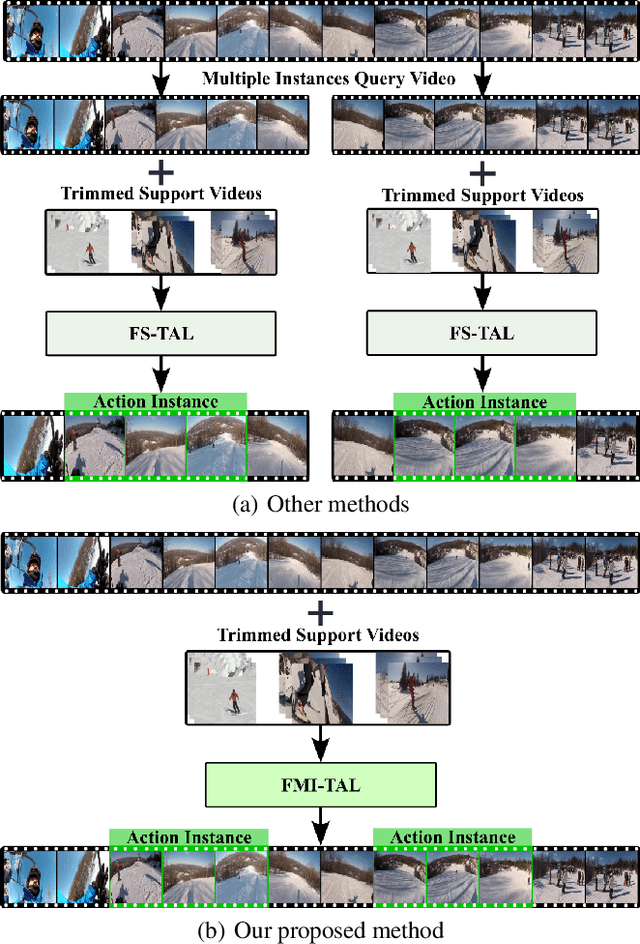
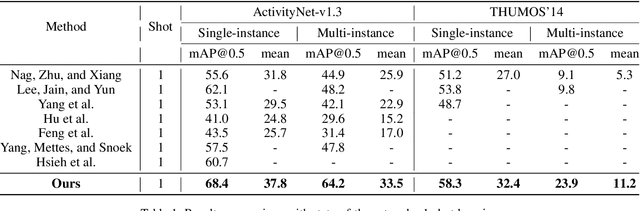
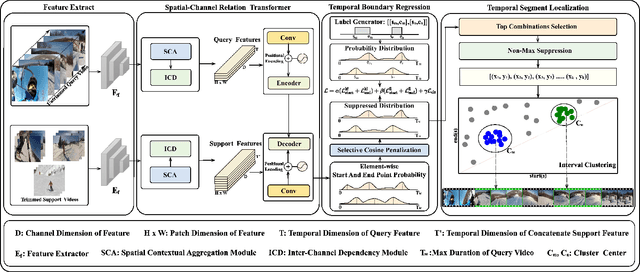
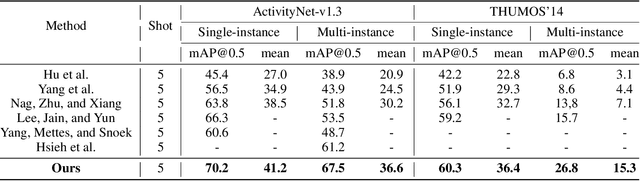
The present few-shot temporal action localization model can't handle the situation where videos contain multiple action instances. So the purpose of this paper is to achieve manifold action instances localization in a lengthy untrimmed query video using limited trimmed support videos. To address this challenging problem effectively, we proposed a novel solution involving a spatial-channel relation transformer with probability learning and cluster refinement. This method can accurately identify the start and end boundaries of actions in the query video, utilizing only a limited number of labeled videos. Our proposed method is adept at capturing both temporal and spatial contexts to effectively classify and precisely locate actions in videos, enabling a more comprehensive utilization of these crucial details. The selective cosine penalization algorithm is designed to suppress temporal boundaries that do not include action scene switches. The probability learning combined with the label generation algorithm alleviates the problem of action duration diversity and enhances the model's ability to handle fuzzy action boundaries. The interval cluster can help us get the final results with multiple instances situations in few-shot temporal action localization. Our model achieves competitive performance through meticulous experimentation utilizing the benchmark datasets ActivityNet1.3 and THUMOS14. Our code is readily available at https://github.com/ycwfs/FMI-TAL.