 Add to Chrome
 Add to Firefox
 Add to Edge
OmniOPD: Logit-Free On-Policy Distillation via Speculative Verification
May 31, 2026
On-Policy Distillation (OPD) trains a student model on its own generative trajectories under dense token-level feedback from a stronger teacher, mitigating both the off-policy distribution shift of Supervised Fine-Tuning (SFT) and the sparse credit assignment of Reinforcement Learning (RL). However, standard OPD faces two coupled limitations. First, it requires direct access to the teacher's token-level logits, excluding a broad class of capable proprietary models from serving as teachers. Second, the token-level logit signal itself is brittle, depending on a narrow overlap of plausible next tokens between teacher and student, and prone to amplifying degenerate patterns such as repetition loops. In this paper, we introduce OmniOPD, a novel framework that addresses both limitations through a logit-free, chunk-level supervision signal. OmniOPD replaces deterministic logit matching with Monte Carlo rollouts that approximate the teacher's local preferences through a continuous semantic similarity metric over multi-token chunks, and concentrates this supervision via a peak-entropy scheduler that audits the student only at its high-uncertainty reasoning forks. A Dirichlet-Multinomial Bayesian prior and a base-model KL anchor further bound the variance of discrete sampling and prevent policy collapse across unaudited tokens. Across competitive benchmarks, OmniOPD surpasses the standard OPD approach by up to +28.64% on math, confirming that chunk-level semantic verification extracts a more reliable learning signal than token-level logit matching, whose high information density is offset by significant noise and brittleness. Furthermore, when paired with stronger black-box teachers such as Claude-4.5-Haiku and Gemini-2.5-Flash, OmniOPD achieves an additional +9.54% relative on math over its open-weight teacher counterpart, advancing the student past the performance of self-exploratory RL.

DiffDet4SAR: Diffusion-based Aircraft Target Detection Network for SAR Images
Apr 04, 2024
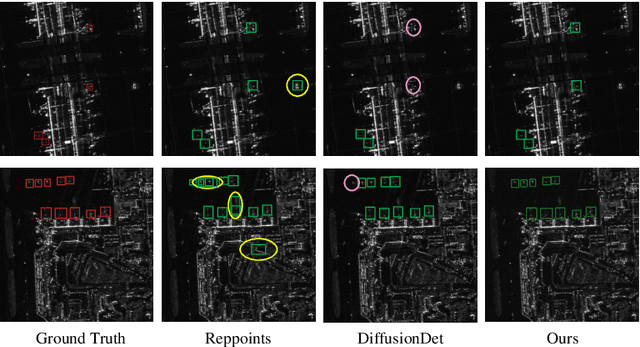


Aircraft target detection in SAR images is a challenging task due to the discrete scattering points and severe background clutter interference. Currently, methods with convolution-based or transformer-based paradigms cannot adequately address these issues. In this letter, we explore diffusion models for SAR image aircraft target detection for the first time and propose a novel \underline{Diff}usion-based aircraft target \underline{Det}ection network \underline{for} \underline{SAR} images (DiffDet4SAR). Specifically, the proposed DiffDet4SAR yields two main advantages for SAR aircraft target detection: 1) DiffDet4SAR maps the SAR aircraft target detection task to a denoising diffusion process of bounding boxes without heuristic anchor size selection, effectively enabling large variations in aircraft sizes to be accommodated; and 2) the dedicatedly designed Scattering Feature Enhancement (SFE) module further reduces the clutter intensity and enhances the target saliency during inference. Extensive experimental results on the SAR-AIRcraft-1.0 dataset show that the proposed DiffDet4SAR achieves 88.4\% mAP$_{50}$, outperforming the state-of-the-art methods by 6\%. Code is availabel at \href{https://github.com/JoyeZLearning/DiffDet4SAR}.