 Add to Chrome
 Add to Firefox
 Add to Edge
THEMIS: Towards Holistic Evaluation of MLLMs for Scientific Paper Fraud Forensics
Mar 26, 2026
We present THEMIS, a novel multi-task benchmark designed to comprehensively evaluate multimodal large language models (MLLMs) on visual fraud reasoning within real-world academic scenarios. Compared to existing benchmarks, THEMIS introduces three major advances. (1) Real-World Scenarios and Complexity: Our benchmark comprises over 4,000 questions spanning seven scenarios, derived from authentic retracted-paper cases and carefully curated multimodal synthetic data. With 60.47% complex-texture images, THEMIS bridges the critical gap between existing benchmarks and the complexity of real-world academic fraud. (2) Fraud-Type Diversity and Granularity: THEMIS systematically covers five challenging fraud types and introduces 16 fine-grained manipulation operations. On average, each sample undergoes multiple stacked manipulation operations, with the diversity and difficulty of these manipulations demanding a high level of visual fraud reasoning from the models. (3) Multi-Dimensional Capability Evaluation: We establish a mapping from fraud types to five core visual fraud reasoning capabilities, thereby enabling an evaluation that reveals the distinct strengths and specific weaknesses of different models across these core capabilities. Experiments on 16 leading MLLMs show that even the best-performing model, GPT-5, achieves an overall performance of only 56.15%, demonstrating that our benchmark presents a stringent test. We expect THEMIS to advance the development of MLLMs for complex, real-world fraud reasoning tasks.

FinMMDocR: Benchmarking Financial Multimodal Reasoning with Scenario Awareness, Document Understanding, and Multi-Step Computation
Dec 31, 2025We introduce FinMMDocR, a novel bilingual multimodal benchmark for evaluating multimodal large language models (MLLMs) on real-world financial numerical reasoning. Compared to existing benchmarks, our work delivers three major advancements. (1) Scenario Awareness: 57.9% of 1,200 expert-annotated problems incorporate 12 types of implicit financial scenarios (e.g., Portfolio Management), challenging models to perform expert-level reasoning based on assumptions; (2) Document Understanding: 837 Chinese/English documents spanning 9 types (e.g., Company Research) average 50.8 pages with rich visual elements, significantly surpassing existing benchmarks in both breadth and depth of financial documents; (3) Multi-Step Computation: Problems demand 11-step reasoning on average (5.3 extraction + 5.7 calculation steps), with 65.0% requiring cross-page evidence (2.4 pages average). The best-performing MLLM achieves only 58.0% accuracy, and different retrieval-augmented generation (RAG) methods show significant performance variations on this task. We expect FinMMDocR to drive improvements in MLLMs and reasoning-enhanced methods on complex multimodal reasoning tasks in real-world scenarios.
Learning Partial Differential Equations with Deep Parallel Neural Operators
Sep 30, 2024


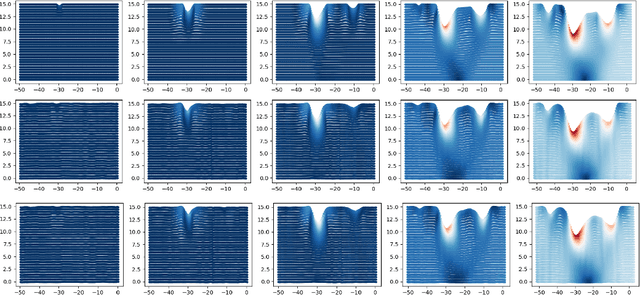
In recent years, Solving partial differential equations has shifted the focus of traditional neural network studies from finite-dimensional Euclidean spaces to generalized functional spaces in research. A novel methodology is to learn an operator as a means of approximating the mapping between outputs. Currently, researchers have proposed a variety of operator architectures. Nevertheless, the majority of these architectures adopt an iterative update architecture, whereby a single operator is learned from the same function space. In practical physical science problems, the numerical solutions of partial differential equations are complex, and a serial single operator is unable to accurately approximate the intricate mapping between input and output. So, We propose a deep parallel operator model (DPNO) for efficiently and accurately solving partial differential equations. DPNO employs convolutional neural networks to extract local features and map data into distinct latent spaces. Designing a parallel block of double Fourier neural operators to solve the iterative error problem. DPNO approximates complex mappings between inputs and outputs by learning multiple operators in different potential spaces in parallel blocks. DPNO achieved the best performance on five of them, with an average improvement of 10.5\%, and ranked second on one dataset.
General-Kindred Physics-Informed Neural Network to the Solutions of Singularly Perturbed Differential Equations
Aug 27, 2024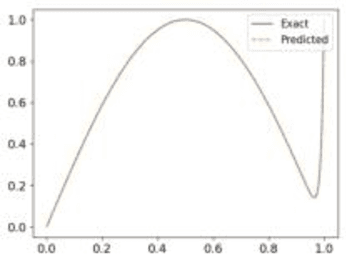
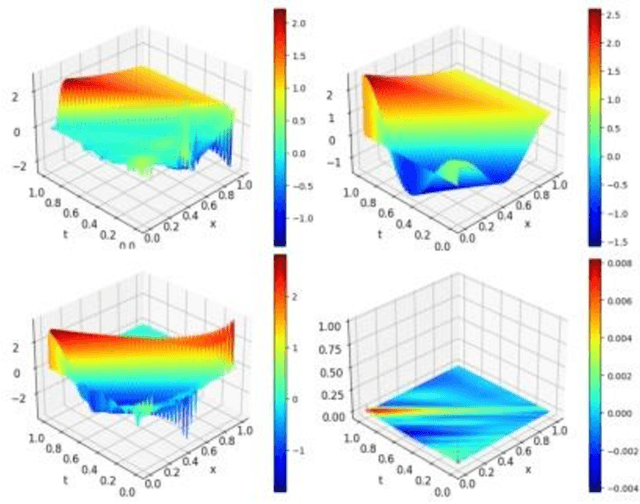
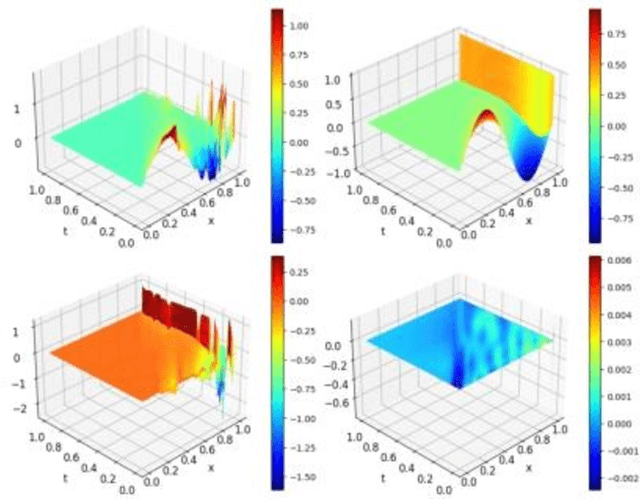
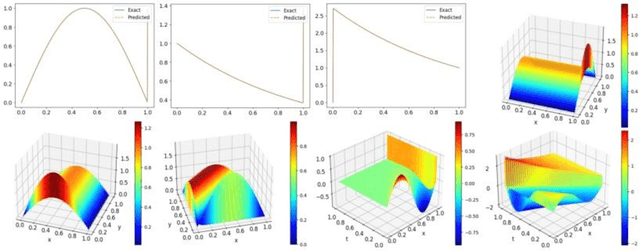
Physics-Informed Neural Networks (PINNs) have become a promising research direction in the field of solving Partial Differential Equations (PDEs). Dealing with singular perturbation problems continues to be a difficult challenge in the field of PINN. The solution of singular perturbation problems often exhibits sharp boundary layers and steep gradients, and traditional PINN cannot achieve approximation of boundary layers. In this manuscript, we propose the General-Kindred Physics-Informed Neural Network (GKPINN) for solving Singular Perturbation Differential Equations (SPDEs). This approach utilizes asymptotic analysis to acquire prior knowledge of the boundary layer from the equation and establishes a novel network to assist PINN in approximating the boundary layer. It is compared with traditional PINN by solving examples of one-dimensional, two-dimensional, and time-varying SPDE equations. The research findings underscore the exceptional performance of our novel approach, GKPINN, which delivers a remarkable enhancement in reducing the $L_2$ error by two to four orders of magnitude compared to the established PINN methodology. This significant improvement is accompanied by a substantial acceleration in convergence rates, without compromising the high precision that is critical for our applications. Furthermore, GKPINN still performs well in extreme cases with perturbation parameters of ${1\times10}^{-38}$, demonstrating its excellent generalization ability.