 Add to Chrome
 Add to Firefox
 Add to Edge
When Routes Run Out: Adversarial Co-Learning and Explainable Robustness in Quantum Repeater Networks
Jul 10, 2026
We study an adversarial bandit problem for entanglement-based quantum-network routing over a modest graph corpus. Alice selects an end-to-end repeater route for an Ekert-91 protocol (E91) representing her move, while Eve selects an attack surface, either edge intercept--resend or repeater memory degradation. Payoffs are drawn from cached SeQUeNCe-simulated E91 transcripts, and Alice accepts a turn when the finite-sample statistic violates the Clauser-Horne-Shimony-Holt (CHSH) bound. Performing adversarial co-learning across 50 structured topologies, we find that learned retention tracks a full-matrix minimax reference closely (Pearson $r=0.99$): under a one-surface Eve action model, bottleneck families have zero retention, while non-bottleneck families follow a $1-1/N$ coverage principle. We then fit decision-tree explanation models to graph-, attack-, and route-level topology-corpus targets and report their faithfulness. Finally, we construct prompt records for local language models to summarize the tree evidence, resulting in an open-source explanation workflow for quantum-repeater network games.

Quantum computing and artificial intelligence: status and perspectives
May 29, 2025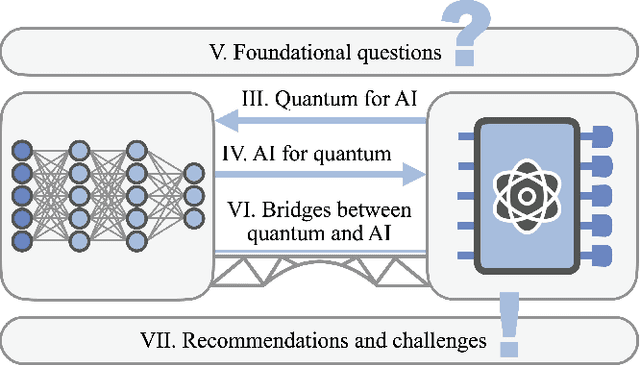
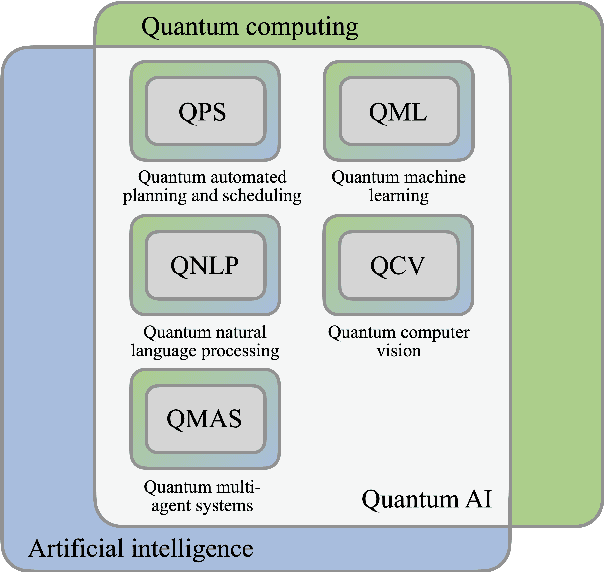
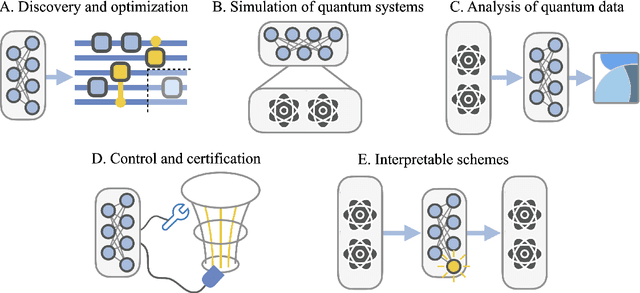
This white paper discusses and explores the various points of intersection between quantum computing and artificial intelligence (AI). It describes how quantum computing could support the development of innovative AI solutions. It also examines use cases of classical AI that can empower research and development in quantum technologies, with a focus on quantum computing and quantum sensing. The purpose of this white paper is to provide a long-term research agenda aimed at addressing foundational questions about how AI and quantum computing interact and benefit one another. It concludes with a set of recommendations and challenges, including how to orchestrate the proposed theoretical work, align quantum AI developments with quantum hardware roadmaps, estimate both classical and quantum resources - especially with the goal of mitigating and optimizing energy consumption - advance this emerging hybrid software engineering discipline, and enhance European industrial competitiveness while considering societal implications.