 Add to Chrome
 Add to Firefox
 Add to Edge
Experiment-as-Code Labs: A Declarative Stack for AI-Driven Scientific Discovery
May 06, 2026
To unleash the full potential of AI for Science, we must untether the agents from a purely digital environment. The agent's ability to control and explore in real-world labs is essential because the physical lab remains foundational to scientific discovery. While some tasks can be performed on a computer (e.g., data analysis, running simulated experiments), Eureka moments could occur at any time while operating lab instruments (e.g., when a scientist notices unexpected clues, intuition may prompt a real-time course change). Although autonomous labs are on the rise, which expose programmable APIs to control scientific instruments via software, bridging the gap between increasingly powerful AI agents and automated lab equipment requires innovation that draws insights from computer systems. We propose a new paradigm called ``Experiment-as-Code (EaC) Labs,'' where a core concept is to encode experiments as declarative configurations that can be compiled down to device-level APIs. AI agents come up with hypotheses and experiments, written as an ensemble of declarative configurations. The systems layer performs program analysis, safety checks, resource assignment, and job orchestration. Finally, programmatic experimentation occurs via actuating the device APIs. This is a general stack that is science-, lab-, and instrument-independent, representing a novel synthesis across the physical, systems, and intelligence layers to unleash the next breakthrough in AI for Science.

Ambig-IaC: Multi-level Disambiguation for Interactive Cloud Infrastructure-as-Code Synthesis
Apr 01, 2026The scale and complexity of modern cloud infrastructure have made Infrastructure-as-Code (IaC) essential for managing deployments. While large Language models (LLMs) are increasingly being used to generate IaC configurations from natural language, user requests are often underspecified. Unlike traditional code generation, IaC configurations cannot be executed cheaply or iteratively repaired, forcing the LLMs into an almost one-shot regime. We observe that ambiguity in IaC exhibits a tractable compositional structure: configurations decompose into three hierarchical axes (resources, topology, attributes) where higher-level decisions constrain lower-level ones. We propose a training-free, disagreement-driven framework that generates diverse candidate specifications, identifies structural disagreements across these axes, ranks them by informativeness, and produces targeted clarification questions that progressively narrow the configuration space. We introduce \textsc{Ambig-IaC}, a benchmark of 300 validated IaC tasks with ambiguous prompts, and an evaluation framework based on graph edit distance and embedding similarity. Our method outperforms the strongest baseline, achieving relative improvements of +18.4\% and +25.4\% on structure and attribute evaluations, respectively.
SWE-Protégé: Learning to Selectively Collaborate With an Expert Unlocks Small Language Models as Software Engineering Agents
Feb 25, 2026Small language models (SLMs) offer compelling advantages in cost, latency, and adaptability, but have so far lagged behind larger models on long-horizon software engineering tasks such as SWE-bench, where they suffer from pervasive action looping and low resolution rates. We introduce SWE-Protégé, a post-training framework that reframes software repair as an expert-protégé collaboration problem. In SWE-Protégé, an SLM remains the sole decision-maker while learning to selectively seek guidance from a strong expert model, recognize stalled states, and follow through on expert feedback. Our approach combines supervised fine-tuning on expert-augmented trajectories with agentic reinforcement learning that explicitly discourages degenerative looping and unproductive expert collaboration. We lightly post-train Qwen2.5-Coder-7B-Instruct to achieve 42.4% Pass@1 on SWE-bench Verified, a +25.4% improvement over the prior SLM state of the art, while using expert assistance sparsely (~4 calls per task and 11% of total tokens).
Cloud Infrastructure Management in the Age of AI Agents
Jun 13, 2025Cloud infrastructure is the cornerstone of the modern IT industry. However, managing this infrastructure effectively requires considerable manual effort from the DevOps engineering team. We make a case for developing AI agents powered by large language models (LLMs) to automate cloud infrastructure management tasks. In a preliminary study, we investigate the potential for AI agents to use different cloud/user interfaces such as software development kits (SDK), command line interfaces (CLI), Infrastructure-as-Code (IaC) platforms, and web portals. We report takeaways on their effectiveness on different management tasks, and identify research challenges and potential solutions.
EXP-Bench: Can AI Conduct AI Research Experiments?
May 30, 2025
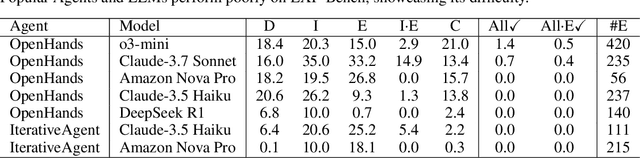
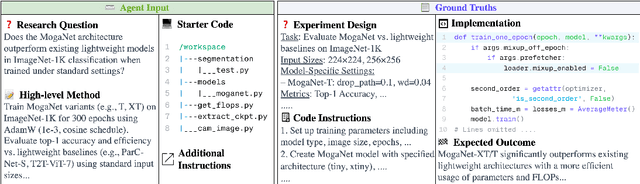
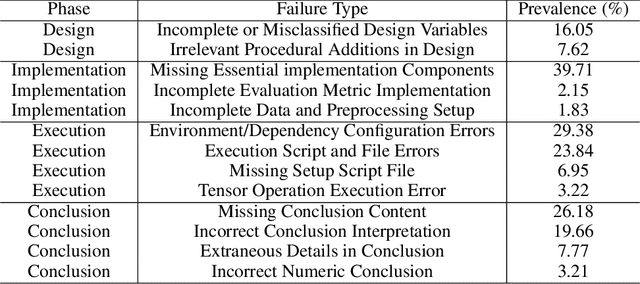
Automating AI research holds immense potential for accelerating scientific progress, yet current AI agents struggle with the complexities of rigorous, end-to-end experimentation. We introduce EXP-Bench, a novel benchmark designed to systematically evaluate AI agents on complete research experiments sourced from influential AI publications. Given a research question and incomplete starter code, EXP-Bench challenges AI agents to formulate hypotheses, design and implement experimental procedures, execute them, and analyze results. To enable the creation of such intricate and authentic tasks with high-fidelity, we design a semi-autonomous pipeline to extract and structure crucial experimental details from these research papers and their associated open-source code. With the pipeline, EXP-Bench curated 461 AI research tasks from 51 top-tier AI research papers. Evaluations of leading LLM-based agents, such as OpenHands and IterativeAgent on EXP-Bench demonstrate partial capabilities: while scores on individual experimental aspects such as design or implementation correctness occasionally reach 20-35%, the success rate for complete, executable experiments was a mere 0.5%. By identifying these bottlenecks and providing realistic step-by-step experiment procedures, EXP-Bench serves as a vital tool for future AI agents to improve their ability to conduct AI research experiments. EXP-Bench is open-sourced at https://github.com/Just-Curieous/Curie/tree/main/benchmark/exp_bench.
Curie: Toward Rigorous and Automated Scientific Experimentation with AI Agents
Feb 26, 2025
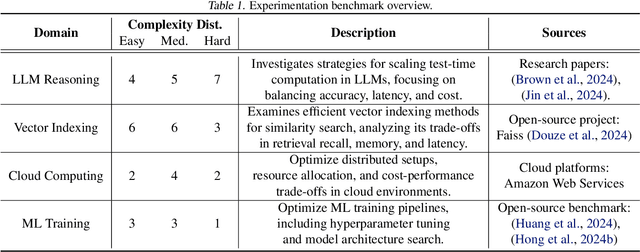
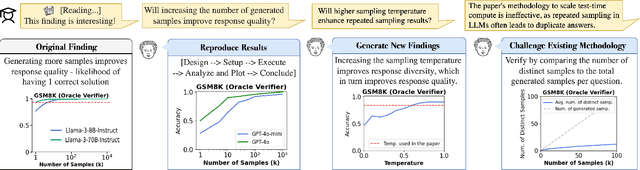
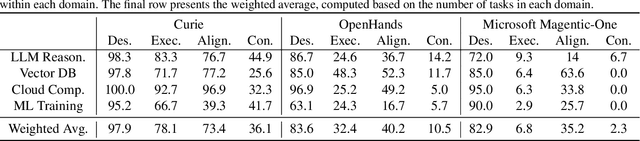
Scientific experimentation, a cornerstone of human progress, demands rigor in reliability, methodical control, and interpretability to yield meaningful results. Despite the growing capabilities of large language models (LLMs) in automating different aspects of the scientific process, automating rigorous experimentation remains a significant challenge. To address this gap, we propose Curie, an AI agent framework designed to embed rigor into the experimentation process through three key components: an intra-agent rigor module to enhance reliability, an inter-agent rigor module to maintain methodical control, and an experiment knowledge module to enhance interpretability. To evaluate Curie, we design a novel experimental benchmark composed of 46 questions across four computer science domains, derived from influential research papers, and widely adopted open-source projects. Compared to the strongest baseline tested, we achieve a 3.4$\times$ improvement in correctly answering experimental questions. Curie is open-sourced at https://github.com/Just-Curieous/Curie.