 Add to Chrome
 Add to Firefox
 Add to Edge
Expected Free Energy as Belief-Dependent Utility for rho-POMDPs
Jul 18, 2026
An agent acting under partial observability must decide when to gather information and which observations are worth their cost. Standard POMDPs value information only through its eventual effect on reward. The $ρ$-POMDP framework instead rewards uncertainty reduction directly, through a belief-dependent utility $ρ$, but in practice both the choice of $ρ$ and the weight placed on it are tuned by hand for every task. We show that active inference removes this tuning entirely. Minimizing Expected Free Energy (EFE) is exactly equivalent to solving a $ρ$-POMDP whose utility is expected information gain, and the exploration weight is fixed at $w=1$ because the variational bound expresses pragmatic and epistemic value in the same units (nats). We prove this equivalence for observe-then-commit POMDPs and extend it to factored observation POMDPs, a broader class that covers interleaved observe-act problems such as non-destructive testing and mobile sensing, where gathering information leaves the hidden state unchanged. Experiments support the theory. Across environments ranging from the classic Tiger problem to RockSample and a new Structural Inspection benchmark with over 65,000 states, the untuned weight matches or outperforms reward-only planning at the same horizon, avoids the over-exploration of bonuses tuned per task, and sits near the reward-maximizing knee of the success-reward Pareto frontier. The practical payoff is an exploration objective that works out of the box. In applications such as fault detection and medical screening, where every test has a price and every missed fault has a cost, EFE supplies a belief-dependent utility that is derived rather than tuned.

Narration-of-Thought: Inference-Time Scaffolding for Defeasible Ethical Reasoning in Large Language Models
Jun 24, 2026Standard chain-of-thought on moral dilemmas exhibits two failure modes: stakeholder collapse (the trace names at most one party with a stake in the outcome) and uncertainty suppression (no explicit unknowns or hedges before committing to an action). We introduce narration-of-thought (NoT), a system prompt that structures chain-of-thought into five sections: protagonist, stakeholders, two-step consequences, uncertainty, then commitment. NoT adds no training, parameters, or fine-tuning. On 100 DailyDilemmas scenarios across four generators from three vendors, NoT cuts stakeholder collapse from up to 31% to under 1% and uncertainty suppression from up to 72% to 1-24% on every model. A matched-budget verbose-CoT control rules out token spend as the active ingredient; NoT retains Cliff's delta advantages of +0.79 to +0.90 on stakeholder count and +0.65 to +0.93 on uncertainty score for three of four generators, and a section ablation attributes each shift to its specific sub-instruction. Textual-gradient descent initialised at NoT improves the scaffold further; a cross-family training judge (different vendor from the generator) dominates an in-family one on every measured axis. Extended to a five-round multi-stakeholder debate protocol, the scaffold converts a 6% standoff into 95% full consensus on a calibration set and 100% combined convergence on a DailyDilemmas replication. The resulting traces externalise the stakeholders, consequences, and uncertainty grounding each commitment, providing an auditable substrate for dependable agentic deployment.
DeFAb: A Verifiable Benchmark for Defeasible Abduction in Foundation Models
Jun 17, 2026A rule-based logic solver resolves every instance in our benchmark in under 50 microseconds with 100% accuracy; the best frontier language model reaches 65% at best and drops to 23.5% under rendering-robust evaluation (worst case over four surface renderings). We introduce DeFAb (Defeasible Abduction Benchmark), a dataset and generation pipeline that converts four decades of publicly funded knowledge bases into formally grounded instances for defeasible abduction: constructing hypotheses that explain anomalies by overriding defaults while preserving unrelated expectations. Because every hypothesis must pass polynomial-time checks for valid derivation, conservativity, and minimality, DeFAb makes logical rigor the instrument for measuring creativity and theoretical reasoning, scoring the disciplined construction of theory revisions rather than fluent but theory-destroying prose. The pipeline pairs taxonomic hierarchies (OpenCyc, YAGO, Wikidata) with behavioral property graphs (ConceptNet, UMLS) to produce 372,648+ instances across 33.75M materialized rules from 18 sources, in three levels with polynomial-time verifiable gold standards. Four frontier models do not reliably internalize defeasible reasoning: rendering-robust Level 2 accuracy is 7.8-23.5%; chain-of-thought variance (~36 pp) exceeds any inter-model gap; and a matched contamination control isolates a +19.4 pp Level 3 gap. We further release DeFAb-Hard (a 235-instance Level 3 difficulty variant; best model 53.3% vs 100% symbolic) and CONJURE (a kernel-verified transformative-creativity variant of 560 Lean 4/Mathlib instances whose gold answers are definitions the proof kernel did not previously contain, judge-free verifier; a pilot finds zero novel concepts). The same verifier doubles as an exact reward for preference optimization (DPO, RLVR/GRPO). Released under MIT at https://huggingface.co/datasets/PatrickAllenCooper/DeFAb.
KV-Fold: One-Step KV-Cache Recurrence for Long-Context Inference
May 12, 2026We introduce KV-Fold, a simple, training-free long-context inference protocol that treats the key-value (KV) cache as the accumulator in a left fold over sequence chunks. At each step, the model processes the next chunk conditioned on the accumulated cache, appends the newly produced keys and values, and passes the enlarged cache forward; the same one-step update is applied repeatedly, analogous to foldl in functional programming. Building on the KV cache concatenation primitive introduced for latent multi-agent communication, we repurpose it as a chunk-to-chunk recurrence for long-context inference. When processing chunk t, the model attends to the KV cache carried from earlier chunks as a prefix, reusing its internal state across segments without modifying or retraining the model. Despite its simplicity, the induced recurrence is stable: per-step drift rises briefly and then saturates into a flat plateau that persists across deep chains. This plateau is insensitive to a 10,000x change in numerical precision, robust across chunk sizes, and consistent across model families. At the task level, KV-Fold preserves exact information over long distances. On a needle-in-a-haystack benchmark, it achieves 100% exact-match retrieval across 152 trials spanning contexts from 16K to 128K tokens and chain depths up to 511 on Llama-3.1-8B, while remaining within the memory limits of a single 40GB GPU. Compared to streaming methods, which trade fidelity for bounded memory, KV-Fold maintains long-range retrieval while operating as a sequence of tractable forward passes. Overall, our results show that frozen pretrained transformers already support a stable form of KV-cache recurrence, providing a practical route to long-context inference without architectural changes or training.
Active Causal Experimentalist (ACE): Learning Intervention Strategies via Direct Preference Optimization
Feb 02, 2026Discovering causal relationships requires controlled experiments, but experimentalists face a sequential decision problem: each intervention reveals information that should inform what to try next. Traditional approaches such as random sampling, greedy information maximization, and round-robin coverage treat each decision in isolation, unable to learn adaptive strategies from experience. We propose Active Causal Experimentalist (ACE), which learns experimental design as a sequential policy. Our key insight is that while absolute information gains diminish as knowledge accumulates (making value-based RL unstable), relative comparisons between candidate interventions remain meaningful throughout. ACE exploits this via Direct Preference Optimization, learning from pairwise intervention comparisons rather than non-stationary reward magnitudes. Across synthetic benchmarks, physics simulations, and economic data, ACE achieves 70-71% improvement over baselines at equal intervention budgets (p < 0.001, Cohen's d ~ 2). Notably, the learned policy autonomously discovers that collider mechanisms require concentrated interventions on parent variables, a theoretically-grounded strategy that emerges purely from experience. This suggests preference-based learning can recover principled experimental strategies, complementing theory with learned domain adaptation.
Monotonicity as an Architectural Bias for Robust Language Models
Feb 02, 2026Large language models (LLMs) are known to exhibit brittle behavior under adversarial prompts and jailbreak attacks, even after extensive alignment and fine-tuning. This fragility reflects a broader challenge of modern neural language models: small, carefully structured perturbations in high-dimensional input spaces can induce large and unpredictable changes in internal semantic representations and output. We investigate monotonicity as an architectural inductive bias for improving the robustness of Transformer-based language models. Monotonicity constrains semantic transformations so that strengthening information, evidence, or constraints cannot lead to regressions in the corresponding internal representations. Such order-preserving behavior has long been exploited in control and safety-critical systems to simplify reasoning and improve robustness, but has traditionally been viewed as incompatible with the expressivity required by neural language models. We show that this trade-off is not inherent. By enforcing monotonicity selectively in the feed-forward sublayers of sequence-to-sequence Transformers -- while leaving attention mechanisms unconstrained -- we obtain monotone language models that preserve the performance of their pretrained counterparts. This architectural separation allows negation, contradiction, and contextual interactions to be introduced explicitly through attention, while ensuring that subsequent semantic refinement is order-preserving. Empirically, monotonicity substantially improves robustness: adversarial attack success rates drop from approximately 69% to 19%, while standard summarization performance degrades only marginally.
CogExplore: Contextual Exploration with Language-Encoded Environment Representations
Jun 24, 2024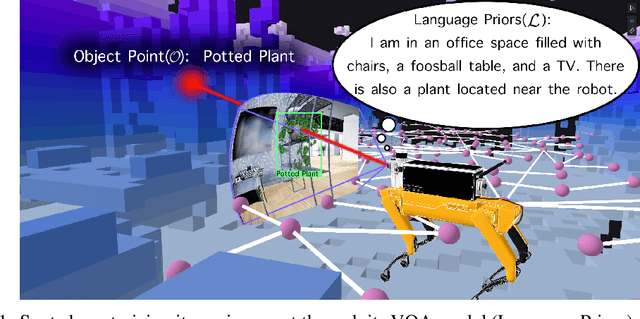


Integrating language models into robotic exploration frameworks improves performance in unmapped environments by providing the ability to reason over semantic groundings, contextual cues, and temporal states. The proposed method employs large language models (GPT-3.5 and Claude Haiku) to reason over these cues and express that reasoning in terms of natural language, which can be used to inform future states. We are motivated by the context of search-and-rescue applications where efficient exploration is critical. We find that by leveraging natural language, semantics, and tracking temporal states, the proposed method greatly reduces exploration path distance and further exposes the need for environment-dependent heuristics. Moreover, the method is highly robust to a variety of environments and noisy vision detections, as shown with a 100% success rate in a series of comprehensive experiments across three different environments conducted in a custom simulation pipeline operating in Unreal Engine.