 Add to Chrome
 Add to Firefox
 Add to Edge
"I followed what felt right, not what I was told": Autonomy, Coaching, and Recognizing Bias Through AI-Mediated Dialogue
Mar 11, 2026
Ableist microaggressions remain pervasive in everyday interactions, yet interventions to help people recognize them are limited. We present an experiment testing how AI-mediated dialogue influences recognition of ableism. 160 participants completed a pre-test, intervention, and a post-test across four conditions: AI nudges toward bias (Bias-Directed), inclusion (Neutral-Directed), unguided dialogue (Self-Directed), and a text-only non-dialogue (Reading). Participants rated scenarios on standardness of social experience and emotional impact; those in dialogue-based conditions also provided qualitative reflections. Quantitative results showed dialogue-based conditions produced stronger recognition than Reading, though trajectories diverged: biased nudges improved differentiation of bias from neutrality but increased overall negativity. Inclusive or no nudges remained more balanced, while Reading participants showed weaker gains and even declines. Qualitative findings revealed biased nudges were often rejected, while inclusive nudges were adopted as scaffolding. We contribute a validated vignette corpus, an AI-mediated intervention platform, and design implications highlighting trade-offs conversational systems face when integrating bias-related nudges.

StepWrite: Adaptive Planning for Speech-Driven Text Generation
Aug 06, 2025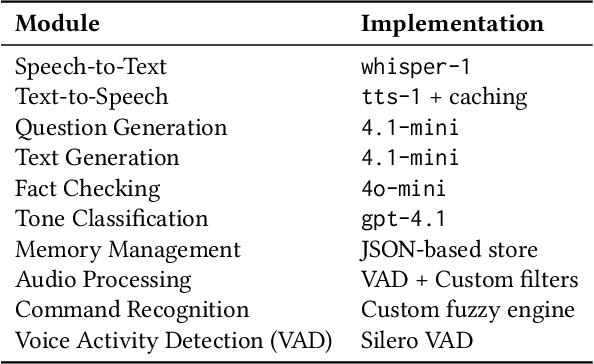
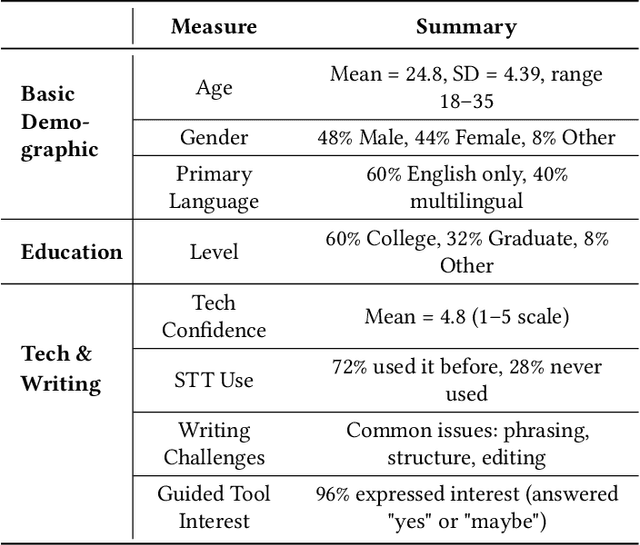
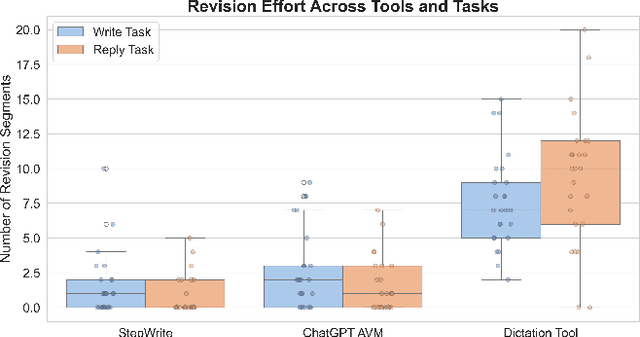
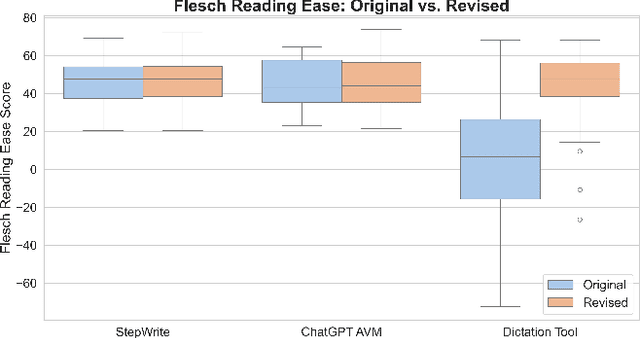
People frequently use speech-to-text systems to compose short texts with voice. However, current voice-based interfaces struggle to support composing more detailed, contextually complex texts, especially in scenarios where users are on the move and cannot visually track progress. Longer-form communication, such as composing structured emails or thoughtful responses, requires persistent context tracking, structured guidance, and adaptability to evolving user intentions--capabilities that conventional dictation tools and voice assistants do not support. We introduce StepWrite, a large language model-driven voice-based interaction system that augments human writing ability by enabling structured, hands-free and eyes-free composition of longer-form texts while on the move. StepWrite decomposes the writing process into manageable subtasks and sequentially guides users with contextually-aware non-visual audio prompts. StepWrite reduces cognitive load by offloading the context-tracking and adaptive planning tasks to the models. Unlike baseline methods like standard dictation features (e.g., Microsoft Word) and conversational voice assistants (e.g., ChatGPT Advanced Voice Mode), StepWrite dynamically adapts its prompts based on the evolving context and user intent, and provides coherent guidance without compromising user autonomy. An empirical evaluation with 25 participants engaging in mobile or stationary hands-occupied activities demonstrated that StepWrite significantly reduces cognitive load, improves usability and user satisfaction compared to baseline methods. Technical evaluations further confirmed StepWrite's capability in dynamic contextual prompt generation, accurate tone alignment, and effective fact checking. This work highlights the potential of structured, context-aware voice interactions in enhancing hands-free and eye-free communication in everyday multitasking scenarios.
Deep Reinforcement Learning for Autonomous Vehicle Intersection Navigation
Oct 16, 2023
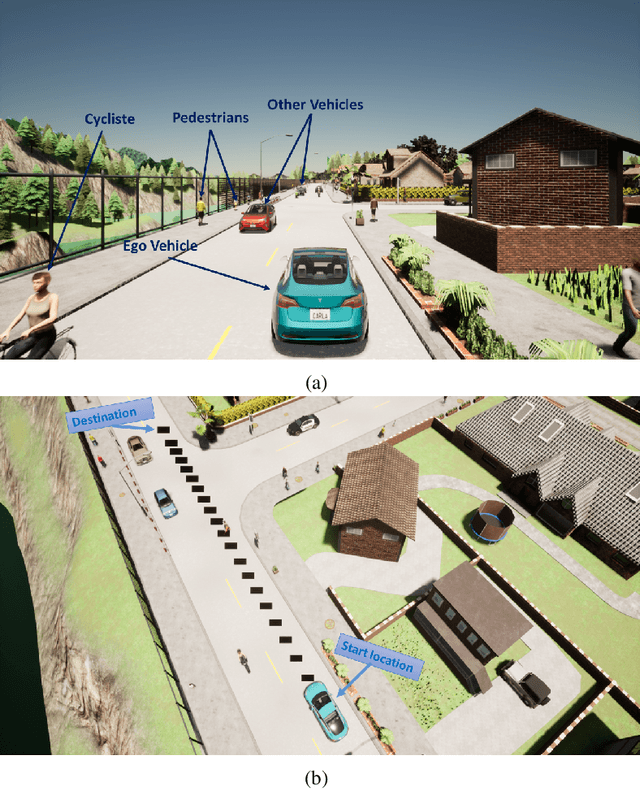
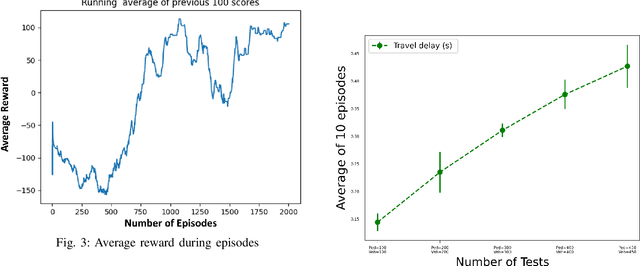

In this paper, we explore the challenges associated with navigating complex T-intersections in dense traffic scenarios for autonomous vehicles (AVs). Reinforcement learning algorithms have emerged as a promising approach to address these challenges by enabling AVs to make safe and efficient decisions in real-time. Here, we address the problem of efficiently and safely navigating T-intersections using a lower-cost, single-agent approach based on the Twin Delayed Deep Deterministic Policy Gradient (TD3) reinforcement learning algorithm. We show that our TD3-based method, when trained and tested in the CARLA simulation platform, demonstrates stable convergence and improved safety performance in various traffic densities. Our results reveal that the proposed approach enables the AV to effectively navigate T-intersections, outperforming previous methods in terms of travel delays, collision minimization, and overall cost. This study contributes to the growing body of knowledge on reinforcement learning applications in autonomous driving and highlights the potential of single-agent, cost-effective methods for addressing more complex driving scenarios and advancing reinforcement learning algorithms in the future.