 Add to Chrome
 Add to Firefox
 Add to Edge
On the Equivalence of Random Network Distillation, Deep Ensembles, and Bayesian Inference
Feb 26, 2026
Uncertainty quantification is central to safe and efficient deployments of deep learning models, yet many computationally practical methods lack lacking rigorous theoretical motivation. Random network distillation (RND) is a lightweight technique that measures novelty via prediction errors against a fixed random target. While empirically effective, it has remained unclear what uncertainties RND measures and how its estimates relate to other approaches, e.g. Bayesian inference or deep ensembles. This paper establishes these missing theoretical connections by analyzing RND within the neural tangent kernel framework in the limit of infinite network width. Our analysis reveals two central findings in this limit: (1) The uncertainty signal from RND -- its squared self-predictive error -- is equivalent to the predictive variance of a deep ensemble. (2) By constructing a specific RND target function, we show that the RND error distribution can be made to mirror the centered posterior predictive distribution of Bayesian inference with wide neural networks. Based on this equivalence, we moreover devise a posterior sampling algorithm that generates i.i.d. samples from an exact Bayesian posterior predictive distribution using this modified \textit{Bayesian RND} model. Collectively, our findings provide a unified theoretical perspective that places RND within the principled frameworks of deep ensembles and Bayesian inference, and offer new avenues for efficient yet theoretically grounded uncertainty quantification methods.

Universal Value-Function Uncertainties
May 27, 2025

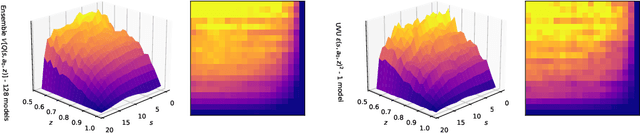
Estimating epistemic uncertainty in value functions is a crucial challenge for many aspects of reinforcement learning (RL), including efficient exploration, safe decision-making, and offline RL. While deep ensembles provide a robust method for quantifying value uncertainty, they come with significant computational overhead. Single-model methods, while computationally favorable, often rely on heuristics and typically require additional propagation mechanisms for myopic uncertainty estimates. In this work we introduce universal value-function uncertainties (UVU), which, similar in spirit to random network distillation (RND), quantify uncertainty as squared prediction errors between an online learner and a fixed, randomly initialized target network. Unlike RND, UVU errors reflect policy-conditional value uncertainty, incorporating the future uncertainties any given policy may encounter. This is due to the training procedure employed in UVU: the online network is trained using temporal difference learning with a synthetic reward derived from the fixed, randomly initialized target network. We provide an extensive theoretical analysis of our approach using neural tangent kernel (NTK) theory and show that in the limit of infinite network width, UVU errors are exactly equivalent to the variance of an ensemble of independent universal value functions. Empirically, we show that UVU achieves equal performance to large ensembles on challenging multi-task offline RL settings, while offering simplicity and substantial computational savings.
Contextual Similarity Distillation: Ensemble Uncertainties with a Single Model
Mar 14, 2025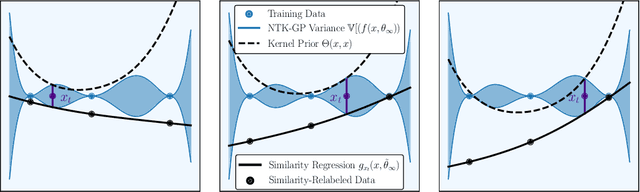
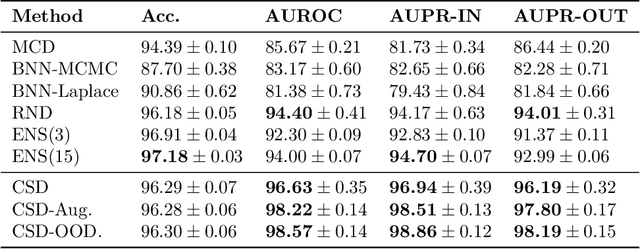
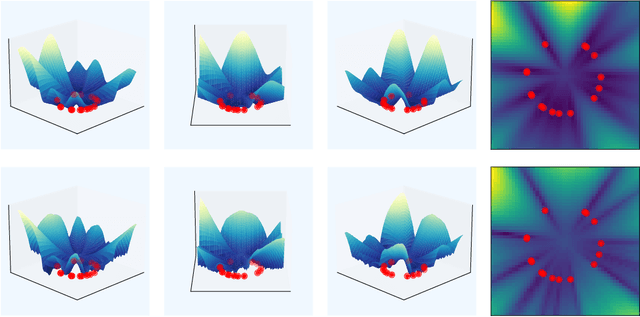
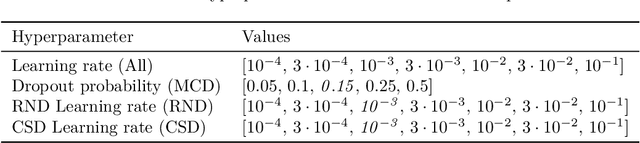
Uncertainty quantification is a critical aspect of reinforcement learning and deep learning, with numerous applications ranging from efficient exploration and stable offline reinforcement learning to outlier detection in medical diagnostics. The scale of modern neural networks, however, complicates the use of many theoretically well-motivated approaches such as full Bayesian inference. Approximate methods like deep ensembles can provide reliable uncertainty estimates but still remain computationally expensive. In this work, we propose contextual similarity distillation, a novel approach that explicitly estimates the variance of an ensemble of deep neural networks with a single model, without ever learning or evaluating such an ensemble in the first place. Our method builds on the predictable learning dynamics of wide neural networks, governed by the neural tangent kernel, to derive an efficient approximation of the predictive variance of an infinite ensemble. Specifically, we reinterpret the computation of ensemble variance as a supervised regression problem with kernel similarities as regression targets. The resulting model can estimate predictive variance at inference time with a single forward pass, and can make use of unlabeled target-domain data or data augmentations to refine its uncertainty estimates. We empirically validate our method across a variety of out-of-distribution detection benchmarks and sparse-reward reinforcement learning environments. We find that our single-model method performs competitively and sometimes superior to ensemble-based baselines and serves as a reliable signal for efficient exploration. These results, we believe, position contextual similarity distillation as a principled and scalable alternative for uncertainty quantification in reinforcement learning and general deep learning.