 Add to Chrome
 Add to Firefox
 Add to Edge
Unifying Depth and Width Pruning for LLMs via Binary Knapsack Optimization
Aug 13, 2026
Structured pruning is a promising approach for compressing large language models (LLMs), yet existing methods rely heavily on greedy heuristics that produce myopic decisions, and often fail to precisely meet target compression budgets. We present SNIPER, a two-stage structured pruning framework that solves a knapsack optimization over coarse-granularity components to yield conditionally optimal parameter allocations with respect to fixed importance estimates, followed by a fine-grained pruning stage to meet strict budget constraints. We introduce the Compression Ratio Adherence Factor (CRAFT) to quantify budget fidelity, showing that while existing pruners deviate from target compression ratios by up to 33%, SNIPER achieves near-exact adherence with a CRAFT score of 0.98. Evaluations across four diverse architectures over a set of 18 tasks spanning five domains demonstrate SNIPER's consistent improvements in average performance retention and task-level stability over six state-of-the-art pruners. Across all pruning configurations, SNIPER achieves an excellent mean rank of 1.25, indicating its robust cross-architectural generalizability and excellent reliability.

It Takes a MAESTRO To Prune Bad Experts
Jul 09, 2026Sparsely-activated Mixture-of-Experts (MoE) language models achieve remarkable inference efficiency by activating only a small fraction of parameters per token, yet their full expert banks reside in memory at all times, creating a prohibitive deployment bottleneck. Existing structured pruning methods, largely designed for dense transformers, assess expert importance using locally derived heuristics that are blind to the interdependent nature of MoE routing. We introduce MAESTRO (Markov-chain Approximated Expert Sparsification via Transition-based ROuting), a structured pruning framework designed for MoE architectures that models autoregressive expert activation trajectories as Ergodic Markov chains whose stationary distributions encode cross-layer dependencies, yielding a globally aware importance heuristic. Evaluated across five diverse domains including Safety, Bias, and Ethics, MAESTRO outperforms state-of-the-art baselines by up to 10.61% in average performance retention under a strict 50% compression regime, while exhibiting substantially lower cross-task variance, indicating that global, routing-congruent pruning produces models that generalize more consistently across heterogeneous tasks.
Target-Augmented Shared Fusion-based Multimodal Sarcasm Explanation Generation
Feb 11, 2025
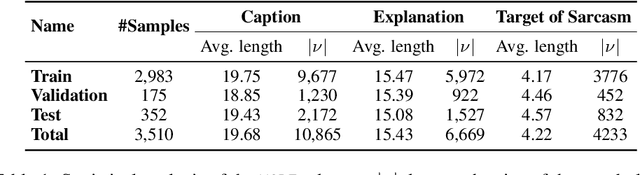
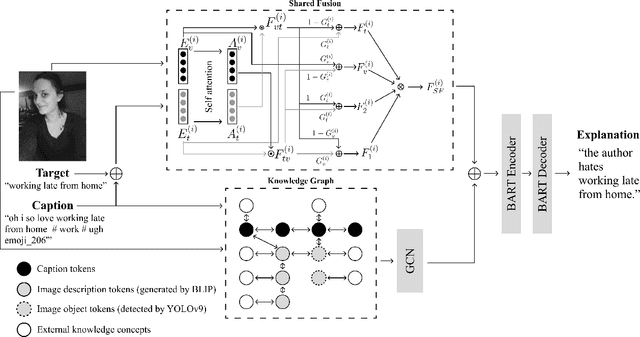
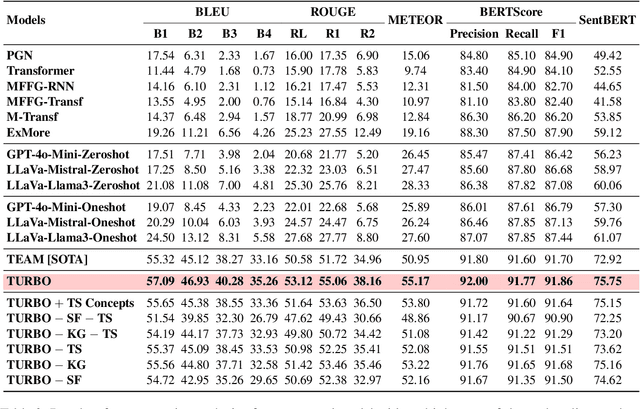
Sarcasm is a linguistic phenomenon that intends to ridicule a target (e.g., entity, event, or person) in an inherent way. Multimodal Sarcasm Explanation (MuSE) aims at revealing the intended irony in a sarcastic post using a natural language explanation. Though important, existing systems overlooked the significance of the target of sarcasm in generating explanations. In this paper, we propose a Target-aUgmented shaRed fusion-Based sarcasm explanatiOn model, aka. TURBO. We design a novel shared-fusion mechanism to leverage the inter-modality relationships between an image and its caption. TURBO assumes the target of the sarcasm and guides the multimodal shared fusion mechanism in learning intricacies of the intended irony for explanations. We evaluate our proposed TURBO model on the MORE+ dataset. Comparison against multiple baselines and state-of-the-art models signifies the performance improvement of TURBO by an average margin of $+3.3\%$. Moreover, we explore LLMs in zero and one-shot settings for our task and observe that LLM-generated explanation, though remarkable, often fails to capture the critical nuances of the sarcasm. Furthermore, we supplement our study with extensive human evaluation on TURBO's generated explanations and find them out to be comparatively better than other systems.