 Add to Chrome
 Add to Firefox
 Add to Edge
Self-Consistency via Marginal Sharpening
May 27, 2026
Inference-time sampling can elicit strong reasoning abilities from language models without additional training. Existing power-sampling methods do so by sharpening the distribution over full generated outputs, favoring completions that are individually likely under the model. We argue that this is the wrong object to target for reasoning: a completion entangles a reasoning trace with a final answer, whereas what matters is whether an answer is supported by many plausible reasoning paths. We therefore shift the target from the full-output distribution to the sharpened answer marginal, making self-consistency an inference-time objective rather than a post-hoc voting criterion. Surprisingly, this marginal target admits an efficient approximation: we propose a simple, purely autoregressive parallel sampling algorithm that approximately samples from the sharpened answer marginal, eliciting stronger performance than standard power sampling on mathematics and coding benchmarks while being orders of magnitude faster.

Logarithmic Smoothing for Pessimistic Off-Policy Evaluation, Selection and Learning
May 23, 2024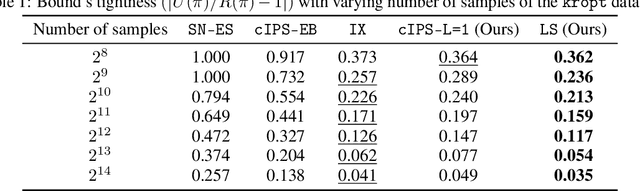
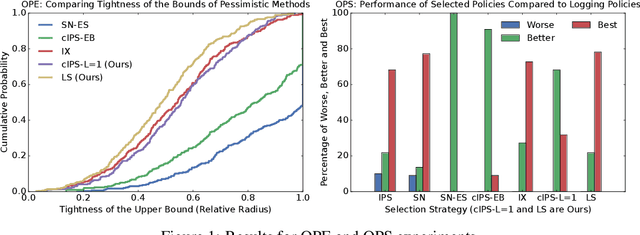

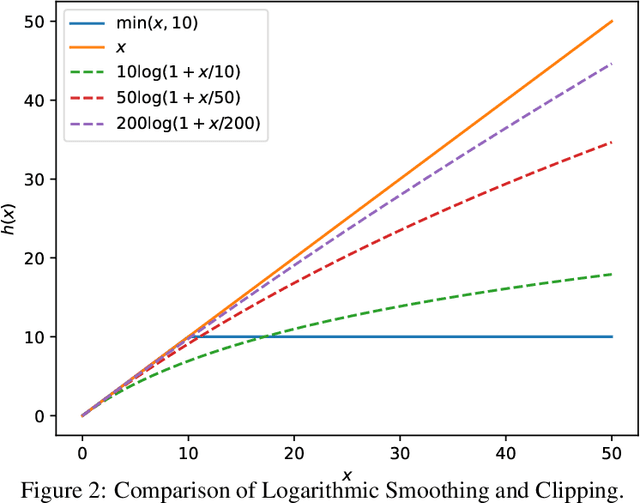
This work investigates the offline formulation of the contextual bandit problem, where the goal is to leverage past interactions collected under a behavior policy to evaluate, select, and learn new, potentially better-performing, policies. Motivated by critical applications, we move beyond point estimators. Instead, we adopt the principle of pessimism where we construct upper bounds that assess a policy's worst-case performance, enabling us to confidently select and learn improved policies. Precisely, we introduce novel, fully empirical concentration bounds for a broad class of importance weighting risk estimators. These bounds are general enough to cover most existing estimators and pave the way for the development of new ones. In particular, our pursuit of the tightest bound within this class motivates a novel estimator (LS), that logarithmically smooths large importance weights. The bound for LS is provably tighter than all its competitors, and naturally results in improved policy selection and learning strategies. Extensive policy evaluation, selection, and learning experiments highlight the versatility and favorable performance of LS.
A connection between Tempering and Entropic Mirror Descent
Oct 18, 2023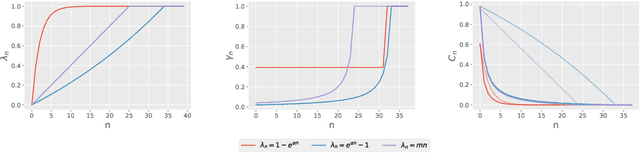
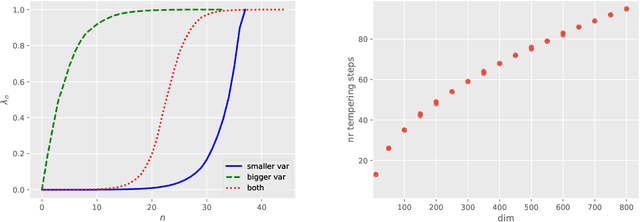
This paper explores the connections between tempering (for Sequential Monte Carlo; SMC) and entropic mirror descent to sample from a target probability distribution whose unnormalized density is known. We establish that tempering SMC is a numerical approximation of entropic mirror descent applied to the Kullback-Leibler (KL) divergence and obtain convergence rates for the tempering iterates. Our result motivates the tempering iterates from an optimization point of view, showing that tempering can be used as an alternative to Langevin-based algorithms to minimize the KL divergence. We exploit the connection between tempering and mirror descent iterates to justify common practices in SMC and propose improvements to algorithms in literature.
Fast Slate Policy Optimization: Going Beyond Plackett-Luce
Aug 03, 2023An increasingly important building block of large scale machine learning systems is based on returning slates; an ordered lists of items given a query. Applications of this technology include: search, information retrieval and recommender systems. When the action space is large, decision systems are restricted to a particular structure to complete online queries quickly. This paper addresses the optimization of these large scale decision systems given an arbitrary reward function. We cast this learning problem in a policy optimization framework and propose a new class of policies, born from a novel relaxation of decision functions. This results in a simple, yet efficient learning algorithm that scales to massive action spaces. We compare our method to the commonly adopted Plackett-Luce policy class and demonstrate the effectiveness of our approach on problems with action space sizes in the order of millions.
PAC-Bayesian Offline Contextual Bandits With Guarantees
Oct 24, 2022
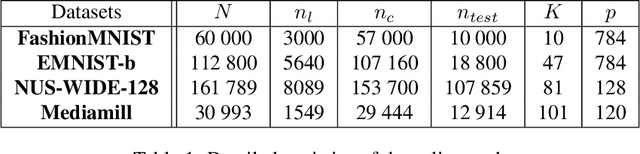


This paper introduces a new principled approach for offline policy optimisation in contextual bandits. For two well-established risk estimators, we propose novel generalisation bounds able to confidently improve upon the logging policy offline. Unlike previous work, our approach does not require tuning hyperparameters on held-out sets, and enables deployment with no prior A/B testing. This is achieved by analysing the problem through the PAC-Bayesian lens; mainly, we let go of traditional policy parametrisation (e.g. softmax) and instead interpret the policies as mixtures of deterministic strategies. We demonstrate through extensive experiments evidence of our bounds tightness and the effectiveness of our approach in practical scenarios.
Computational Doob's $h$-transforms for Online Filtering of Discretely Observed Diffusions
Jun 07, 2022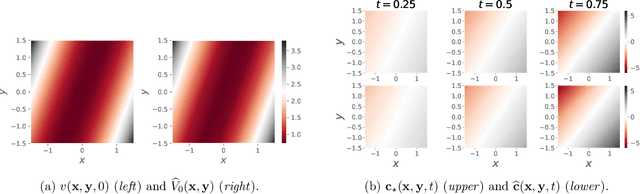
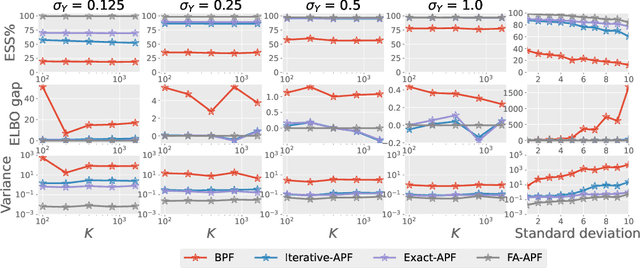
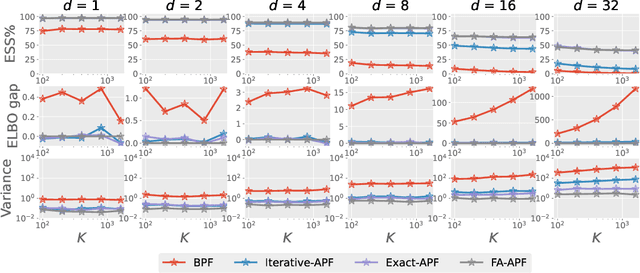
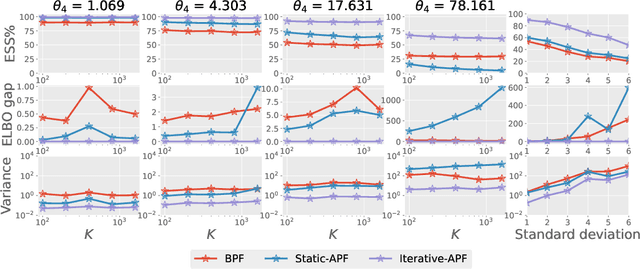
This paper is concerned with online filtering of discretely observed nonlinear diffusion processes. Our approach is based on the fully adapted auxiliary particle filter, which involves Doob's $h$-transforms that are typically intractable. We propose a computational framework to approximate these $h$-transforms by solving the underlying backward Kolmogorov equations using nonlinear Feynman-Kac formulas and neural networks. The methodology allows one to train a locally optimal particle filter prior to the data-assimilation procedure. Numerical experiments illustrate that the proposed approach can be orders of magnitude more efficient than the bootstrap particle filter in the regime of highly informative observations, when the observations are extreme under the model, and if the state dimension is large.
De-Sequentialized Monte Carlo: a parallel-in-time particle smoother
Feb 04, 2022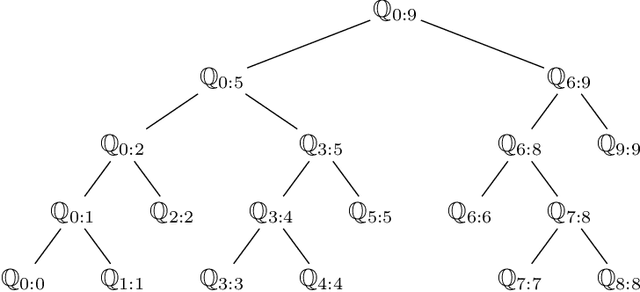
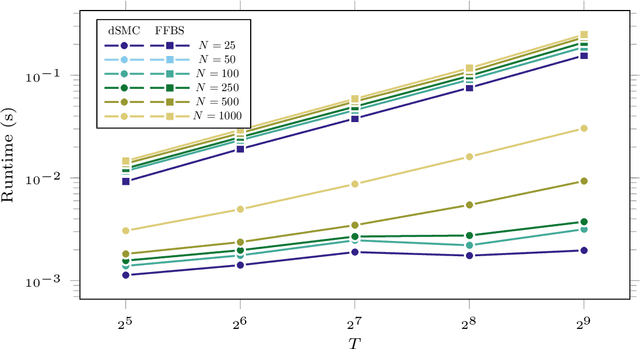
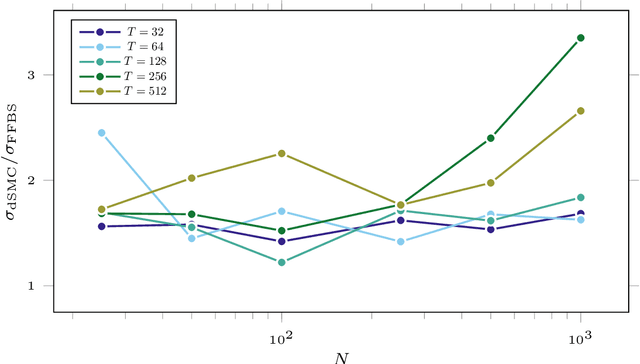
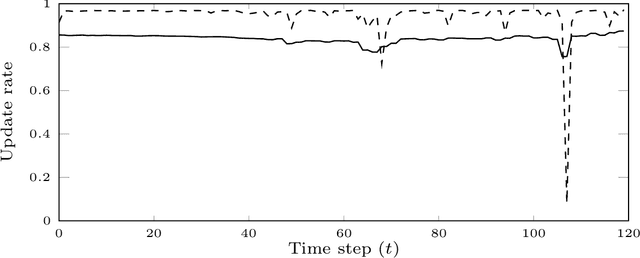
Particle smoothers are SMC (Sequential Monte Carlo) algorithms designed to approximate the joint distribution of the states given observations from a state-space model. We propose dSMC (de-Sequentialized Monte Carlo), a new particle smoother that is able to process $T$ observations in $\mathcal{O}(\log T)$ time on parallel architecture. This compares favourably with standard particle smoothers, the complexity of which is linear in $T$. We derive $\mathcal{L}_p$ convergence results for dSMC, with an explicit upper bound, polynomial in $T$. We then discuss how to reduce the variance of the smoothing estimates computed by dSMC by (i) designing good proposal distributions for sampling the particles at the initialization of the algorithm, as well as by (ii) using lazy resampling to increase the number of particles used in dSMC. Finally, we design a particle Gibbs sampler based on dSMC, which is able to perform parameter inference in a state-space model at a $\mathcal{O}(\log(T))$ cost on parallel hardware.
Modelling dependency completion in sentence comprehension as a Bayesian hierarchical mixture process: A case study involving Chinese relative clauses
May 05, 2017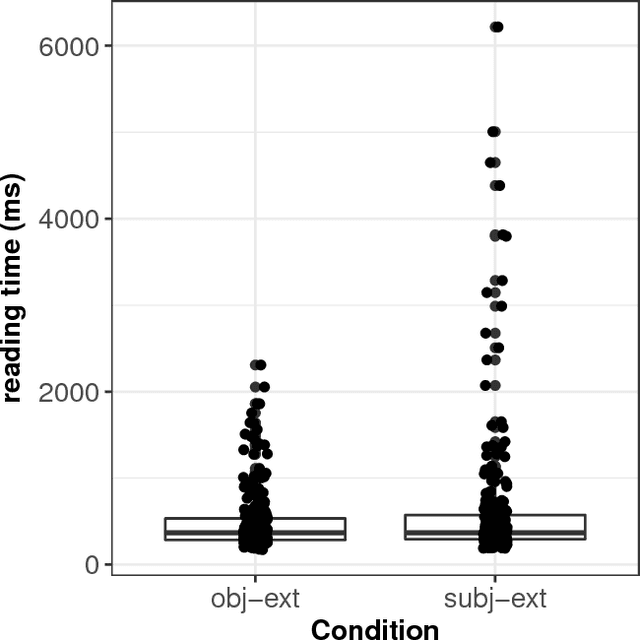
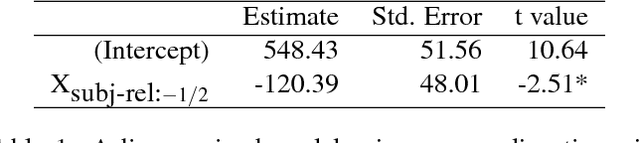
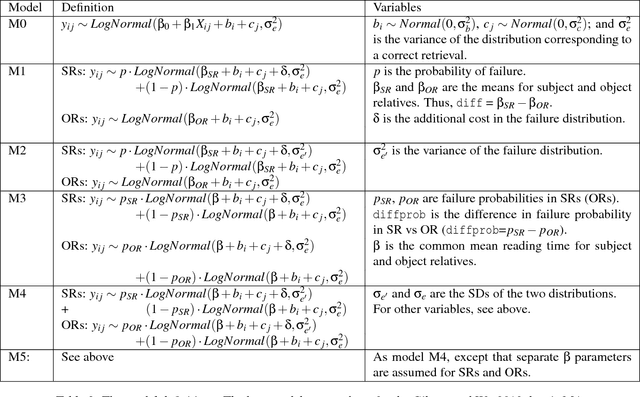
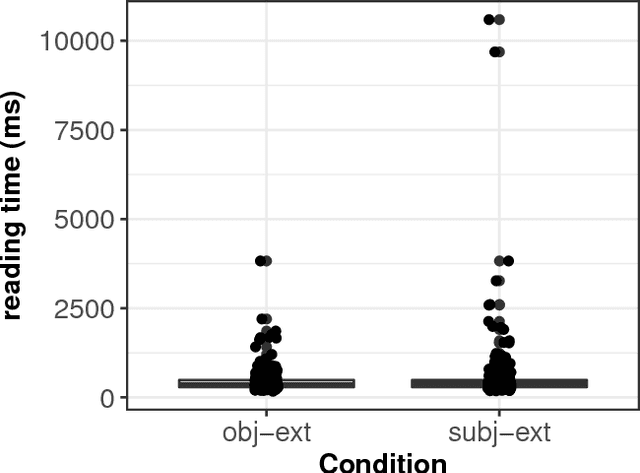
We present a case-study demonstrating the usefulness of Bayesian hierarchical mixture modelling for investigating cognitive processes. In sentence comprehension, it is widely assumed that the distance between linguistic co-dependents affects the latency of dependency resolution: the longer the distance, the longer the retrieval time (the distance-based account). An alternative theory, direct-access, assumes that retrieval times are a mixture of two distributions: one distribution represents successful retrievals (these are independent of dependency distance) and the other represents an initial failure to retrieve the correct dependent, followed by a reanalysis that leads to successful retrieval. We implement both models as Bayesian hierarchical models and show that the direct-access model explains Chinese relative clause reading time data better than the distance account.
On the properties of variational approximations of Gibbs posteriors
Jun 15, 2015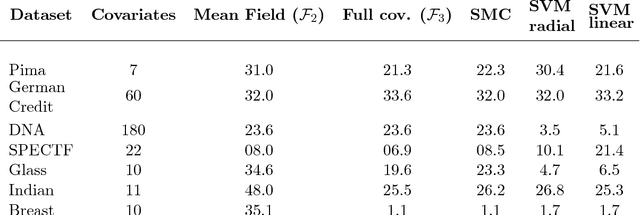
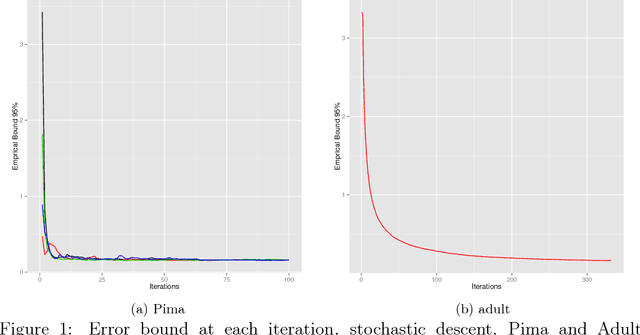
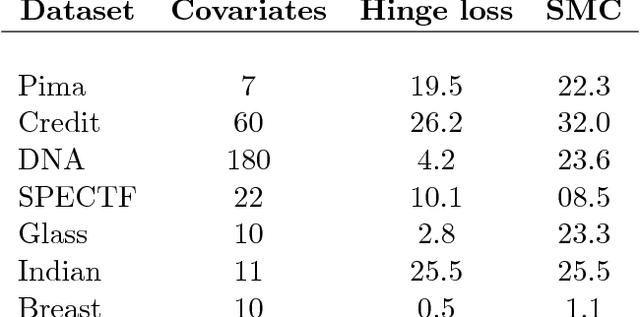
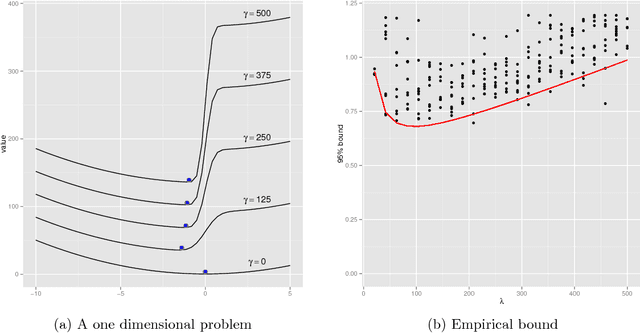
The PAC-Bayesian approach is a powerful set of techniques to derive non- asymptotic risk bounds for random estimators. The corresponding optimal distribution of estimators, usually called the Gibbs posterior, is unfortunately intractable. One may sample from it using Markov chain Monte Carlo, but this is often too slow for big datasets. We consider instead variational approximations of the Gibbs posterior, which are fast to compute. We undertake a general study of the properties of such approximations. Our main finding is that such a variational approximation has often the same rate of convergence as the original PAC-Bayesian procedure it approximates. We specialise our results to several learning tasks (classification, ranking, matrix completion),discuss how to implement a variational approximation in each case, and illustrate the good properties of said approximation on real datasets.
The Poisson transform for unnormalised statistical models
Nov 27, 2014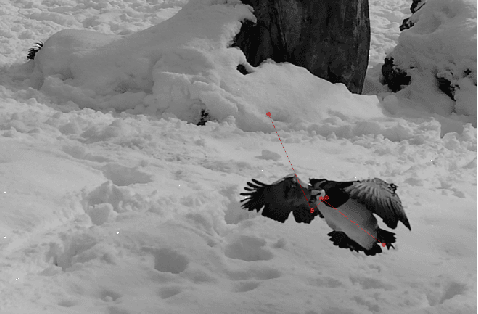
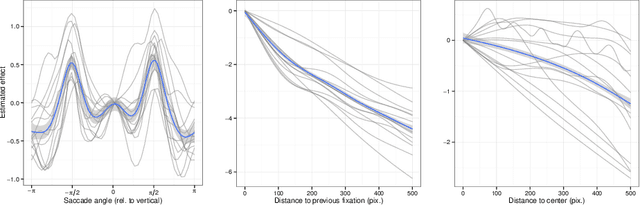
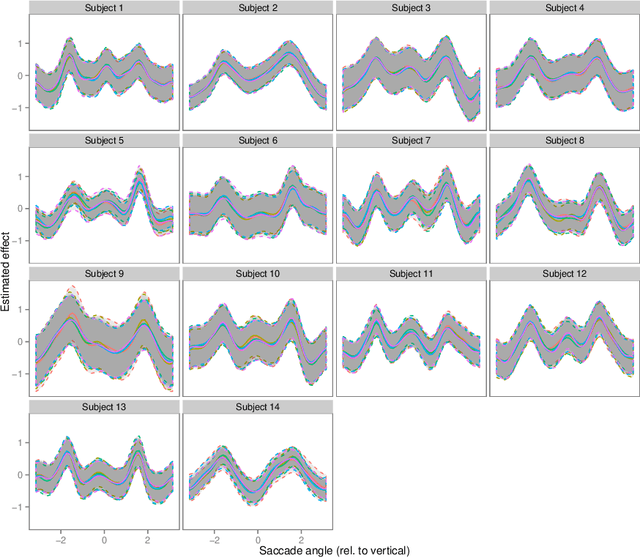
Contrary to standard statistical models, unnormalised statistical models only specify the likelihood function up to a constant. While such models are natural and popular, the lack of normalisation makes inference much more difficult. Here we show that inferring the parameters of a unnormalised model on a space $\Omega$ can be mapped onto an equivalent problem of estimating the intensity of a Poisson point process on $\Omega$. The unnormalised statistical model now specifies an intensity function that does not need to be normalised. Effectively, the normalisation constant may now be inferred as just another parameter, at no loss of information. The result can be extended to cover non-IID models, which includes for example unnormalised models for sequences of graphs (dynamical graphs), or for sequences of binary vectors. As a consequence, we prove that unnormalised parameteric inference in non-IID models can be turned into a semi-parametric estimation problem. Moreover, we show that the noise-contrastive divergence of Gutmann & Hyv\"arinen (2012) can be understood as an approximation of the Poisson transform, and extended to non-IID settings. We use our results to fit spatial Markov chain models of eye movements, where the Poisson transform allows us to turn a highly non-standard model into vanilla semi-parametric logistic regression.