 Add to Chrome
 Add to Firefox
 Add to Edge
Optimal-Transport-Guided Functional Flow Matching for Turbulent Field Generation in Hilbert Space
Apr 07, 2026
High-fidelity modeling of turbulent flows requires capturing complex spatiotemporal dynamics and multi-scale intermittency, posing a fundamental challenge for traditional knowledge-based systems. While deep generative models, such as diffusion models and Flow Matching, have shown promising performance, they are fundamentally constrained by their discrete, pixel-based nature. This limitation restricts their applicability in turbulence computing, where data inherently exists in a functional form. To address this gap, we propose Functional Optimal Transport Conditional Flow Matching (FOT-CFM), a generative framework defined directly in infinite-dimensional function space. Unlike conventional approaches defined on fixed grids, FOT-CFM treats physical fields as elements of an infinite-dimensional Hilbert space, and learns resolution-invariant generative dynamics directly at the level of probability measures. By integrating Optimal Transport (OT) theory, we construct deterministic, straight-line probability paths between noise and data measures in Hilbert space. This formulation enables simulation-free training and significantly accelerates the sampling process. We rigorously evaluate the proposed system on a diverse suite of chaotic dynamical systems, including the Navier-Stokes equations, Kolmogorov Flow, and Hasegawa-Wakatani equations, all of which exhibit rich multi-scale turbulent structures. Experimental results demonstrate that FOT-CFM achieves superior fidelity in reproducing high-order turbulent statistics and energy spectra compared to state-of-the-art baselines.

ExpertFlow: Optimized Expert Activation and Token Allocation for Efficient Mixture-of-Experts Inference
Oct 23, 2024
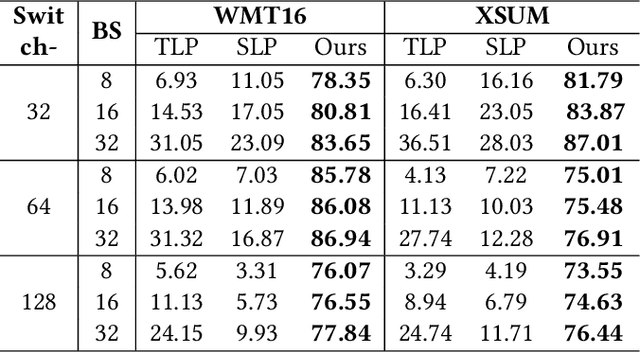


Sparse Mixture of Experts (MoE) models, while outperforming dense Large Language Models (LLMs) in terms of performance, face significant deployment challenges during inference due to their high memory demands. Existing offloading techniques, which involve swapping activated and idle experts between the GPU and CPU, often suffer from rigid expert caching mechanisms. These mechanisms fail to adapt to dynamic routing, leading to inefficient cache utilization, or incur prohibitive costs for prediction training. To tackle these inference-specific challenges, we introduce ExpertFlow, a comprehensive system specifically designed to enhance inference efficiency by accommodating flexible routing and enabling efficient expert scheduling between CPU and GPU. This reduces overhead and boosts system performance. Central to our approach is a predictive routing path-based offloading mechanism that utilizes a lightweight predictor to accurately forecast routing paths before computation begins. This proactive strategy allows for real-time error correction in expert caching, significantly increasing cache hit ratios and reducing the frequency of expert transfers, thereby minimizing I/O overhead. Additionally, we implement a dynamic token scheduling strategy that optimizes MoE inference by rearranging input tokens across different batches. This method not only reduces the number of activated experts per batch but also improves computational efficiency. Our extensive experiments demonstrate that ExpertFlow achieves up to 93.72\% GPU memory savings and enhances inference speed by 2 to 10 times compared to baseline methods, highlighting its effectiveness and utility as a robust solution for resource-constrained inference scenarios.