 Add to Chrome
 Add to Firefox
 Add to Edge
Plasma GraphRAG: Physics-Grounded Parameter Selection for Gyrokinetic Simulations
Apr 07, 2026
Accurate parameter selection is fundamental to gyrokinetic plasma simulations, yet current practices rely heavily on manual literature reviews, leading to inefficiencies and inconsistencies. We introduce Plasma GraphRAG, a novel framework that integrates Graph Retrieval-Augmented Generation (GraphRAG) with large language models (LLMs) for automated, physics-grounded parameter range identification. By constructing a domain-specific knowledge graph from curated plasma literature and enabling structured retrieval over graph-anchored entities and relations, Plasma GraphRAG enables LLMs to generate accurate, context-aware recommendations. Extensive evaluations across five metrics, comprehensiveness, diversity, grounding, hallucination, and empowerment, demonstrate that Plasma GraphRAG outperforms vanilla RAG by over $10\%$ in overall quality and reduces hallucination rates by up to $25\%$. {Beyond enhancing simulation reliability, Plasma GraphRAG offers a methodology for accelerating scientific discovery across complex, data-rich domains.

Optimal-Transport-Guided Functional Flow Matching for Turbulent Field Generation in Hilbert Space
Apr 07, 2026High-fidelity modeling of turbulent flows requires capturing complex spatiotemporal dynamics and multi-scale intermittency, posing a fundamental challenge for traditional knowledge-based systems. While deep generative models, such as diffusion models and Flow Matching, have shown promising performance, they are fundamentally constrained by their discrete, pixel-based nature. This limitation restricts their applicability in turbulence computing, where data inherently exists in a functional form. To address this gap, we propose Functional Optimal Transport Conditional Flow Matching (FOT-CFM), a generative framework defined directly in infinite-dimensional function space. Unlike conventional approaches defined on fixed grids, FOT-CFM treats physical fields as elements of an infinite-dimensional Hilbert space, and learns resolution-invariant generative dynamics directly at the level of probability measures. By integrating Optimal Transport (OT) theory, we construct deterministic, straight-line probability paths between noise and data measures in Hilbert space. This formulation enables simulation-free training and significantly accelerates the sampling process. We rigorously evaluate the proposed system on a diverse suite of chaotic dynamical systems, including the Navier-Stokes equations, Kolmogorov Flow, and Hasegawa-Wakatani equations, all of which exhibit rich multi-scale turbulent structures. Experimental results demonstrate that FOT-CFM achieves superior fidelity in reproducing high-order turbulent statistics and energy spectra compared to state-of-the-art baselines.
Physics informed Neural Networks applied to the description of wave-particle resonance in kinetic simulations of fusion plasmas
Aug 23, 2023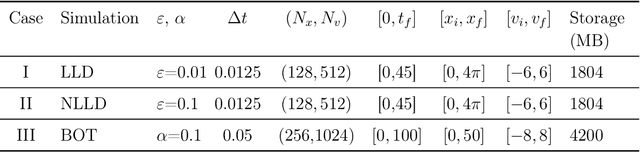
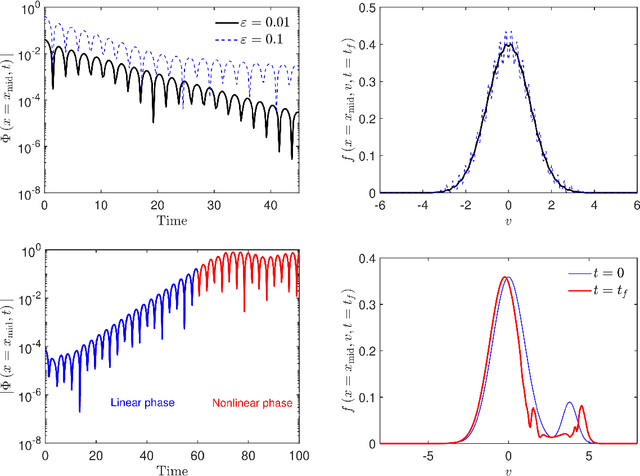
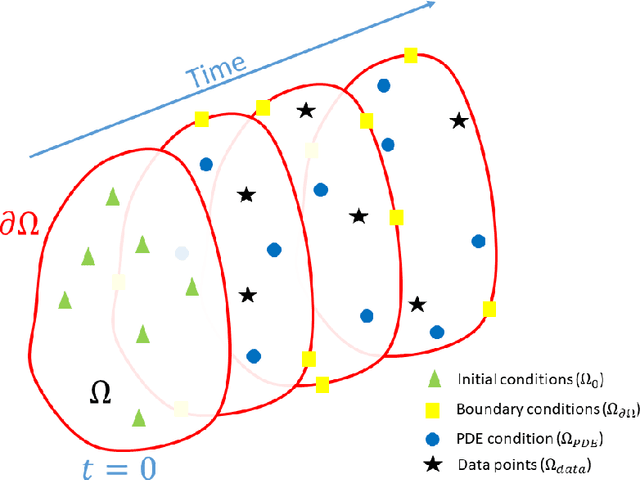
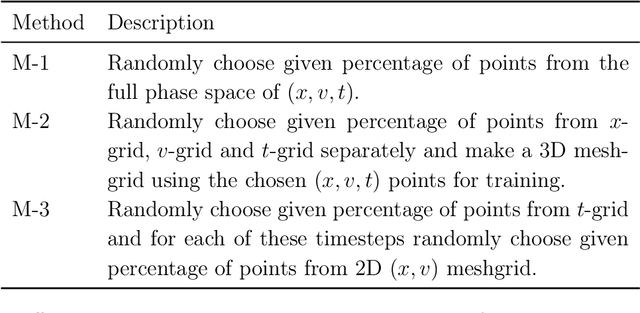
The Vlasov-Poisson system is employed in its reduced form version (1D1V) as a test bed for the applicability of Physics Informed Neural Network (PINN) to the wave-particle resonance. Two examples are explored: the Landau damping and the bump-on-tail instability. PINN is first tested as a compression method for the solution of the Vlasov-Poisson system and compared to the standard neural networks. Second, the application of PINN to solving the Vlasov-Poisson system is also presented with the special emphasis on the integral part, which motivates the implementation of a PINN variant, called Integrable PINN (I-PINN), based on the automatic-differentiation to solve the partial differential equation and on the automatic-integration to solve the integral equation.