 Add to Chrome
 Add to Firefox
 Add to Edge
IQRA 2026: Interspeech Challenge on Automatic Assessment Pronunciation for Modern Standard Arabic (MSA)
Mar 31, 2026
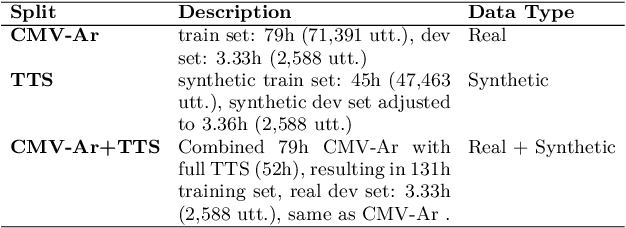
We present the findings of the second edition of the IQRA Interspeech Challenge, a challenge on automatic Mispronunciation Detection and Diagnosis (MDD) for Modern Standard Arabic (MSA). Building on the previous edition, this iteration introduces \textbf{Iqra\_Extra\_IS26}, a new dataset of authentic human mispronounced speech, complementing the existing training and evaluation resources. Submitted systems employed a diverse range of approaches, spanning CTC-based self-supervised learning models, two-stage fine-tuning strategies, and using large audio-language models. Compared to the first edition, we observe a substantial jump of \textbf{0.28 in F1-score}, attributable both to novel architectures and modeling strategies proposed by participants and to the additional authentic mispronunciation data made available. These results demonstrate the growing maturity of Arabic MDD research and establish a stronger foundation for future work in Arabic pronunciation assessment.

Towards a Unified Benchmark for Arabic Pronunciation Assessment: Quranic Recitation as Case Study
Jun 09, 2025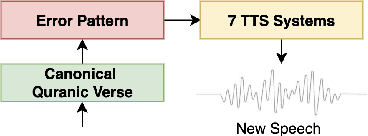
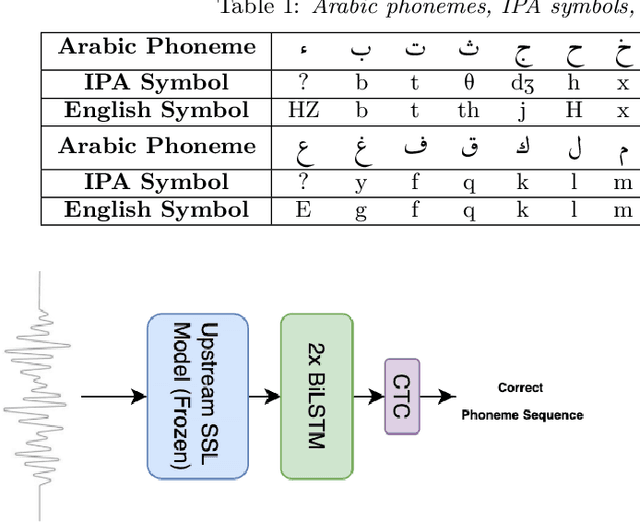
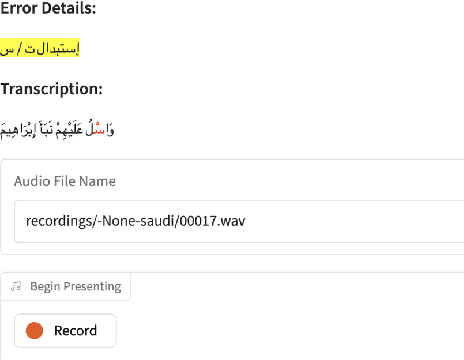
We present a unified benchmark for mispronunciation detection in Modern Standard Arabic (MSA) using Qur'anic recitation as a case study. Our approach lays the groundwork for advancing Arabic pronunciation assessment by providing a comprehensive pipeline that spans data processing, the development of a specialized phoneme set tailored to the nuances of MSA pronunciation, and the creation of the first publicly available test set for this task, which we term as the Qur'anic Mispronunciation Benchmark (QuranMB.v1). Furthermore, we evaluate several baseline models to provide initial performance insights, thereby highlighting both the promise and the challenges inherent in assessing MSA pronunciation. By establishing this standardized framework, we aim to foster further research and development in pronunciation assessment in Arabic language technology and related applications.