 Add to Chrome
 Add to Firefox
 Add to Edge
Accelerating Bayesian inverse design in computational fluid dynamics using neural operators
May 25, 2026
Bayesian inverse design provides a principled framework for inferring aerodynamic geometries from sparse flow observations while quantifying uncertainty. However, its practical use in computational fluid dynamics (CFD) is severely limited by the cost of repeated high-fidelity simulations required for gradient-based Markov chain Monte Carlo (MCMC) sampling. While surrogate models are commonly proposed to reduce this cost, their effect on posterior geometry and uncertainty, especially for shock-dominated flows, remains poorly understood. In this work, we demonstrate that neural operator surrogates can be embedded directly within the MCMC inference loop while preserving posterior structure. Using a fully Bayesian inverse formulation of quasi-one-dimensional nozzle flow, we demonstrate that geometry parameterization plays a decisive role in identifiability and posterior conditioning, with cubic B-splines yielding stable and physically meaningful uncertainty estimates. Building on this formulation, a Deep Operator Network trained on CFD-generated data is substituted for the CFD solver within a No-U-Turn Sampler, while keeping the likelihood model, priors, and sampling configuration unchanged. Across sparse to fully observed regimes, surrogate-based inference reproduces the posterior geometry and uncertainty trends of the CFD reference. As a result of surrogate integration, total inference time is reduced to under one second, corresponding to a speedup exceeding three orders of magnitude. In addition, a direct inverse neural operator is examined as a deterministic alternative for inverse design, enabling single-shot geometry reconstruction without posterior sampling. These results demonstrate that neural operator-accelerated Bayesian inference enables practical, uncertainty-aware inverse design workflows for aerodynamic applications.

WLNO: Wavelet-Laplace Neural Operator for Solving Partial Differential Equations
May 23, 2026This work introduces the Wavelet-Laplace Neural Operator (WLNO), a novel neural operator that fuses Haar wavelet multi-scale spatial decomposition with the Laplace-domain pole-residue formulation of the Laplace Neural Operator (LNO). While LNO captures transient and steady-state dynamics through learnable system poles and residues, it lacks an explicit mechanism for extracting spatially localized multi-scale features inherent in complex PDE solutions. WLNO addresses this by augmenting the LNO core with a parallel single-level Haar discrete wavelet transform (DWT) branch that decomposes the lifted feature map into four frequency subbands: approximation (LL), horizontal detail (LH), vertical detail (HL), and diagonal detail (HH) and applies independent learned $1\times1$ convolutions to each subband before reconstruction via the inverse DWT. The two branches are fused through a learnable sigmoid-gated weight $α_\mathrm{wav}$, initialized to give a small initial contribution to the wavelet branch, allowing the model to adaptively balance Laplace-domain dynamics against spatial multi-scale features throughout training. WLNO is evaluated against LNO on five benchmark PDE problems using identical hyperparameters, training data, and evaluation protocols: the diffusion equation, the Burgers equation, the reaction-diffusion system, Darcy flow, and the two-dimensional Navier-Stokes equation. WLNO consistently outperforms LNO on all five problems, with the most pronounced improvement on problems with strong spatial multi-scale structure, such as the Burgers equation with sharp shock fronts and the Navier-Stokes equation with coherent vortical structures, while remaining consistent across smoother and elliptic problems. These results demonstrate that wavelet-based multi-scale spatial decomposition is a principled and effective complement to Laplace-domain operator learning.
The impact of observation density on Bayesian inversion of latent dynamics in shock-dominated flows
May 18, 2026Inferring unknown initial states in shock-dominated compressible flows from sparse and noisy measurements is a challenging ill-posed inverse problem due to nonlinear wave interactions and limited sensing. In this work, we develop a non-intrusive reduced-order modeling framework for efficient Bayesian initial-state inversion with uncertainty quantification. The framework combines a convolutional autoencoder with a learned latent-space forward operator. The autoencoder compresses high-dimensional flow fields into a compact nonlinear latent representation, while the forward operator predicts final-time latent states from encoded initial conditions. This AE-ROM surrogate enables rapid forward evaluations and is embedded within a No-U-Turn Sampler (NUTS) for posterior exploration. The framework is demonstrated using 500 high-fidelity Sod shock tube simulations generated through Latin hypercube sampling and solved using a fifth-order WENO scheme. The inverse problem seeks to recover unknown left and right density and pressure states from sparse noisy observations of final-time density and pressure fields. Results show that the AE-ROM accurately reconstructs key shock-tube structures, including the rarefaction wave, contact discontinuity, and shock front. A latent dimension of 32 provides an effective balance between reconstruction accuracy and reduced-space compactness, while 250 training simulations are sufficient for accurate reconstruction. Increasing observation density significantly contracts posterior uncertainty, reducing the mean posterior standard deviation by approximately 78% for density and 76% for pressure. Overall, the proposed framework provides a computationally efficient and uncertainty-aware approach for inverse analysis of shock-dominated flows, with potential extensions to multidimensional compressible-flow and digital-twin applications.
SIMR-NO: A Spectrally-Informed Multi-Resolution Neural Operator for Turbulent Flow Super-Resolution
Mar 30, 2026Reconstructing high-resolution turbulent flow fields from severely under-resolved observations is a fundamental inverse problem in computational fluid dynamics and scientific machine learning. Classical interpolation methods fail to recover missing fine-scale structures, while existing deep learning approaches rely on convolutional architectures that lack the spectral and multiscale inductive biases necessary for physically faithful reconstruction at large upscaling factors. We introduce the Spectrally-Informed Multi-Resolution Neural Operator (SIMR-NO), a hierarchical operator learning framework that factorizes the ill-posed inverse mapping across intermediate spatial resolutions, combines deterministic interpolation priors with spectrally gated Fourier residual corrections at each stage, and incorporates local refinement modules to recover fine-scale spatial features beyond the truncated Fourier basis. The proposed method is evaluated on Kolmogorov-forced two-dimensional turbulence, where $128\times128$ vorticity fields are reconstructed from extremely coarse $8\times8$ observations representing a $16\times$ downsampling factor. Across 201 independent test realizations, SIMR-NO achieves a mean relative $\ell_2$ error of $26.04\%$ with the lowest error variance among all methods, reducing reconstruction error by $31.7\%$ over FNO, $26.0\%$ over EDSR, and $9.3\%$ over LapSRN. Beyond pointwise accuracy, SIMR-NO is the only method that faithfully reproduces the ground-truth energy and enstrophy spectra across the full resolved wavenumber range, demonstrating physically consistent super-resolution of turbulent flow fields.
Stabilizing autoregressive forecasts in chaotic systems via multi-rate latent recurrence
Jan 20, 2026Long-horizon autoregressive forecasting of chaotic dynamical systems remains challenging due to rapid error amplification and distribution shift: small one-step inaccuracies compound into physically inconsistent rollouts and collapse of large-scale statistics. We introduce MSR-HINE, a hierarchical implicit forecaster that augments multiscale latent priors with multi-rate recurrent modules operating at distinct temporal scales. At each step, coarse-to-fine recurrent states generate latent priors, an implicit one-step predictor refines the state with multiscale latent injections, and a gated fusion with posterior latents enforces scale-consistent updates; a lightweight hidden-state correction further aligns recurrent memories with fused latents. The resulting architecture maintains long-term context on slow manifolds while preserving fast-scale variability, mitigating error accumulation in chaotic rollouts. Across two canonical benchmarks, MSR-HINE yields substantial gains over a U-Net autoregressive baseline: on Kuramoto-Sivashinsky it reduces end-horizon RMSE by 62.8% at H=400 and improves end-horizon ACC by +0.983 (from -0.155 to 0.828), extending the ACC >= 0.5 predictability horizon from 241 to 400 steps; on Lorenz-96 it reduces RMSE by 27.0% at H=100 and improves end horizon ACC by +0.402 (from 0.144 to 0.545), extending the ACC >= 0.5 horizon from 58 to 100 steps.
Spectral Embedding via Chebyshev Bases for Robust DeepONet Approximation
Dec 09, 2025Deep Operator Networks (DeepONets) have become a central tool in data-driven operator learning, providing flexible surrogates for nonlinear mappings arising in partial differential equations (PDEs). However, the standard trunk design based on fully connected layers acting on raw spatial or spatiotemporal coordinates struggles to represent sharp gradients, boundary layers, and non-periodic structures commonly found in PDEs posed on bounded domains with Dirichlet or Neumann boundary conditions. To address these limitations, we introduce the Spectral-Embedded DeepONet (SEDONet), a new DeepONet variant in which the trunk is driven by a fixed Chebyshev spectral dictionary rather than coordinate inputs. This non-periodic spectral embedding provides a principled inductive bias tailored to bounded domains, enabling the learned operator to capture fine-scale non-periodic features that are difficult for Fourier or MLP trunks to represent. SEDONet is evaluated on a suite of PDE benchmarks including 2D Poisson, 1D Burgers, 1D advection-diffusion, Allen-Cahn dynamics, and the Lorenz-96 chaotic system, covering elliptic, parabolic, advective, and multiscale temporal phenomena, all of which can be viewed as canonical problems in computational mechanics. Across all datasets, SEDONet consistently achieves the lowest relative L2 errors among DeepONet, FEDONet, and SEDONet, with average improvements of about 30-40% over the baseline DeepONet and meaningful gains over Fourier-embedded variants on non-periodic geometries. Spectral analyses further show that SEDONet more accurately preserves high-frequency and boundary-localized features, demonstrating the value of Chebyshev embeddings in non-periodic operator learning. The proposed architecture offers a simple, parameter-neutral modification to DeepONets, delivering a robust and efficient spectral framework for surrogate modeling of PDEs on bounded domains.
Method of Manufactured Learning for Solver-free Training of Neural Operators
Nov 17, 2025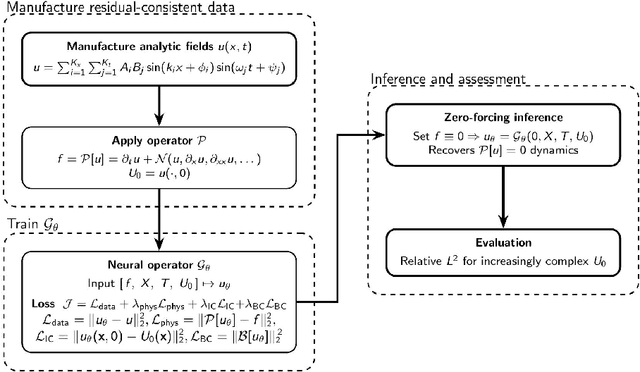
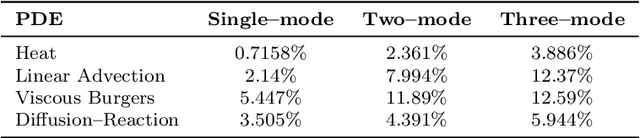
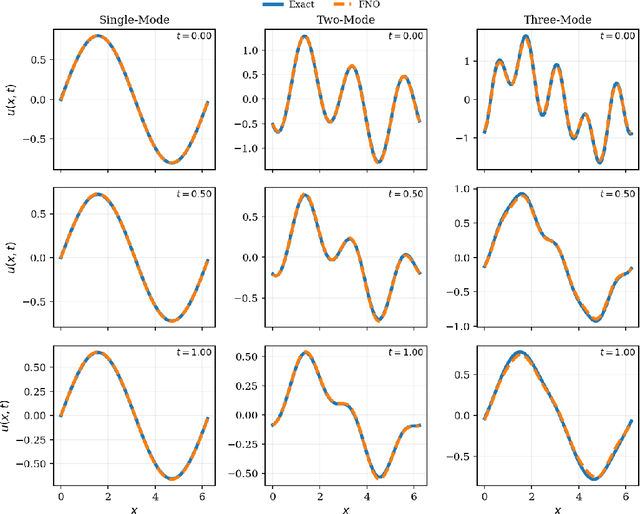
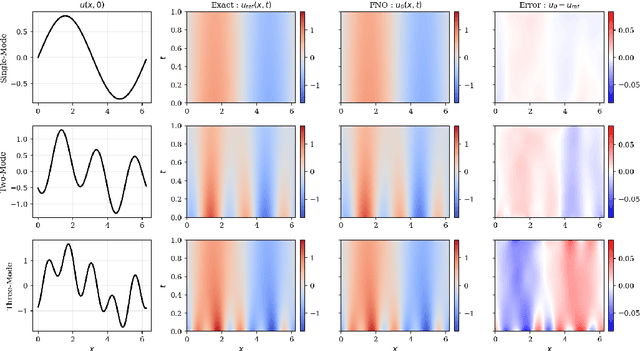
Training neural operators to approximate mappings between infinite-dimensional function spaces often requires extensive datasets generated by either demanding experimental setups or computationally expensive numerical solvers. This dependence on solver-based data limits scalability and constrains exploration across physical systems. Here we introduce the Method of Manufactured Learning (MML), a solver-independent framework for training neural operators using analytically constructed, physics-consistent datasets. Inspired by the classical method of manufactured solutions, MML replaces numerical data generation with functional synthesis, i.e., smooth candidate solutions are sampled from controlled analytical spaces, and the corresponding forcing fields are derived by direct application of the governing differential operators. During inference, setting these forcing terms to zero restores the original governing equations, allowing the trained neural operator to emulate the true solution operator of the system. The framework is agnostic to network architecture and can be integrated with any operator learning paradigm. In this paper, we employ Fourier neural operator as a representative example. Across canonical benchmarks including heat, advection, Burgers, and diffusion-reaction equations. MML achieves high spectral accuracy, low residual errors, and strong generalization to unseen conditions. By reframing data generation as a process of analytical synthesis, MML offers a scalable, solver-agnostic pathway toward constructing physically grounded neural operators that retain fidelity to governing laws without reliance on expensive numerical simulations or costly experimental data for training.
FEDONet : Fourier-Embedded DeepONet for Spectrally Accurate Operator Learning
Sep 15, 2025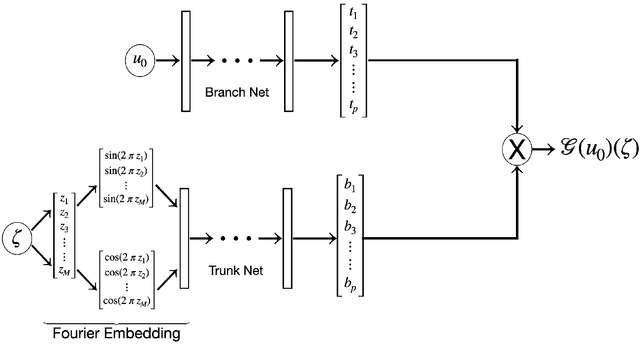

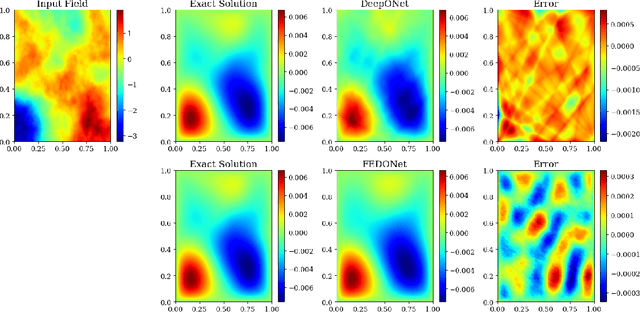

Deep Operator Networks (DeepONets) have recently emerged as powerful data-driven frameworks for learning nonlinear operators, particularly suited for approximating solutions to partial differential equations (PDEs). Despite their promising capabilities, the standard implementation of DeepONets, which typically employs fully connected linear layers in the trunk network, can encounter limitations in capturing complex spatial structures inherent to various PDEs. To address this, we introduce Fourier-embedded trunk networks within the DeepONet architecture, leveraging random Fourier feature mappings to enrich spatial representation capabilities. Our proposed Fourier-embedded DeepONet, FEDONet demonstrates superior performance compared to the traditional DeepONet across a comprehensive suite of PDE-driven datasets, including the two-dimensional Poisson equation, Burgers' equation, the Lorenz-63 chaotic system, Eikonal equation, Allen-Cahn equation, Kuramoto-Sivashinsky equation, and the Lorenz-96 system. Empirical evaluations of FEDONet consistently show significant improvements in solution reconstruction accuracy, with average relative L2 performance gains ranging between 2-3x compared to the DeepONet baseline. This study highlights the effectiveness of Fourier embeddings in enhancing neural operator learning, offering a robust and broadly applicable methodology for PDE surrogate modeling.
Machine Learning for enhancing Wind Field Resolution in Complex Terrain
Sep 18, 2023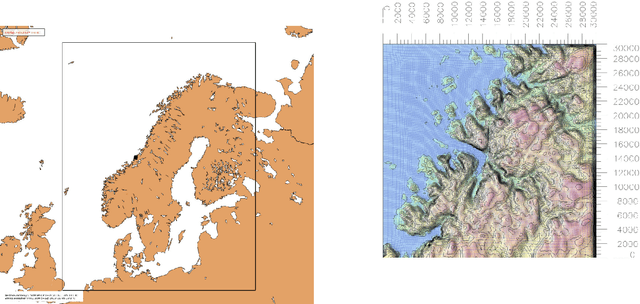
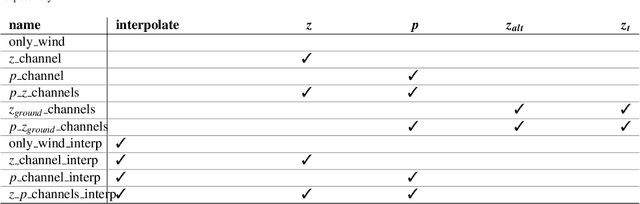
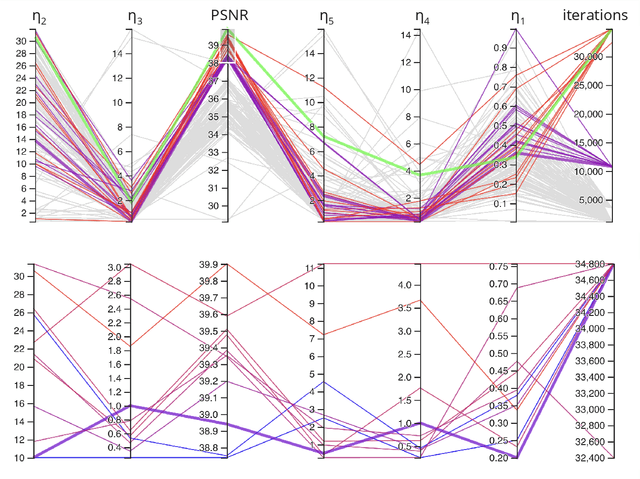
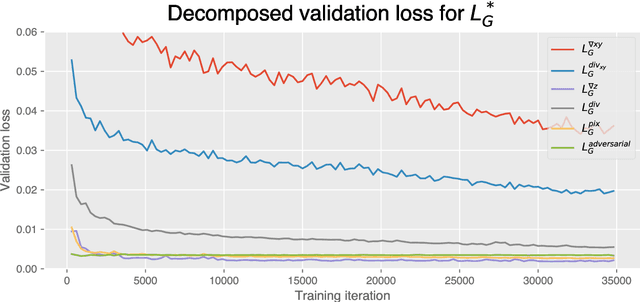
Atmospheric flows are governed by a broad variety of spatio-temporal scales, thus making real-time numerical modeling of such turbulent flows in complex terrain at high resolution computationally intractable. In this study, we demonstrate a neural network approach motivated by Enhanced Super-Resolution Generative Adversarial Networks to upscale low-resolution wind fields to generate high-resolution wind fields in an actual wind farm in Bessaker, Norway. The neural network-based model is shown to successfully reconstruct fully resolved 3D velocity fields from a coarser scale while respecting the local terrain and that it easily outperforms trilinear interpolation. We also demonstrate that by using appropriate cost function based on domain knowledge, we can alleviate the use of adversarial training.
SuperBench: A Super-Resolution Benchmark Dataset for Scientific Machine Learning
Jun 24, 2023
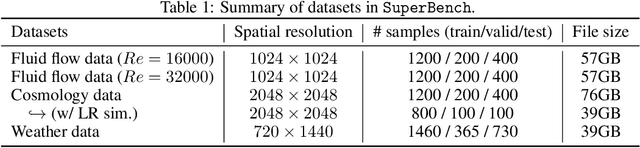

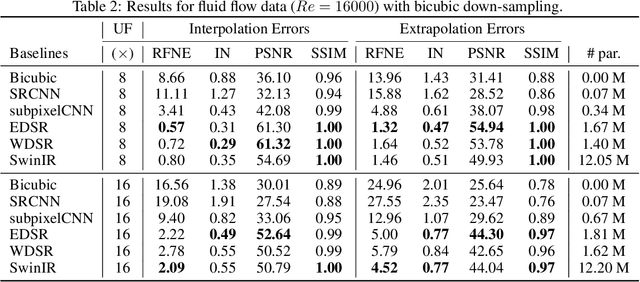
Super-Resolution (SR) techniques aim to enhance data resolution, enabling the retrieval of finer details, and improving the overall quality and fidelity of the data representation. There is growing interest in applying SR methods to complex spatiotemporal systems within the Scientific Machine Learning (SciML) community, with the hope of accelerating numerical simulations and/or improving forecasts in weather, climate, and related areas. However, the lack of standardized benchmark datasets for comparing and validating SR methods hinders progress and adoption in SciML. To address this, we introduce SuperBench, the first benchmark dataset featuring high-resolution datasets (up to $2048\times2048$ dimensions), including data from fluid flows, cosmology, and weather. Here, we focus on validating spatial SR performance from data-centric and physics-preserved perspectives, as well as assessing robustness to data degradation tasks. While deep learning-based SR methods (developed in the computer vision community) excel on certain tasks, despite relatively limited prior physics information, we identify limitations of these methods in accurately capturing intricate fine-scale features and preserving fundamental physical properties and constraints in scientific data. These shortcomings highlight the importance and subtlety of incorporating domain knowledge into ML models. We anticipate that SuperBench will significantly advance SR methods for scientific tasks.