 Add to Chrome
 Add to Firefox
 Add to Edge
WLNO: Wavelet-Laplace Neural Operator for Solving Partial Differential Equations
May 23, 2026
This work introduces the Wavelet-Laplace Neural Operator (WLNO), a novel neural operator that fuses Haar wavelet multi-scale spatial decomposition with the Laplace-domain pole-residue formulation of the Laplace Neural Operator (LNO). While LNO captures transient and steady-state dynamics through learnable system poles and residues, it lacks an explicit mechanism for extracting spatially localized multi-scale features inherent in complex PDE solutions. WLNO addresses this by augmenting the LNO core with a parallel single-level Haar discrete wavelet transform (DWT) branch that decomposes the lifted feature map into four frequency subbands: approximation (LL), horizontal detail (LH), vertical detail (HL), and diagonal detail (HH) and applies independent learned $1\times1$ convolutions to each subband before reconstruction via the inverse DWT. The two branches are fused through a learnable sigmoid-gated weight $α_\mathrm{wav}$, initialized to give a small initial contribution to the wavelet branch, allowing the model to adaptively balance Laplace-domain dynamics against spatial multi-scale features throughout training. WLNO is evaluated against LNO on five benchmark PDE problems using identical hyperparameters, training data, and evaluation protocols: the diffusion equation, the Burgers equation, the reaction-diffusion system, Darcy flow, and the two-dimensional Navier-Stokes equation. WLNO consistently outperforms LNO on all five problems, with the most pronounced improvement on problems with strong spatial multi-scale structure, such as the Burgers equation with sharp shock fronts and the Navier-Stokes equation with coherent vortical structures, while remaining consistent across smoother and elliptic problems. These results demonstrate that wavelet-based multi-scale spatial decomposition is a principled and effective complement to Laplace-domain operator learning.

The impact of observation density on Bayesian inversion of latent dynamics in shock-dominated flows
May 18, 2026Inferring unknown initial states in shock-dominated compressible flows from sparse and noisy measurements is a challenging ill-posed inverse problem due to nonlinear wave interactions and limited sensing. In this work, we develop a non-intrusive reduced-order modeling framework for efficient Bayesian initial-state inversion with uncertainty quantification. The framework combines a convolutional autoencoder with a learned latent-space forward operator. The autoencoder compresses high-dimensional flow fields into a compact nonlinear latent representation, while the forward operator predicts final-time latent states from encoded initial conditions. This AE-ROM surrogate enables rapid forward evaluations and is embedded within a No-U-Turn Sampler (NUTS) for posterior exploration. The framework is demonstrated using 500 high-fidelity Sod shock tube simulations generated through Latin hypercube sampling and solved using a fifth-order WENO scheme. The inverse problem seeks to recover unknown left and right density and pressure states from sparse noisy observations of final-time density and pressure fields. Results show that the AE-ROM accurately reconstructs key shock-tube structures, including the rarefaction wave, contact discontinuity, and shock front. A latent dimension of 32 provides an effective balance between reconstruction accuracy and reduced-space compactness, while 250 training simulations are sufficient for accurate reconstruction. Increasing observation density significantly contracts posterior uncertainty, reducing the mean posterior standard deviation by approximately 78% for density and 76% for pressure. Overall, the proposed framework provides a computationally efficient and uncertainty-aware approach for inverse analysis of shock-dominated flows, with potential extensions to multidimensional compressible-flow and digital-twin applications.
SIMR-NO: A Spectrally-Informed Multi-Resolution Neural Operator for Turbulent Flow Super-Resolution
Mar 30, 2026Reconstructing high-resolution turbulent flow fields from severely under-resolved observations is a fundamental inverse problem in computational fluid dynamics and scientific machine learning. Classical interpolation methods fail to recover missing fine-scale structures, while existing deep learning approaches rely on convolutional architectures that lack the spectral and multiscale inductive biases necessary for physically faithful reconstruction at large upscaling factors. We introduce the Spectrally-Informed Multi-Resolution Neural Operator (SIMR-NO), a hierarchical operator learning framework that factorizes the ill-posed inverse mapping across intermediate spatial resolutions, combines deterministic interpolation priors with spectrally gated Fourier residual corrections at each stage, and incorporates local refinement modules to recover fine-scale spatial features beyond the truncated Fourier basis. The proposed method is evaluated on Kolmogorov-forced two-dimensional turbulence, where $128\times128$ vorticity fields are reconstructed from extremely coarse $8\times8$ observations representing a $16\times$ downsampling factor. Across 201 independent test realizations, SIMR-NO achieves a mean relative $\ell_2$ error of $26.04\%$ with the lowest error variance among all methods, reducing reconstruction error by $31.7\%$ over FNO, $26.0\%$ over EDSR, and $9.3\%$ over LapSRN. Beyond pointwise accuracy, SIMR-NO is the only method that faithfully reproduces the ground-truth energy and enstrophy spectra across the full resolved wavenumber range, demonstrating physically consistent super-resolution of turbulent flow fields.
Neuro-Symbolic Control with Large Language Models for Language-Guided Spatial Tasks
Dec 19, 2025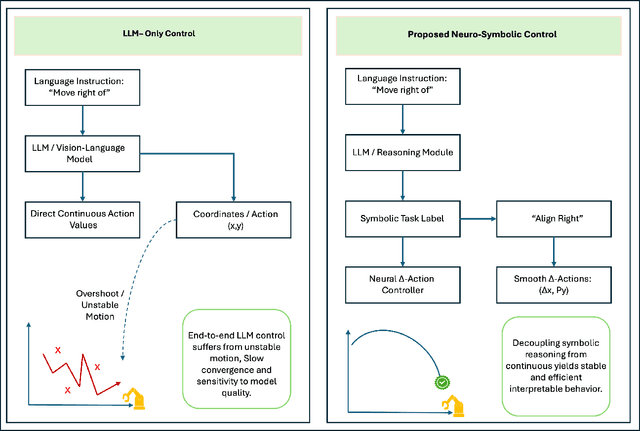
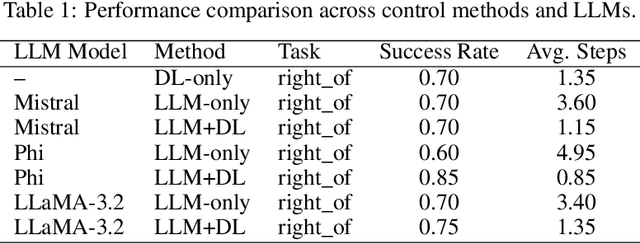
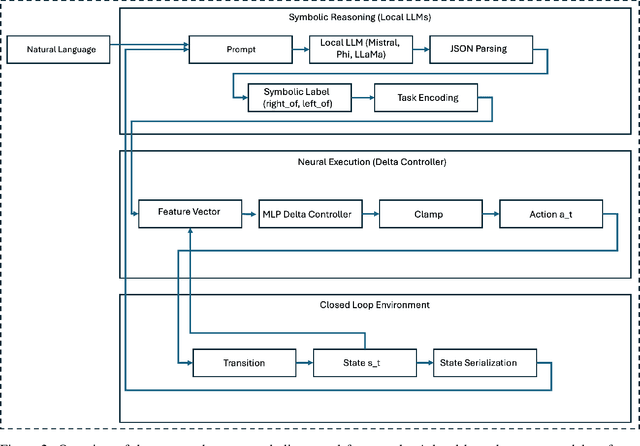
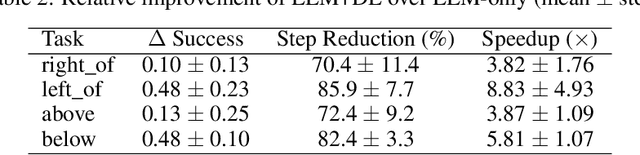
Although large language models (LLMs) have recently become effective tools for language-conditioned control in embodied systems, instability, slow convergence, and hallucinated actions continue to limit their direct application to continuous control. A modular neuro-symbolic control framework that clearly distinguishes between low-level motion execution and high-level semantic reasoning is proposed in this work. While a lightweight neural delta controller performs bounded, incremental actions in continuous space, a locally deployed LLM interprets symbolic tasks. We assess the suggested method in a planar manipulation setting with spatial relations between objects specified by language. Numerous tasks and local language models, such as Mistral, Phi, and LLaMA-3.2, are used in extensive experiments to compare LLM-only control, neural-only control, and the suggested LLM+DL framework. In comparison to LLM-only baselines, the results show that the neuro-symbolic integration consistently increases both success rate and efficiency, achieving average step reductions exceeding 70% and speedups of up to 8.83x while remaining robust to language model quality. The suggested framework enhances interpretability, stability, and generalization without any need of reinforcement learning or costly rollouts by controlling the LLM to symbolic outputs and allocating uninterpreted execution to a neural controller trained on artificial geometric data. These outputs show empirically that neuro-symbolic decomposition offers a scalable and principled way to integrate language understanding with ongoing control, this approach promotes the creation of dependable and effective language-guided embodied systems.
Spectral Embedding via Chebyshev Bases for Robust DeepONet Approximation
Dec 09, 2025Deep Operator Networks (DeepONets) have become a central tool in data-driven operator learning, providing flexible surrogates for nonlinear mappings arising in partial differential equations (PDEs). However, the standard trunk design based on fully connected layers acting on raw spatial or spatiotemporal coordinates struggles to represent sharp gradients, boundary layers, and non-periodic structures commonly found in PDEs posed on bounded domains with Dirichlet or Neumann boundary conditions. To address these limitations, we introduce the Spectral-Embedded DeepONet (SEDONet), a new DeepONet variant in which the trunk is driven by a fixed Chebyshev spectral dictionary rather than coordinate inputs. This non-periodic spectral embedding provides a principled inductive bias tailored to bounded domains, enabling the learned operator to capture fine-scale non-periodic features that are difficult for Fourier or MLP trunks to represent. SEDONet is evaluated on a suite of PDE benchmarks including 2D Poisson, 1D Burgers, 1D advection-diffusion, Allen-Cahn dynamics, and the Lorenz-96 chaotic system, covering elliptic, parabolic, advective, and multiscale temporal phenomena, all of which can be viewed as canonical problems in computational mechanics. Across all datasets, SEDONet consistently achieves the lowest relative L2 errors among DeepONet, FEDONet, and SEDONet, with average improvements of about 30-40% over the baseline DeepONet and meaningful gains over Fourier-embedded variants on non-periodic geometries. Spectral analyses further show that SEDONet more accurately preserves high-frequency and boundary-localized features, demonstrating the value of Chebyshev embeddings in non-periodic operator learning. The proposed architecture offers a simple, parameter-neutral modification to DeepONets, delivering a robust and efficient spectral framework for surrogate modeling of PDEs on bounded domains.