 Add to Chrome
 Add to Firefox
 Add to Edge
Iterative Refinement Diffusion for Super-Resolved Data Assimilation of Multiscale Physical Systems
Aug 13, 2026
Recovering high-resolution states from sparse, low-resolution observations is a central challenge in scientific machine learning and data assimilation. Classical data assimilation exploits temporal information through forecast-analysis cycles, but often requires repeated access to expensive high-resolution forecast models. Generative super-resolution can recover unresolved structure from coarse observations, but is commonly used as a one-shot mapping that does not fully exploit constraints from past states. We introduce Iterative Refinement (IR), a learned data assimilation framework that combines these perspectives. Instead of performing a single coarse-to-fine reconstruction, IR decomposes the task into resolution-wise forecast-analysis operations across a multiresolution hierarchy. At each stage, a shared neural operator with resolution-dependent spectral mode slicing provides a dynamical prior, while a shared conditional diffusion corrector uses the current coarser-resolution state to produce a refined posterior at the next finer resolution. We evaluate IR on one-dimensional stochastically forced Burgers dynamics and two-dimensional Kraichnan turbulence. On the challenging 256x256 Kraichnan benchmark, IR achieves an RMSE of 0.184 and an SSIM of 0.836, outperforming spectral upsampling, one-shot diffusion super-resolution, enhanced deep super-resolution, and an autoregressive forecaster. On the more constrained Burgers testbed, IR remains competitive with one-shot diffusion, which achieves the lowest RMSE. These results show that one-shot generative reconstruction can be effective for simpler settings, while hierarchical forecast-analysis refinement becomes advantageous in strongly multiscale and underdetermined regimes. Overall, IR combines temporal priors, generative correction, and multiresolution reconstruction for learned data assimilation in complex physical systems.

Stabilizing autoregressive forecasts in chaotic systems via multi-rate latent recurrence
Jan 20, 2026Long-horizon autoregressive forecasting of chaotic dynamical systems remains challenging due to rapid error amplification and distribution shift: small one-step inaccuracies compound into physically inconsistent rollouts and collapse of large-scale statistics. We introduce MSR-HINE, a hierarchical implicit forecaster that augments multiscale latent priors with multi-rate recurrent modules operating at distinct temporal scales. At each step, coarse-to-fine recurrent states generate latent priors, an implicit one-step predictor refines the state with multiscale latent injections, and a gated fusion with posterior latents enforces scale-consistent updates; a lightweight hidden-state correction further aligns recurrent memories with fused latents. The resulting architecture maintains long-term context on slow manifolds while preserving fast-scale variability, mitigating error accumulation in chaotic rollouts. Across two canonical benchmarks, MSR-HINE yields substantial gains over a U-Net autoregressive baseline: on Kuramoto-Sivashinsky it reduces end-horizon RMSE by 62.8% at H=400 and improves end-horizon ACC by +0.983 (from -0.155 to 0.828), extending the ACC >= 0.5 predictability horizon from 241 to 400 steps; on Lorenz-96 it reduces RMSE by 27.0% at H=100 and improves end horizon ACC by +0.402 (from 0.144 to 0.545), extending the ACC >= 0.5 horizon from 58 to 100 steps.
FEDONet : Fourier-Embedded DeepONet for Spectrally Accurate Operator Learning
Sep 15, 2025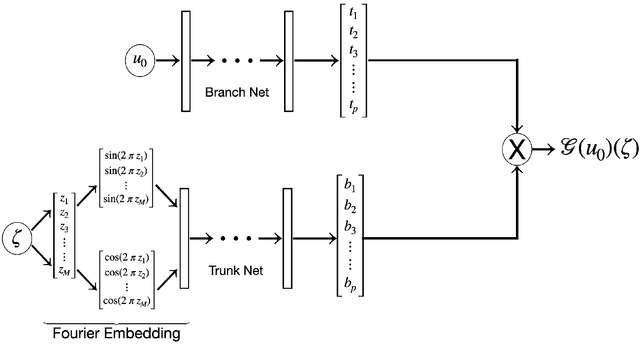

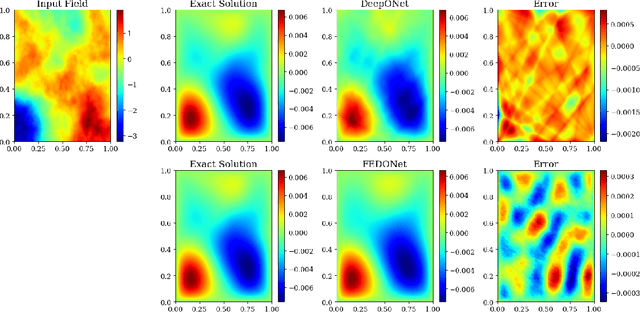

Deep Operator Networks (DeepONets) have recently emerged as powerful data-driven frameworks for learning nonlinear operators, particularly suited for approximating solutions to partial differential equations (PDEs). Despite their promising capabilities, the standard implementation of DeepONets, which typically employs fully connected linear layers in the trunk network, can encounter limitations in capturing complex spatial structures inherent to various PDEs. To address this, we introduce Fourier-embedded trunk networks within the DeepONet architecture, leveraging random Fourier feature mappings to enrich spatial representation capabilities. Our proposed Fourier-embedded DeepONet, FEDONet demonstrates superior performance compared to the traditional DeepONet across a comprehensive suite of PDE-driven datasets, including the two-dimensional Poisson equation, Burgers' equation, the Lorenz-63 chaotic system, Eikonal equation, Allen-Cahn equation, Kuramoto-Sivashinsky equation, and the Lorenz-96 system. Empirical evaluations of FEDONet consistently show significant improvements in solution reconstruction accuracy, with average relative L2 performance gains ranging between 2-3x compared to the DeepONet baseline. This study highlights the effectiveness of Fourier embeddings in enhancing neural operator learning, offering a robust and broadly applicable methodology for PDE surrogate modeling.