 Add to Chrome
 Add to Firefox
 Add to Edge
WLNO: Wavelet-Laplace Neural Operator for Solving Partial Differential Equations
May 23, 2026
This work introduces the Wavelet-Laplace Neural Operator (WLNO), a novel neural operator that fuses Haar wavelet multi-scale spatial decomposition with the Laplace-domain pole-residue formulation of the Laplace Neural Operator (LNO). While LNO captures transient and steady-state dynamics through learnable system poles and residues, it lacks an explicit mechanism for extracting spatially localized multi-scale features inherent in complex PDE solutions. WLNO addresses this by augmenting the LNO core with a parallel single-level Haar discrete wavelet transform (DWT) branch that decomposes the lifted feature map into four frequency subbands: approximation (LL), horizontal detail (LH), vertical detail (HL), and diagonal detail (HH) and applies independent learned $1\times1$ convolutions to each subband before reconstruction via the inverse DWT. The two branches are fused through a learnable sigmoid-gated weight $α_\mathrm{wav}$, initialized to give a small initial contribution to the wavelet branch, allowing the model to adaptively balance Laplace-domain dynamics against spatial multi-scale features throughout training. WLNO is evaluated against LNO on five benchmark PDE problems using identical hyperparameters, training data, and evaluation protocols: the diffusion equation, the Burgers equation, the reaction-diffusion system, Darcy flow, and the two-dimensional Navier-Stokes equation. WLNO consistently outperforms LNO on all five problems, with the most pronounced improvement on problems with strong spatial multi-scale structure, such as the Burgers equation with sharp shock fronts and the Navier-Stokes equation with coherent vortical structures, while remaining consistent across smoother and elliptic problems. These results demonstrate that wavelet-based multi-scale spatial decomposition is a principled and effective complement to Laplace-domain operator learning.

Method of Manufactured Learning for Solver-free Training of Neural Operators
Nov 17, 2025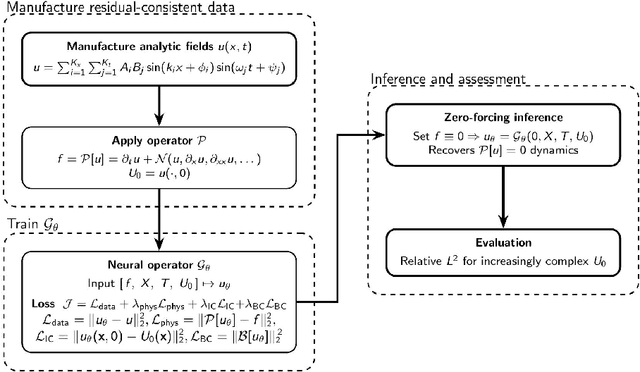
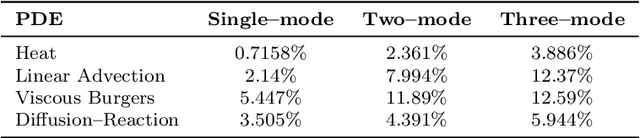
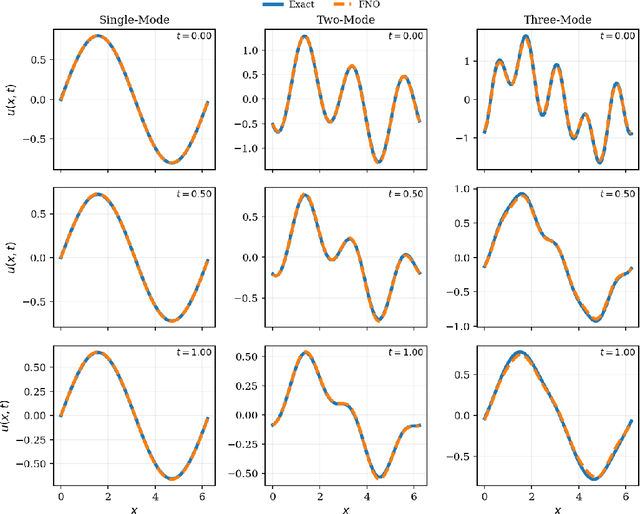
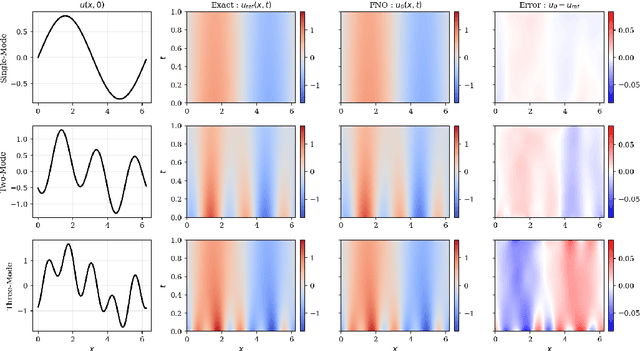
Training neural operators to approximate mappings between infinite-dimensional function spaces often requires extensive datasets generated by either demanding experimental setups or computationally expensive numerical solvers. This dependence on solver-based data limits scalability and constrains exploration across physical systems. Here we introduce the Method of Manufactured Learning (MML), a solver-independent framework for training neural operators using analytically constructed, physics-consistent datasets. Inspired by the classical method of manufactured solutions, MML replaces numerical data generation with functional synthesis, i.e., smooth candidate solutions are sampled from controlled analytical spaces, and the corresponding forcing fields are derived by direct application of the governing differential operators. During inference, setting these forcing terms to zero restores the original governing equations, allowing the trained neural operator to emulate the true solution operator of the system. The framework is agnostic to network architecture and can be integrated with any operator learning paradigm. In this paper, we employ Fourier neural operator as a representative example. Across canonical benchmarks including heat, advection, Burgers, and diffusion-reaction equations. MML achieves high spectral accuracy, low residual errors, and strong generalization to unseen conditions. By reframing data generation as a process of analytical synthesis, MML offers a scalable, solver-agnostic pathway toward constructing physically grounded neural operators that retain fidelity to governing laws without reliance on expensive numerical simulations or costly experimental data for training.
FEDONet : Fourier-Embedded DeepONet for Spectrally Accurate Operator Learning
Sep 15, 2025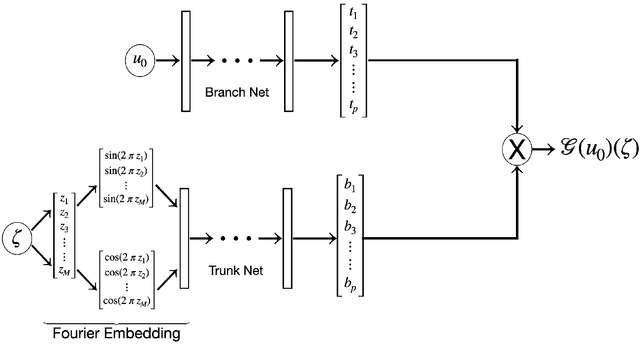

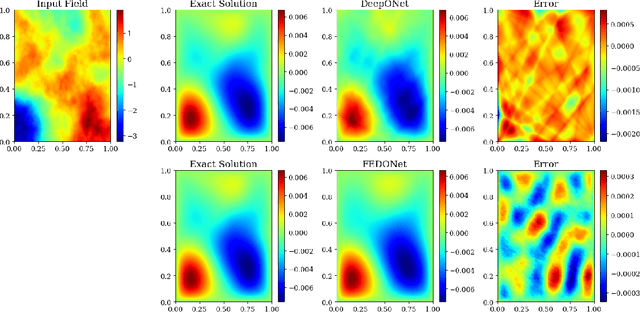

Deep Operator Networks (DeepONets) have recently emerged as powerful data-driven frameworks for learning nonlinear operators, particularly suited for approximating solutions to partial differential equations (PDEs). Despite their promising capabilities, the standard implementation of DeepONets, which typically employs fully connected linear layers in the trunk network, can encounter limitations in capturing complex spatial structures inherent to various PDEs. To address this, we introduce Fourier-embedded trunk networks within the DeepONet architecture, leveraging random Fourier feature mappings to enrich spatial representation capabilities. Our proposed Fourier-embedded DeepONet, FEDONet demonstrates superior performance compared to the traditional DeepONet across a comprehensive suite of PDE-driven datasets, including the two-dimensional Poisson equation, Burgers' equation, the Lorenz-63 chaotic system, Eikonal equation, Allen-Cahn equation, Kuramoto-Sivashinsky equation, and the Lorenz-96 system. Empirical evaluations of FEDONet consistently show significant improvements in solution reconstruction accuracy, with average relative L2 performance gains ranging between 2-3x compared to the DeepONet baseline. This study highlights the effectiveness of Fourier embeddings in enhancing neural operator learning, offering a robust and broadly applicable methodology for PDE surrogate modeling.