 Add to Chrome
 Add to Firefox
 Add to Edge
Querying Counterfactuals on Tissue Graphs with Supervised Disentanglement
Jun 07, 2026
\textit{Tissue graph counterfactuals} ask how a cell's expression would change under altered spatial neighbor contexts. Such queries are central to predicting cell behavior in tissues, but lack a unified definition, with existing methods targeting specific intervention types or treating cells as i.i.d. In this work, we first formalize \textit{tissue graph counterfactuals} as a class of spatial interventions that either rewire connections between cells (\textit{edge perturbation}) or modify the expression of their neighbors (\textit{node perturbation}). We then introduce \textit{Cellina} {\renewcommand{\thefootnote}‡\footnote{https://cellina.readthedocs.io}\addtocounter{footnote}{-1}}, a framework that uses supervised disentanglement to decompose a cell's intrinsic state from its spatial context, using the latter as a conditioning input for counterfactual predictions. Across benchmarks spanning over 2.5 million spatially-resolved cells in colorectal cancer and mouse brain, \textit{Cellina} outperforms spatially-informed and non-spatial competitors in tissue perturbations, disentanglement, and scalability. Additionally, we show that \textit{Cellina} reveals biologically distinct cancer subdomains in an unsupervised manner and enables targeted neighbor perturbation simulations.

Detecting low-complexity unobserved causes
Feb 14, 2012
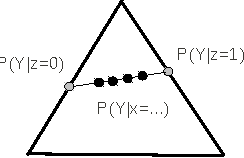
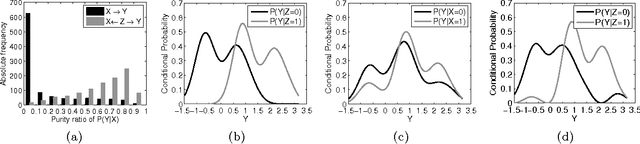
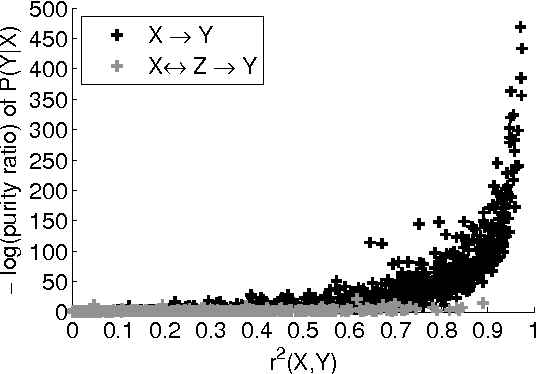
We describe a method that infers whether statistical dependences between two observed variables X and Y are due to a "direct" causal link or only due to a connecting causal path that contains an unobserved variable of low complexity, e.g., a binary variable. This problem is motivated by statistical genetics. Given a genetic marker that is correlated with a phenotype of interest, we want to detect whether this marker is causal or it only correlates with a causal one. Our method is based on the analysis of the location of the conditional distributions P(Y|x) in the simplex of all distributions of Y. We report encouraging results on semi-empirical data.