 Add to Chrome
 Add to Firefox
 Add to Edge
Querying Counterfactuals on Tissue Graphs with Supervised Disentanglement
Jun 07, 2026
\textit{Tissue graph counterfactuals} ask how a cell's expression would change under altered spatial neighbor contexts. Such queries are central to predicting cell behavior in tissues, but lack a unified definition, with existing methods targeting specific intervention types or treating cells as i.i.d. In this work, we first formalize \textit{tissue graph counterfactuals} as a class of spatial interventions that either rewire connections between cells (\textit{edge perturbation}) or modify the expression of their neighbors (\textit{node perturbation}). We then introduce \textit{Cellina} {\renewcommand{\thefootnote}‡\footnote{https://cellina.readthedocs.io}\addtocounter{footnote}{-1}}, a framework that uses supervised disentanglement to decompose a cell's intrinsic state from its spatial context, using the latter as a conditioning input for counterfactual predictions. Across benchmarks spanning over 2.5 million spatially-resolved cells in colorectal cancer and mouse brain, \textit{Cellina} outperforms spatially-informed and non-spatial competitors in tissue perturbations, disentanglement, and scalability. Additionally, we show that \textit{Cellina} reveals biologically distinct cancer subdomains in an unsupervised manner and enables targeted neighbor perturbation simulations.

Towards Context-Aware Domain Generalization: Representing Environments with Permutation-Invariant Networks
Dec 15, 2023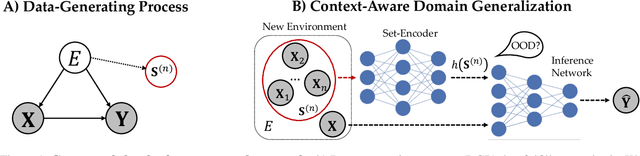
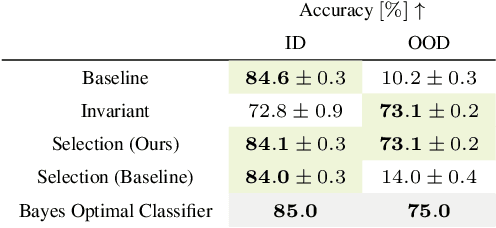
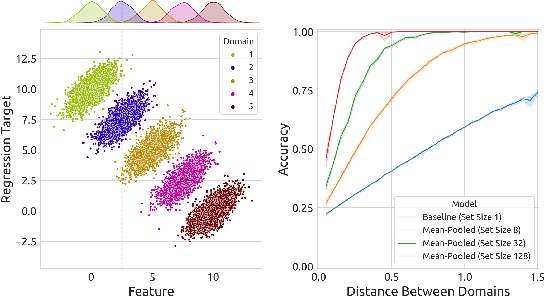
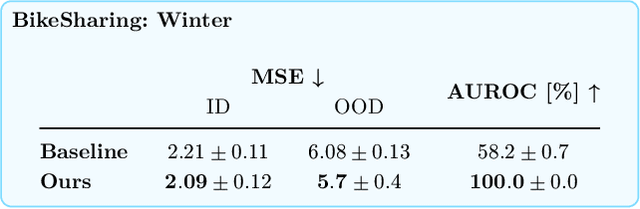
In this work, we show that information about the context of an input $X$ can improve the predictions of deep learning models when applied in new domains or production environments. We formalize the notion of context as a permutation-invariant representation of a set of data points that originate from the same environment/domain as the input itself. These representations are jointly learned with a standard supervised learning objective, providing incremental information about the unknown outcome. Furthermore, we offer a theoretical analysis of the conditions under which our approach can, in principle, yield benefits, and formulate two necessary criteria that can be easily verified in practice. Additionally, we contribute insights into the kind of distribution shifts for which our approach promises robustness. Our empirical evaluation demonstrates the effectiveness of our approach for both low-dimensional and high-dimensional data sets. Finally, we demonstrate that we can reliably detect scenarios where a model is tasked with unwarranted extrapolation in out-of-distribution (OOD) domains, identifying potential failure cases. Consequently, we showcase a method to select between the most predictive and the most robust model, circumventing the well-known trade-off between predictive performance and robustness.