 Add to Chrome
 Add to Firefox
 Add to Edge
Querying Counterfactuals on Tissue Graphs with Supervised Disentanglement
Jun 07, 2026
\textit{Tissue graph counterfactuals} ask how a cell's expression would change under altered spatial neighbor contexts. Such queries are central to predicting cell behavior in tissues, but lack a unified definition, with existing methods targeting specific intervention types or treating cells as i.i.d. In this work, we first formalize \textit{tissue graph counterfactuals} as a class of spatial interventions that either rewire connections between cells (\textit{edge perturbation}) or modify the expression of their neighbors (\textit{node perturbation}). We then introduce \textit{Cellina} {\renewcommand{\thefootnote}‡\footnote{https://cellina.readthedocs.io}\addtocounter{footnote}{-1}}, a framework that uses supervised disentanglement to decompose a cell's intrinsic state from its spatial context, using the latter as a conditioning input for counterfactual predictions. Across benchmarks spanning over 2.5 million spatially-resolved cells in colorectal cancer and mouse brain, \textit{Cellina} outperforms spatially-informed and non-spatial competitors in tissue perturbations, disentanglement, and scalability. Additionally, we show that \textit{Cellina} reveals biologically distinct cancer subdomains in an unsupervised manner and enables targeted neighbor perturbation simulations.

A Markerless Deep Learning-based 6 Degrees of Freedom PoseEstimation for with Mobile Robots using RGB Data
Jan 16, 2020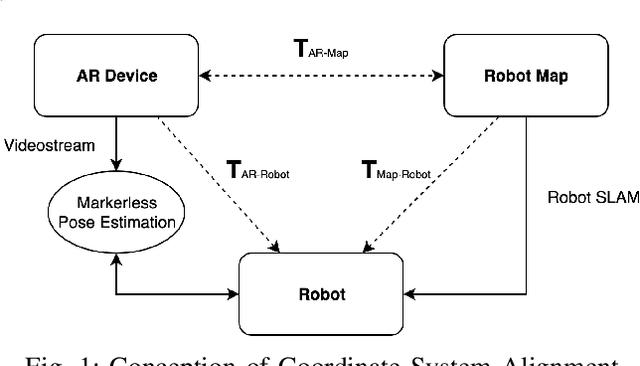
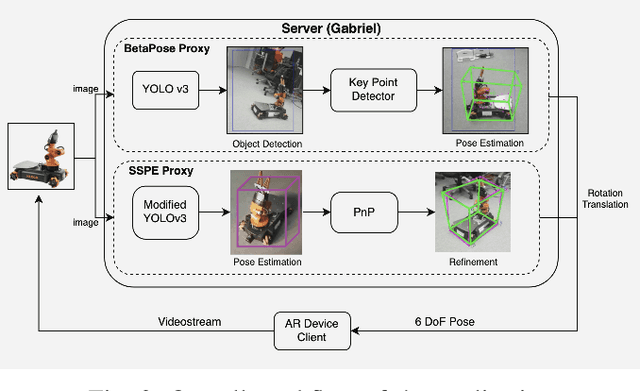
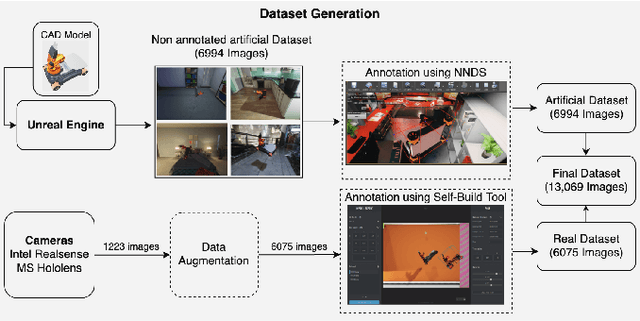
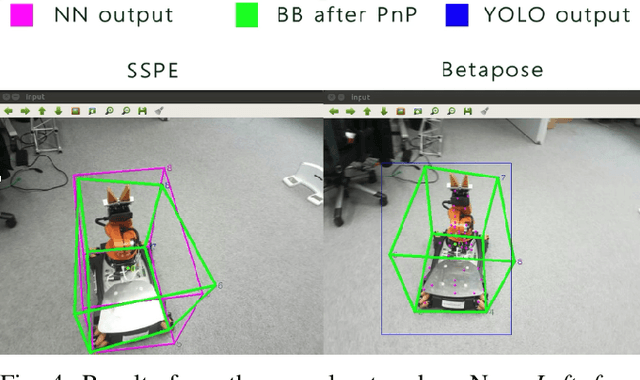
Augmented Reality has been subject to various integration efforts within industries due to its ability to enhance human machine interaction and understanding. Neural networks have achieved remarkable results in areas of computer vision, which bear great potential to assist and facilitate an enhanced Augmented Reality experience. However, most neural networks are computationally intensive and demand huge processing power thus, are not suitable for deployment on Augmented Reality devices. In this work we propose a method to deploy state of the art neural networks for real time 3D object localization on augmented reality devices. As a result, we provide a more automated method of calibrating the AR devices with mobile robotic systems. To accelerate the calibration process and enhance user experience, we focus on fast 2D detection approaches which are extracting the 3D pose of the object fast and accurately by using only 2D input. The results are implemented into an Augmented Reality application for intuitive robot control and sensor data visualization. For the 6D annotation of 2D images, we developed an annotation tool, which is, to our knowledge, the first open source tool to be available. We achieve feasible results which are generally applicable to any AR device thus making this work promising for further research in combining high demanding neural networks with Internet of Things devices.