 Add to Chrome
 Add to Firefox
 Add to Edge
T-STAR: A Context-Aware Transformer Framework for Short-Term Probabilistic Demand Forecasting in Dock-Based Shared Micro-Mobility
Feb 06, 2026
Reliable short-term demand forecasting is essential for managing shared micro-mobility services and ensuring responsive, user-centered operations. This study introduces T-STAR (Two-stage Spatial and Temporal Adaptive contextual Representation), a novel transformer-based probabilistic framework designed to forecast station-level bike-sharing demand at a 15-minute resolution. T-STAR addresses key challenges in high-resolution forecasting by disentangling consistent demand patterns from short-term fluctuations through a hierarchical two-stage structure. The first stage captures coarse-grained hourly demand patterns, while the second stage improves prediction accuracy by incorporating high-frequency, localized inputs, including recent fluctuations and real-time demand variations in connected metro services, to account for temporal shifts in short-term demand. Time series transformer models are employed in both stages to generate probabilistic predictions. Extensive experiments using Washington D.C.'s Capital Bikeshare data demonstrate that T-STAR outperforms existing methods in both deterministic and probabilistic accuracy. The model exhibits strong spatial and temporal robustness across stations and time periods. A zero-shot forecasting experiment further highlights T-STAR's ability to transfer to previously unseen service areas without retraining. These results underscore the framework's potential to deliver granular, reliable, and uncertainty-aware short-term demand forecasts, which enable seamless integration to support multimodal trip planning for travelers and enhance real-time operations in shared micro-mobility services.

Timing the Match: A Deep Reinforcement Learning Approach for Ride-Hailing and Ride-Pooling Services
Mar 17, 2025Efficient timing in ride-matching is crucial for improving the performance of ride-hailing and ride-pooling services, as it determines the number of drivers and passengers considered in each matching process. Traditional batched matching methods often use fixed time intervals to accumulate ride requests before assigning matches. While this approach increases the number of available drivers and passengers for matching, it fails to adapt to real-time supply-demand fluctuations, often leading to longer passenger wait times and driver idle periods. To address this limitation, we propose an adaptive ride-matching strategy using deep reinforcement learning (RL) to dynamically determine when to perform matches based on real-time system conditions. Unlike fixed-interval approaches, our method continuously evaluates system states and executes matching at moments that minimize total passenger wait time. Additionally, we incorporate a potential-based reward shaping (PBRS) mechanism to mitigate sparse rewards, accelerating RL training and improving decision quality. Extensive empirical evaluations using a realistic simulator trained on real-world data demonstrate that our approach outperforms fixed-interval matching strategies, significantly reducing passenger waiting times and detour delays, thereby enhancing the overall efficiency of ride-hailing and ride-pooling systems.
Day-to-day and seasonal regularity of network passenger delay for metro networks
Jul 07, 2021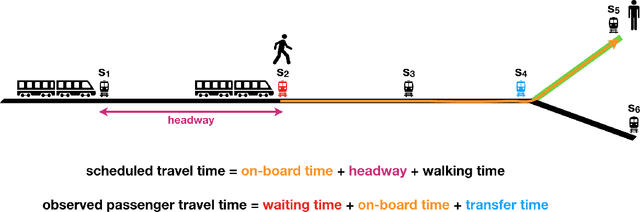
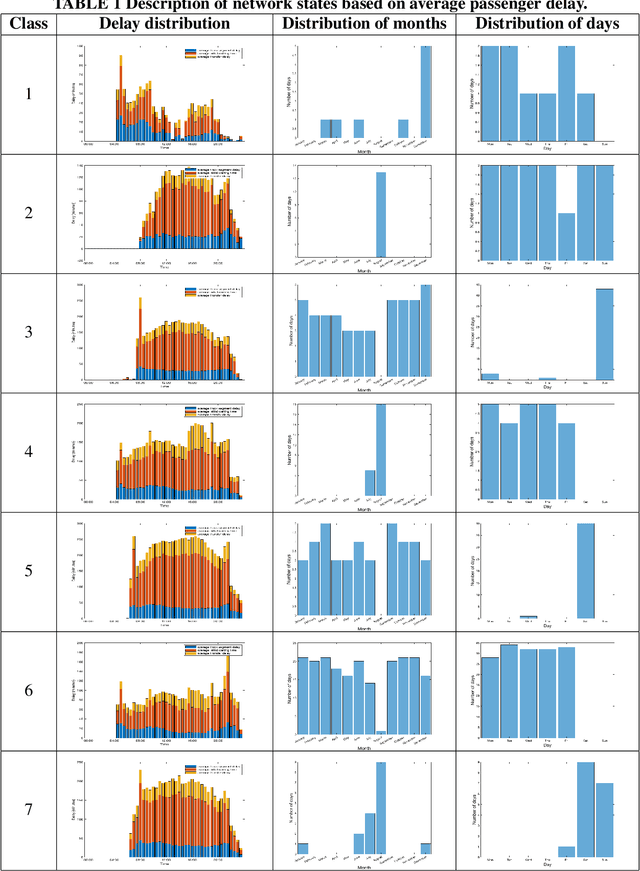
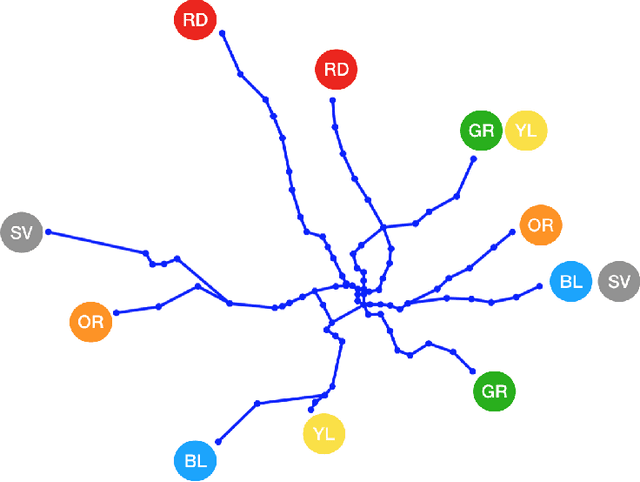
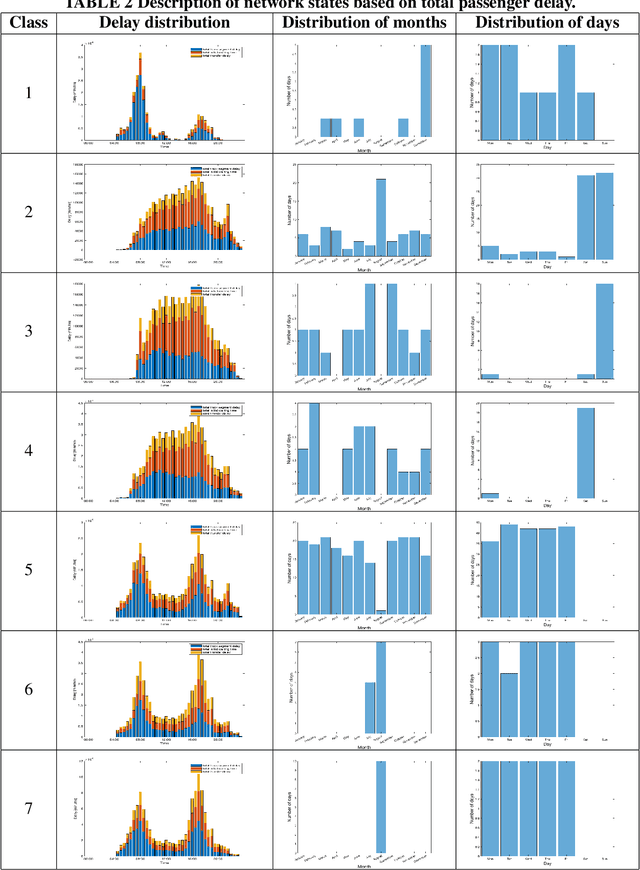
In an effort to improve user satisfaction and transit image, transit service providers worldwide offer delay compensations. Smart card data enables the estimation of passenger delays throughout the network and aid in monitoring service performance. Notwithstanding, in order to prioritize measures for improving service reliability and hence reducing passenger delays, it is paramount to identify the system components - stations and track segments - where most passenger delay occurs. To this end, we propose a novel method for estimating network passenger delay from individual trajectories. We decompose the delay along a passenger trajectory into its corresponding track segment delay, initial waiting time and transfer delay. We distinguish between two different types of passenger delay in relation to the public transit network: average passenger delay and total passenger delay. We employ temporal clustering on these two quantities to reveal daily and seasonal regularity in delay patterns of the transit network. The estimation and clustering methods are demonstrated on one year of data from Washington metro network. The data consists of schedule information and smart card data which includes passenger-train assignment of the metro network for the months of August 2017 to August 2018. Our findings show that the average passenger delay is relatively stable throughout the day. The temporal clustering reveals pronounced and recurrent and thus predictable daily and weekly patterns with distinct characteristics for certain months.