 Add to Chrome
 Add to Firefox
 Add to Edge
T-STAR: A Context-Aware Transformer Framework for Short-Term Probabilistic Demand Forecasting in Dock-Based Shared Micro-Mobility
Feb 06, 2026
Reliable short-term demand forecasting is essential for managing shared micro-mobility services and ensuring responsive, user-centered operations. This study introduces T-STAR (Two-stage Spatial and Temporal Adaptive contextual Representation), a novel transformer-based probabilistic framework designed to forecast station-level bike-sharing demand at a 15-minute resolution. T-STAR addresses key challenges in high-resolution forecasting by disentangling consistent demand patterns from short-term fluctuations through a hierarchical two-stage structure. The first stage captures coarse-grained hourly demand patterns, while the second stage improves prediction accuracy by incorporating high-frequency, localized inputs, including recent fluctuations and real-time demand variations in connected metro services, to account for temporal shifts in short-term demand. Time series transformer models are employed in both stages to generate probabilistic predictions. Extensive experiments using Washington D.C.'s Capital Bikeshare data demonstrate that T-STAR outperforms existing methods in both deterministic and probabilistic accuracy. The model exhibits strong spatial and temporal robustness across stations and time periods. A zero-shot forecasting experiment further highlights T-STAR's ability to transfer to previously unseen service areas without retraining. These results underscore the framework's potential to deliver granular, reliable, and uncertainty-aware short-term demand forecasts, which enable seamless integration to support multimodal trip planning for travelers and enhance real-time operations in shared micro-mobility services.

A Short-Term Predict-Then-Cluster Framework for Meal Delivery Services
Jan 11, 2025

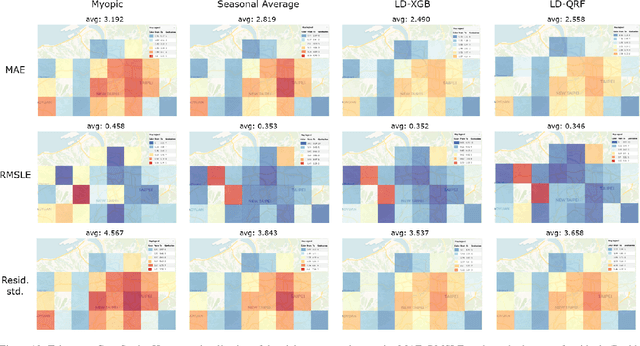
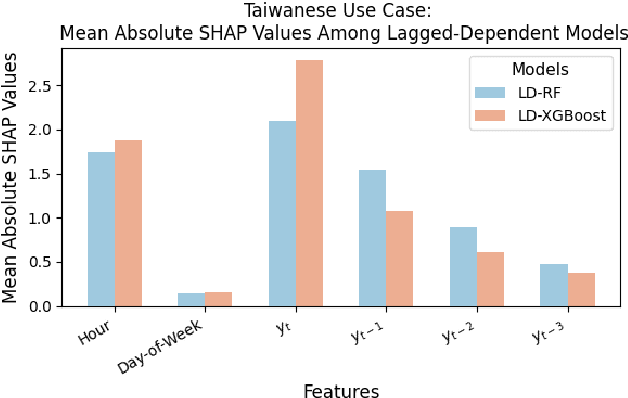
Micro-delivery services offer promising solutions for on-demand city logistics, but their success relies on efficient real-time delivery operations and fleet management. On-demand meal delivery platforms seek to optimize real-time operations based on anticipatory insights into citywide demand distributions. To address these needs, this study proposes a short-term predict-then-cluster framework for on-demand meal delivery services. The framework utilizes ensemble-learning methods for point and distributional forecasting with multivariate features, including lagged-dependent inputs to capture demand dynamics. We introduce Constrained K-Means Clustering (CKMC) and Contiguity Constrained Hierarchical Clustering with Iterative Constraint Enforcement (CCHC-ICE) to generate dynamic clusters based on predicted demand and geographical proximity, tailored to user-defined operational constraints. Evaluations of European and Taiwanese case studies demonstrate that the proposed methods outperform traditional time series approaches in both accuracy and computational efficiency. Clustering results demonstrate that the incorporation of distributional predictions effectively addresses demand uncertainties, improving the quality of operational insights. Additionally, a simulation study demonstrates the practical value of short-term demand predictions for proactive strategies, such as idle fleet rebalancing, significantly enhancing delivery efficiency. By addressing demand uncertainties and operational constraints, our predict-then-cluster framework provides actionable insights for optimizing real-time operations. The approach is adaptable to other on-demand platform-based city logistics and passenger mobility services, promoting sustainable and efficient urban operations.
Real-Time Integrated Dispatching and Idle Fleet Steering with Deep Reinforcement Learning for A Meal Delivery Platform
Jan 10, 2025
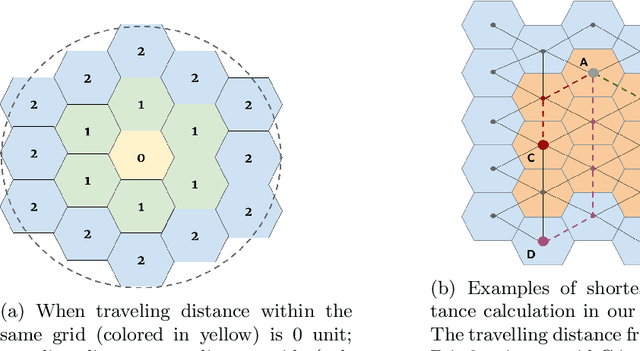
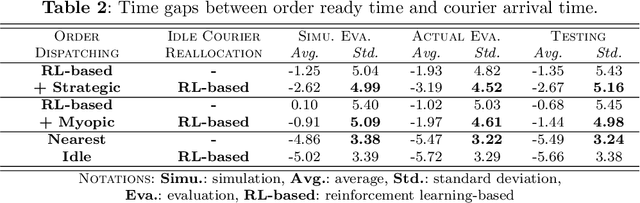
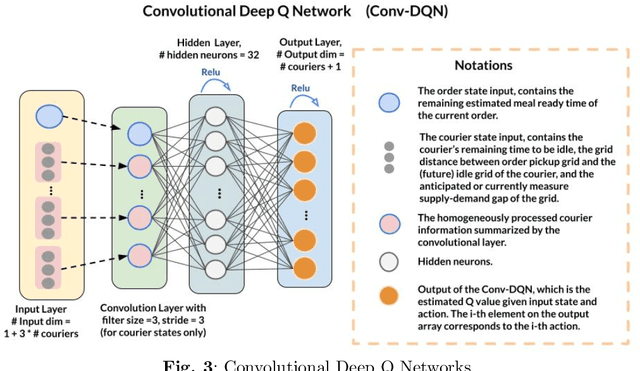
To achieve high service quality and profitability, meal delivery platforms like Uber Eats and Grubhub must strategically operate their fleets to ensure timely deliveries for current orders while mitigating the consequential impacts of suboptimal decisions that leads to courier understaffing in the future. This study set out to solve the real-time order dispatching and idle courier steering problems for a meal delivery platform by proposing a reinforcement learning (RL)-based strategic dual-control framework. To address the inherent sequential nature of these problems, we model both order dispatching and courier steering as Markov Decision Processes. Trained via a deep reinforcement learning (DRL) framework, we obtain strategic policies by leveraging the explicitly predicted demands as part of the inputs. In our dual-control framework, the dispatching and steering policies are iteratively trained in an integrated manner. These forward-looking policies can be executed in real-time and provide decisions while jointly considering the impacts on local and network levels. To enhance dispatching fairness, we propose convolutional deep Q networks to construct fair courier embeddings. To simultaneously rebalance the supply and demand within the service network, we propose to utilize mean-field approximated supply-demand knowledge to reallocate idle couriers at the local level. Utilizing the policies generated by the RL-based strategic dual-control framework, we find the delivery efficiency and fairness of workload distribution among couriers have been improved, and under-supplied conditions have been alleviated within the service network. Our study sheds light on designing an RL-based framework to enable forward-looking real-time operations for meal delivery platforms and other on-demand services.