 Add to Chrome
 Add to Firefox
 Add to Edge
Your Agent is More Brittle Than You Think: Uncovering Indirect Injection Vulnerabilities in Agentic LLMs
Apr 04, 2026
The rapid deployment of open-source frameworks has significantly advanced the development of modern multi-agent systems. However, expanded action spaces, including uncontrolled privilege exposure and hidden inter-system interactions, pose severe security challenges. Specifically, Indirect Prompt Injections (IPI), which conceal malicious instructions within third-party content, can trigger unauthorized actions such as data exfiltration during normal operations. While current security evaluations predominantly rely on isolated single-turn benchmarks, the systemic vulnerabilities of these agents within complex dynamic environments remain critically underexplored. To bridge this gap, we systematically evaluate six defense strategies against four sophisticated IPI attack vectors across nine LLM backbones. Crucially, we conduct our evaluation entirely within dynamic multi-step tool-calling environments to capture the true attack surface of modern autonomous agents. Moving beyond binary success rates, our multidimensional analysis reveals a pronounced fragility. Advanced injections successfully bypass nearly all baseline defenses, and some surface-level mitigations even produce counterproductive side effects. Furthermore, while agents execute malicious instructions almost instantaneously, their internal states exhibit abnormally high decision entropy. Motivated by this latent hesitation, we investigate Representation Engineering (RepE) as a robust detection strategy. By extracting hidden states at the tool-input position, we revealed that the RepE-based circuit breaker successfully identifies and intercepts unauthorized actions before the agent commits to them, achieving high detection accuracy across diverse LLM backbones. This study exposes the limitations of current IPI defenses and provides a highly practical paradigm for building resilient multi-agent architectures.

Reinforcing Multi-Turn Reasoning in LLM Agents via Turn-Level Credit Assignment
May 17, 2025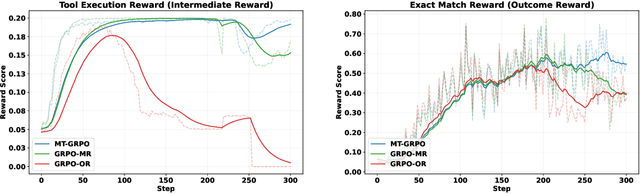
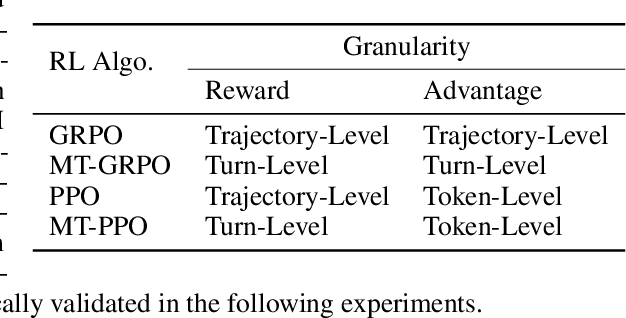
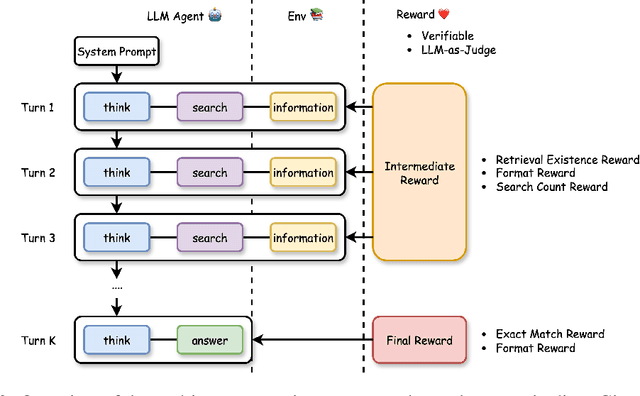
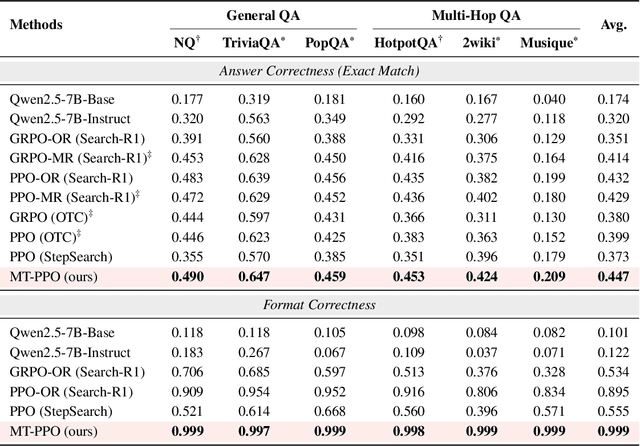
This paper investigates approaches to enhance the reasoning capabilities of Large Language Model (LLM) agents using Reinforcement Learning (RL). Specifically, we focus on multi-turn tool-use scenarios, which can be naturally modeled as Markov Decision Processes (MDPs). While existing approaches often train multi-turn LLM agents with trajectory-level advantage estimation in bandit settings, they struggle with turn-level credit assignment across multiple decision steps, limiting their performance on multi-turn reasoning tasks. To address this, we introduce a fine-grained turn-level advantage estimation strategy to enable more precise credit assignment in multi-turn agent interactions. The strategy is general and can be incorporated into various RL algorithms such as Group Relative Preference Optimization (GRPO). Our experimental evaluation on multi-turn reasoning and search-based tool-use tasks with GRPO implementations highlights the effectiveness of the MDP framework and the turn-level credit assignment in advancing the multi-turn reasoning capabilities of LLM agents in complex decision-making settings. Our method achieves 100% success in tool execution and 50% accuracy in exact answer matching, significantly outperforming baselines, which fail to invoke tools and achieve only 20-30% exact match accuracy.