 Add to Chrome
 Add to Firefox
 Add to Edge
Uncertainty Guided Exploratory Trajectory Optimization for Sampling-Based Model Predictive Control
Apr 13, 2026
Trajectory optimization depends heavily on initialization. In particular, sampling-based approaches are highly sensitive to initial solutions, and limited exploration frequently leads them to converge to local minima in complex environments. We present Uncertainty Guided Exploratory Trajectory Optimization (UGE-TO), a trajectory optimization algorithm that generates well-separated samples to achieve a better coverage of the configuration space. UGE-TO represents trajectories as probability distributions induced by uncertainty ellipsoids. Unlike sampling-based approaches that explore only in the action space, this representation captures the effects of both system dynamics and action selection. By incorporating the impact of dynamics, in addition to the action space, into our distributions, our method enhances trajectory diversity by enforcing distributional separation via the Hellinger distance between them. It enables a systematic exploration of the configuration space and improves robustness against local minima. Further, we present UGE-MPC, which integrates UGE-TO into sampling-based model predictive controller methods. Experiments demonstrate that UGE-MPC achieves higher exploration and faster convergence in trajectory optimization compared to baselines under the same sampling budget, achieving 72.1% faster convergence in obstacle-free environments and 66% faster convergence with a 6.7% higher success rate in the cluttered environment compared to the best-performing baseline. Additionally, we validate the approach through a range of simulation scenarios and real-world experiments. Our results indicate that UGE-MPC has higher success rates and faster convergence, especially in environments that demand significant deviations from nominal trajectories to avoid failures. The project and code are available at https://ogpoyrazoglu.github.io/cuniform_sampling/.

Neural L1 Adaptive Control of Vehicle Lateral Dynamics
May 25, 2024We address the problem of stable and robust control of vehicles with lateral error dynamics for the application of lane keeping. Lane departure is the primary reason for half of the fatalities in road accidents, making the development of stable, adaptive and robust controllers a necessity. Traditional linear feedback controllers achieve satisfactory tracking performance, however, they exhibit unstable behavior when uncertainties are induced into the system. Any disturbance or uncertainty introduced to the steering-angle input can be catastrophic for the vehicle. Therefore, controllers must be developed to actively handle such uncertainties. In this work, we introduce a Neural L1 Adaptive controller (Neural-L1) which learns the uncertainties in the lateral error dynamics of a front-steered Ackermann vehicle and guarantees stability and robustness. Our contributions are threefold: i) We extend the theoretical results for guaranteed stability and robustness of conventional L1 Adaptive controllers to Neural-L1; ii) We implement a Neural-L1 for the lane keeping application which learns uncertainties in the dynamics accurately; iii)We evaluate the performance of Neural-L1 on a physics-based simulator, PyBullet, and conduct extensive real-world experiments with the F1TENTH platform to demonstrate superior reference trajectory tracking performance of Neural-L1 compared to other state-of-the-art controllers, in the presence of uncertainties. Our project page, including supplementary material and videos, can be found at https://mukhe027.github.io/Neural-Adaptive-Control/
System Identification and Control of Front-Steered Ackermann Vehicles through Differentiable Physics
Aug 07, 2023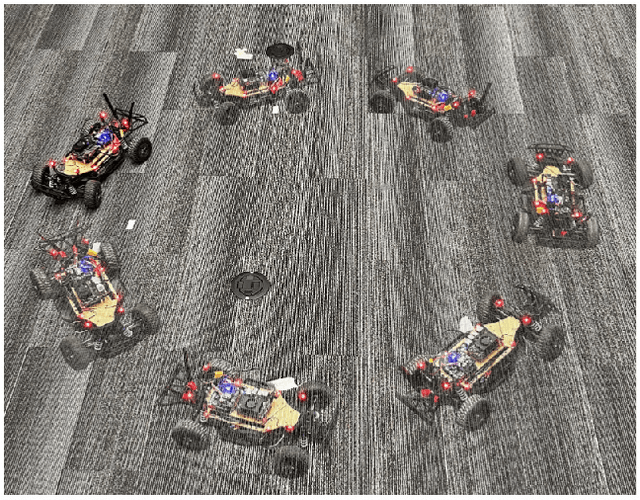
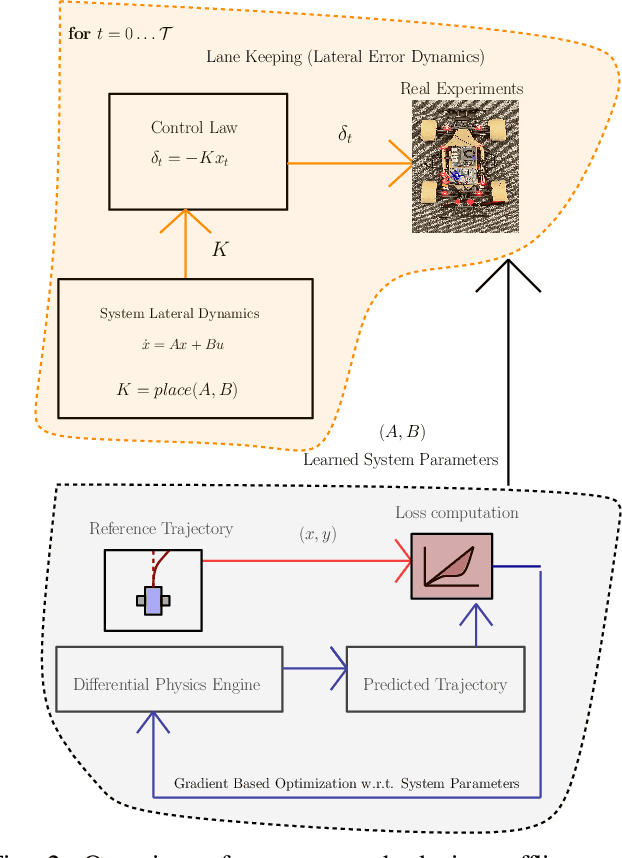
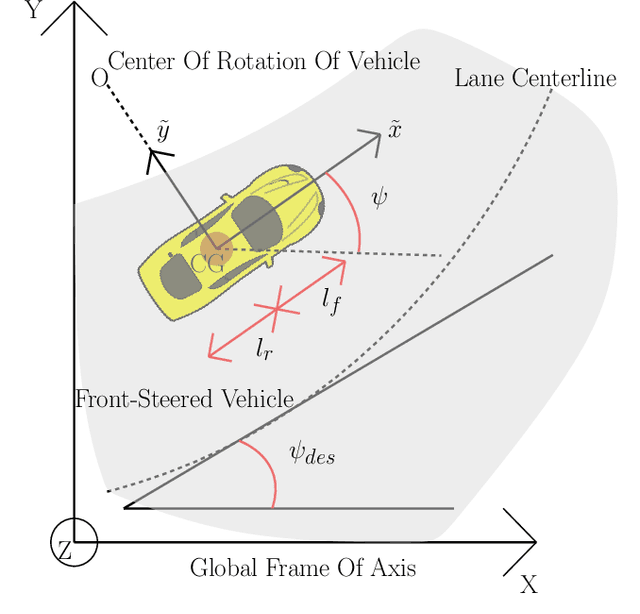
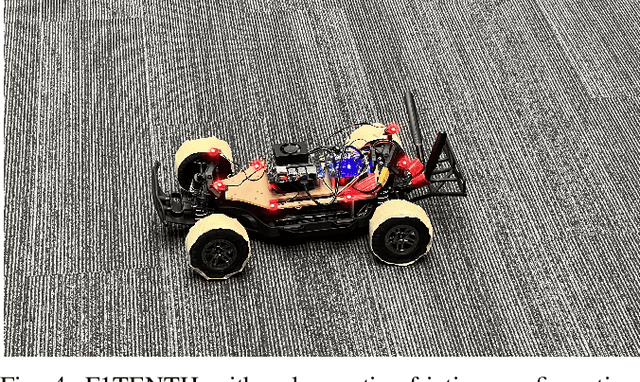
In this paper, we address the problem of system identification and control of a front-steered vehicle which abides by the Ackermann geometry constraints. This problem arises naturally for on-road and off-road vehicles that require reliable system identification and basic feedback controllers for various applications such as lane keeping and way-point navigation. Traditional system identification requires expensive equipment and is time consuming. In this work we explore the use of differentiable physics for system identification and controller design and make the following contributions: i)We develop a differentiable physics simulator (DPS) to provide a method for the system identification of front-steered class of vehicles whose system parameters are learned using a gradient-based method; ii) We provide results for our gradient-based method that exhibit better sample efficiency in comparison to other gradient-free methods; iii) We validate the learned system parameters by implementing a feedback controller to demonstrate stable lane keeping performance on a real front-steered vehicle, the F1TENTH; iv) Further, we provide results exhibiting comparable lane keeping behavior for system parameters learned using our gradient-based method with lane keeping behavior of the actual system parameters of the F1TENTH.