 Add to Chrome
 Add to Firefox
 Add to Edge
HydroAgent: Formalizing Forecaster Expertise into Skill-Orchestrated Flood Forecasting Workflows
Jul 27, 2026
Operational flood forecasting depends on tacit forecaster expertise that is difficult to formalize, audit, and transfer. Although artificial intelligence methods have advanced flood prediction and model-error correction, most existing studies have not explicitly represented the tacit expert rules, review checkpoints, and workflow constraints that connect model outputs to operational warning decisions. To address this issue, we propose HydroAgent, a skill-orchestrated agent framework that embeds Large Language Models (LLMs) into a model-driven flood forecasting workflow, where each skill encodes explicit rules to bound LLM reasoning. We validated its effectiveness using five state-of-the-art LLMs in the South Yamhill River basin. Our results demonstrate that prior judgment captures observed peak flow and flood volume within 5% tolerance in 10 and 11 out of 14 events, with 5-fold cross-validation over 129 events yielding Pearson correlations of 0.62 and 0.84. Building on a high-baseline scheme library (average KGE 0.890), the guided scheme selection further improves KGE by 0.023-0.154, with simulated peak flow and flood volume falling within the prior judgment ranges for 14 and 13 out of 14 events. All five tested LLMs successfully execute the HydroAgent workflow with comparable judgment accuracy (40%-80%), while showing moderate performance variation and substantial cost differences. HydroAgent does not aim to replace human forecasters; instead, it translates their tacit expertise into an auditable and reproducible workflow, streamlining analytical steps and supporting more informed decision-making. This skill-orchestrated paradigm demonstrates how explicit rule boundaries can guide language model reasoning to complement physically based simulation in next-generation flood forecasting.

Data-driven modeling and supervisory control system optimization for plug-in hybrid electric vehicles
Jun 13, 2024
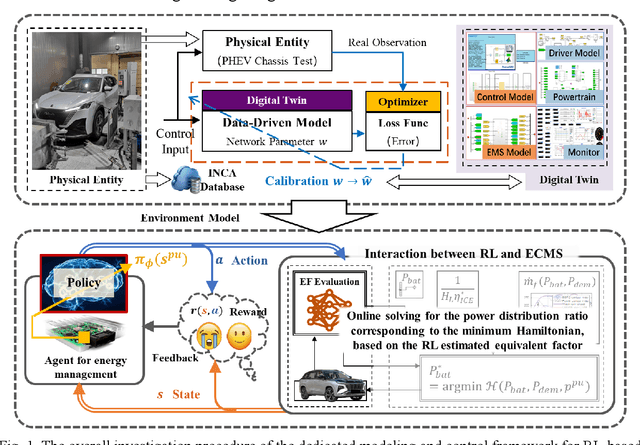
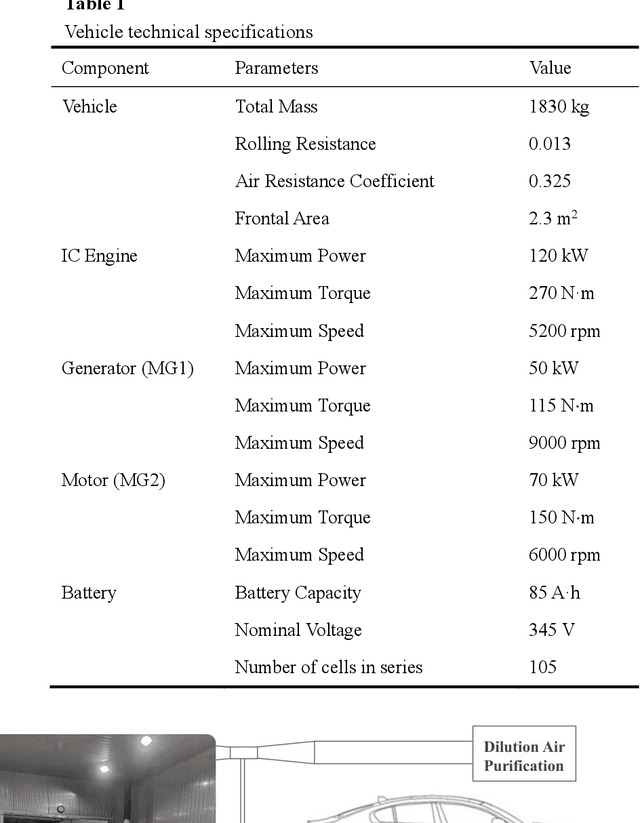
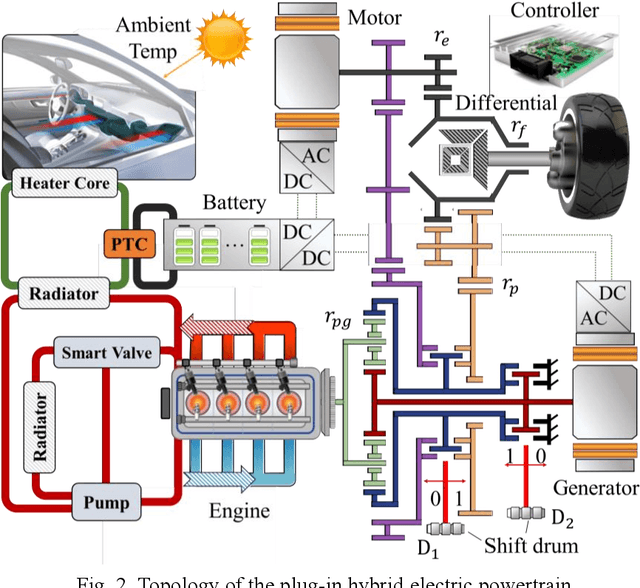
Learning-based intelligent energy management systems for plug-in hybrid electric vehicles (PHEVs) are crucial for achieving efficient energy utilization. However, their application faces system reliability challenges in the real world, which prevents widespread acceptance by original equipment manufacturers (OEMs). This paper begins by establishing a PHEV model based on physical and data-driven models, focusing on the high-fidelity training environment. It then proposes a real-vehicle application-oriented control framework, combining horizon-extended reinforcement learning (RL)-based energy management with the equivalent consumption minimization strategy (ECMS) to enhance practical applicability, and improves the flawed method of equivalent factor evaluation based on instantaneous driving cycle and powertrain states found in existing research. Finally, comprehensive simulation and hardware-in-the-loop validation are carried out which demonstrates the advantages of the proposed control framework in fuel economy over adaptive-ECMS and rule-based strategies. Compared to conventional RL architectures that directly control powertrain components, the proposed control method not only achieves similar optimality but also significantly enhances the disturbance resistance of the energy management system, providing an effective control framework for RL-based energy management strategies aimed at real-vehicle applications by OEMs.