 Add to Chrome
 Add to Firefox
 Add to Edge
Emergent Structured Representations Support Flexible In-Context Inference in Large Language Models
Feb 08, 2026
Large language models (LLMs) exhibit emergent behaviors suggestive of human-like reasoning. While recent work has identified structured, human-like conceptual representations within these models, it remains unclear whether they functionally rely on such representations for reasoning. Here we investigate the internal processing of LLMs during in-context concept inference. Our results reveal a conceptual subspace emerging in middle to late layers, whose representational structure persists across contexts. Using causal mediation analyses, we demonstrate that this subspace is not merely an epiphenomenon but is functionally central to model predictions, establishing its causal role in inference. We further identify a layer-wise progression where attention heads in early-to-middle layers integrate contextual cues to construct and refine the subspace, which is subsequently leveraged by later layers to generate predictions. Together, these findings provide evidence that LLMs dynamically construct and use structured, latent representations in context for inference, offering insights into the computational processes underlying flexible adaptation.

On the Tip of the Tongue: Analyzing Conceptual Representation in Large Language Models with Reverse-Dictionary Probe
Feb 26, 2024Probing and enhancing large language models' reasoning capacity remains a crucial open question. Here we re-purpose the reverse dictionary task as a case study to probe LLMs' capacity for conceptual inference. We use in-context learning to guide the models to generate the term for an object concept implied in a linguistic description. Models robustly achieve high accuracy in this task, and their representation space encodes information about object categories and fine-grained features. Further experiments suggest that the conceptual inference ability as probed by the reverse-dictionary task predicts model's general reasoning performance across multiple benchmarks, despite similar syntactic generalization behaviors across models. Explorative analyses suggest that prompting LLMs with description$\Rightarrow$word examples may induce generalization beyond surface-level differences in task construals and facilitate models on broader commonsense reasoning problems.
Are Structural Concepts Universal in Transformer Language Models? Towards Interpretable Cross-Lingual Generalization
Oct 19, 2023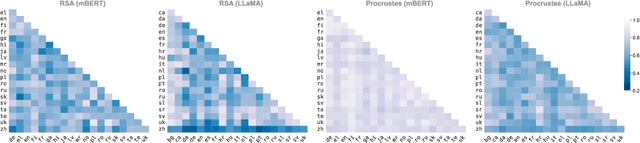
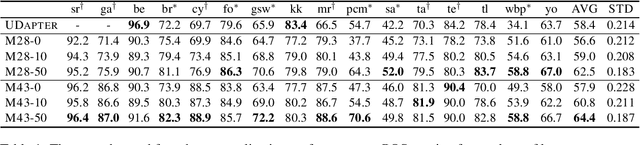
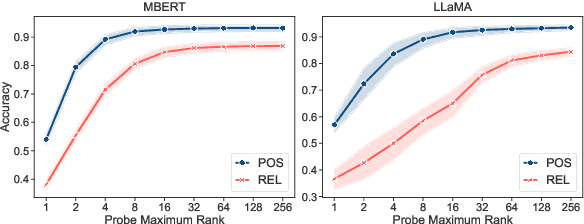
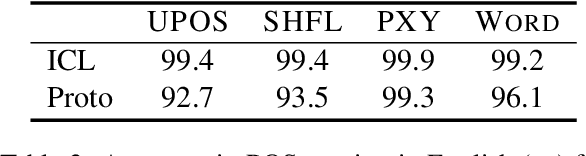
Large language models (LLMs) have exhibited considerable cross-lingual generalization abilities, whereby they implicitly transfer knowledge across languages. However, the transfer is not equally successful for all languages, especially for low-resource ones, which poses an ongoing challenge. It is unclear whether we have reached the limits of implicit cross-lingual generalization and if explicit knowledge transfer is viable. In this paper, we investigate the potential for explicitly aligning conceptual correspondence between languages to enhance cross-lingual generalization. Using the syntactic aspect of language as a testbed, our analyses of 43 languages reveal a high degree of alignability among the spaces of structural concepts within each language for both encoder-only and decoder-only LLMs. We then propose a meta-learning-based method to learn to align conceptual spaces of different languages, which facilitates zero-shot and few-shot generalization in concept classification and also offers insights into the cross-lingual in-context learning phenomenon. Experiments on syntactic analysis tasks show that our approach achieves competitive results with state-of-the-art methods and narrows the performance gap between languages, particularly benefiting those with limited resources.
Cross-Linguistic Syntactic Difference in Multilingual BERT: How Good is It and How Does It Affect Transfer?
Dec 21, 2022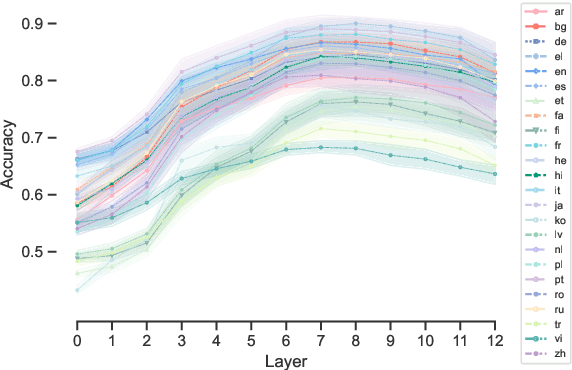
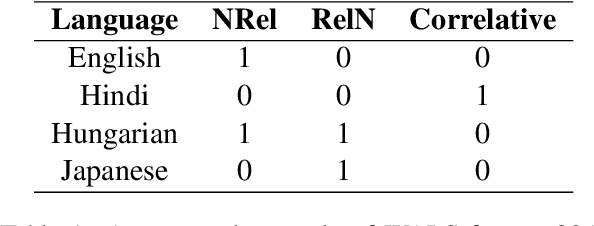
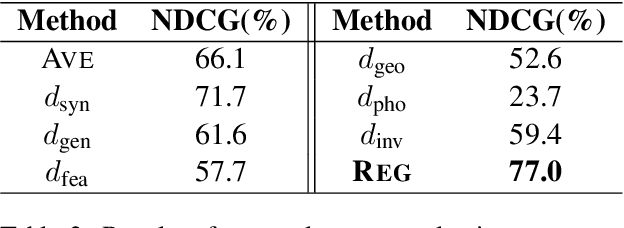
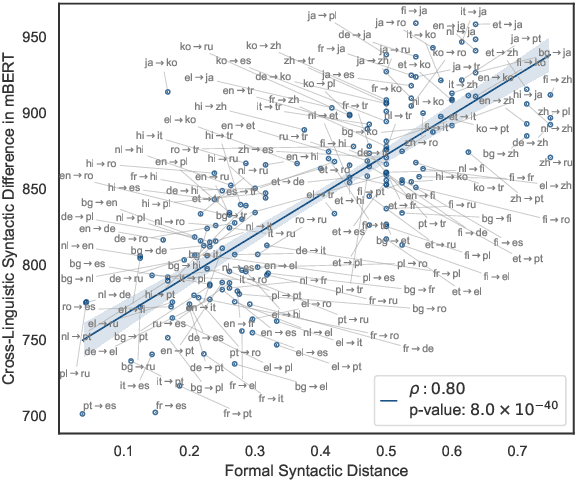
Multilingual BERT (mBERT) has demonstrated considerable cross-lingual syntactic ability, whereby it enables effective zero-shot cross-lingual transfer of syntactic knowledge. The transfer is more successful between some languages, but it is not well understood what leads to this variation and whether it fairly reflects difference between languages. In this work, we investigate the distributions of grammatical relations induced from mBERT in the context of 24 typologically different languages. We demonstrate that the distance between the distributions of different languages is highly consistent with the syntactic difference in terms of linguistic formalisms. Such difference learnt via self-supervision plays a crucial role in the zero-shot transfer performance and can be predicted by variation in morphosyntactic properties between languages. These results suggest that mBERT properly encodes languages in a way consistent with linguistic diversity and provide insights into the mechanism of cross-lingual transfer.