 Add to Chrome
 Add to Firefox
 Add to Edge
Constraints Matrix Diffusion based Generative Neural Solver for Vehicle Routing Problems
Mar 08, 2026
Over the past decade, neural network solvers powered by generative artificial intelligence have garnered significant attention in the domain of vehicle routing problems (VRPs), owing to their exceptional computational efficiency and superior reasoning capabilities. In particular, autoregressive solvers integrated with reinforcement learning have emerged as a prominent trend. However, much of the existing work emphasizes large-scale generalization of neural approaches while neglecting the limited robustness of attention-based methods across heterogeneous distributions of problem parameters. Their improvements over heuristic search remain largely restricted to hand-curated, fixed-distribution benchmarks. Furthermore, these architectures tend to degrade significantly when node representations are highly similar or when tasks involve long decision horizons. To address the aforementioned limitations, we propose a novel fusion neural network framework that employs a discrete noise graph diffusion model to learn the underlying constraints of vehicle routing problems and generate a constraint assignment matrix. This matrix is subsequently integrated adaptively into the feature representation learning and decision process of the autoregressive solver, serving as a graph structure mask that facilitates the formation of solutions characterized by both global vision and local feature integration. To the best of our knowledge, this work represents the first comprehensive experimental investigation of neural network model solvers across a 378-combinatorial space spanning four distinct dimensions within the CVRPlib public dataset. Extensive experimental evaluations demonstrate that our proposed fusion model effectively captures and leverages problem constraints, achieving state-of-the-art performance across multiple benchmark datasets.

Analytics and Machine Learning in Vehicle Routing Research
Feb 19, 2021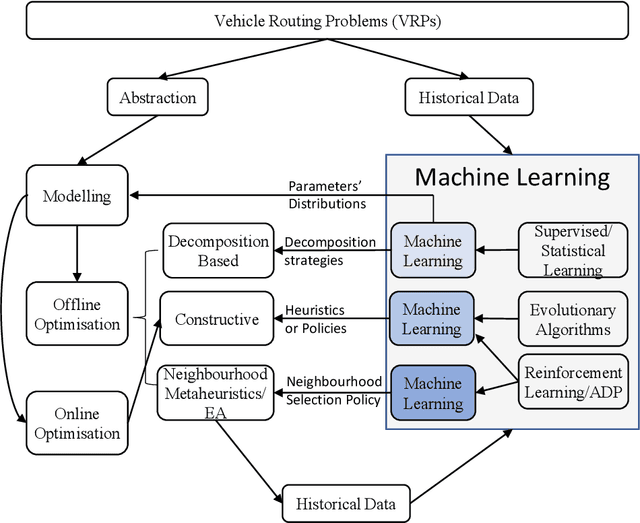
The Vehicle Routing Problem (VRP) is one of the most intensively studied combinatorial optimisation problems for which numerous models and algorithms have been proposed. To tackle the complexities, uncertainties and dynamics involved in real-world VRP applications, Machine Learning (ML) methods have been used in combination with analytical approaches to enhance problem formulations and algorithmic performance across different problem solving scenarios. However, the relevant papers are scattered in several traditional research fields with very different, sometimes confusing, terminologies. This paper presents a first, comprehensive review of hybrid methods that combine analytical techniques with ML tools in addressing VRP problems. Specifically, we review the emerging research streams on ML-assisted VRP modelling and ML-assisted VRP optimisation. We conclude that ML can be beneficial in enhancing VRP modelling, and improving the performance of algorithms for both online and offline VRP optimisations. Finally, challenges and future opportunities of VRP research are discussed.
A Hybrid Pricing and Cutting Approach for the Multi-Shift Full Truckload Vehicle Routing Problem
Dec 03, 2020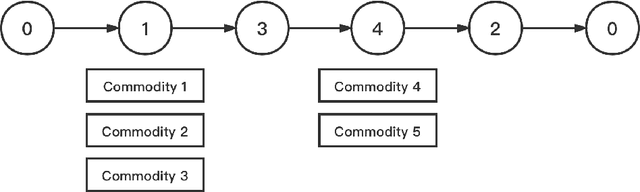
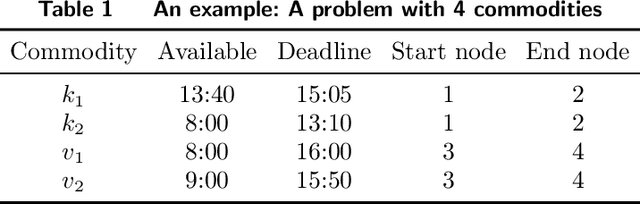
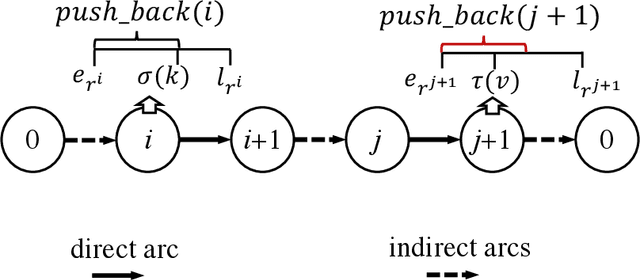
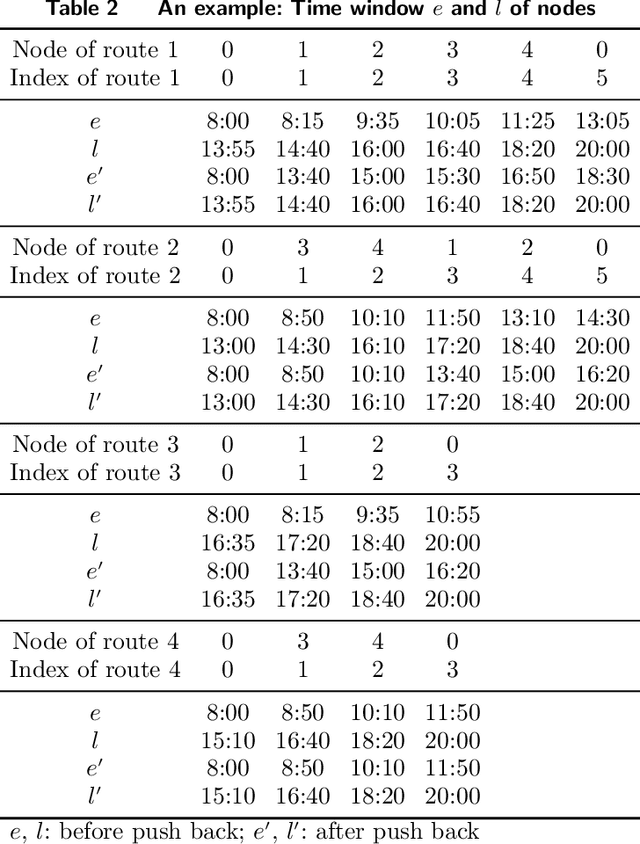
Full truckload transportation (FTL) in the form of freight containers represents one of the most important transportation modes in international trade. Due to large volume and scale, in FTL, delivery time is often less critical but cost and service quality are crucial. Therefore, efficiently solving large scale multiple shift FTL problems is becoming more and more important and requires further research. In one of our earlier studies, a set covering model and a three-stage solution method were developed for a multi-shift FTL problem. This paper extends the previous work and presents a significantly more efficient approach by hybridising pricing and cutting strategies with metaheuristics (a variable neighbourhood search and a genetic algorithm). The metaheuristics were adopted to find promising columns (vehicle routes) guided by pricing and cuts are dynamically generated to eliminate infeasible flow assignments caused by incompatible commodities. Computational experiments on real-life and artificial benchmark FTL problems showed superior performance both in terms of computational time and solution quality, when compared with previous MIP based three-stage methods and two existing metaheuristics. The proposed cutting and heuristic pricing approach can efficiently solve large scale real-life FTL problems.