 Add to Chrome
 Add to Firefox
 Add to Edge
Constraints Matrix Diffusion based Generative Neural Solver for Vehicle Routing Problems
Mar 08, 2026
Over the past decade, neural network solvers powered by generative artificial intelligence have garnered significant attention in the domain of vehicle routing problems (VRPs), owing to their exceptional computational efficiency and superior reasoning capabilities. In particular, autoregressive solvers integrated with reinforcement learning have emerged as a prominent trend. However, much of the existing work emphasizes large-scale generalization of neural approaches while neglecting the limited robustness of attention-based methods across heterogeneous distributions of problem parameters. Their improvements over heuristic search remain largely restricted to hand-curated, fixed-distribution benchmarks. Furthermore, these architectures tend to degrade significantly when node representations are highly similar or when tasks involve long decision horizons. To address the aforementioned limitations, we propose a novel fusion neural network framework that employs a discrete noise graph diffusion model to learn the underlying constraints of vehicle routing problems and generate a constraint assignment matrix. This matrix is subsequently integrated adaptively into the feature representation learning and decision process of the autoregressive solver, serving as a graph structure mask that facilitates the formation of solutions characterized by both global vision and local feature integration. To the best of our knowledge, this work represents the first comprehensive experimental investigation of neural network model solvers across a 378-combinatorial space spanning four distinct dimensions within the CVRPlib public dataset. Extensive experimental evaluations demonstrate that our proposed fusion model effectively captures and leverages problem constraints, achieving state-of-the-art performance across multiple benchmark datasets.

GASE: Graph Attention Sampling with Edges Fusion for Solving Vehicle Routing Problems
May 21, 2024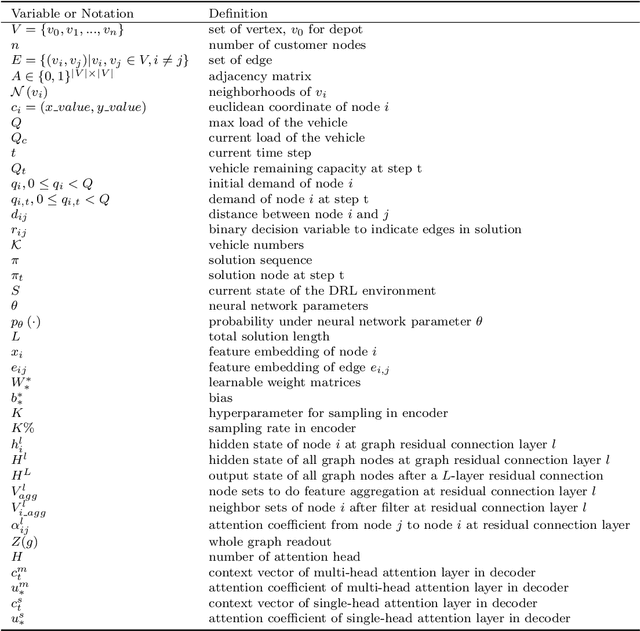

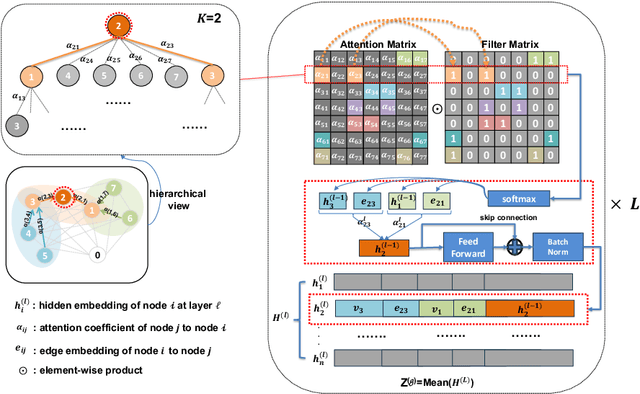
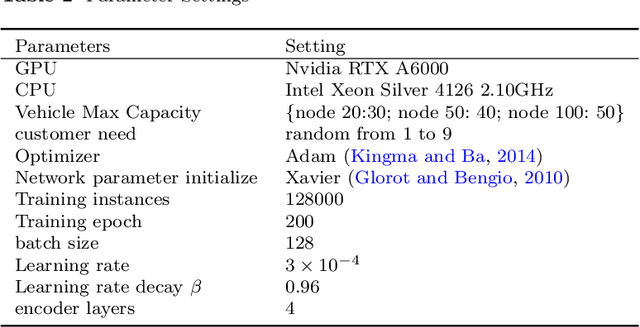
Learning-based methods have become increasingly popular for solving vehicle routing problems due to their near-optimal performance and fast inference speed. Among them, the combination of deep reinforcement learning and graph representation allows for the abstraction of node topology structures and features in an encoder-decoder style. Such an approach makes it possible to solve routing problems end-to-end without needing complicated heuristic operators designed by domain experts. Existing research studies have been focusing on novel encoding and decoding structures via various neural network models to enhance the node embedding representation. Despite the sophisticated approaches applied, there is a noticeable lack of consideration for the graph-theoretic properties inherent to routing problems. Moreover, the potential ramifications of inter-nodal interactions on the decision-making efficacy of the models have not been adequately explored. To bridge this gap, we propose an adaptive Graph Attention Sampling with the Edges Fusion framework (GASE),where nodes' embedding is determined through attention calculation from certain highly correlated neighbourhoods and edges, utilizing a filtered adjacency matrix. In detail, the selections of particular neighbours and adjacency edges are led by a multi-head attention mechanism, contributing directly to the message passing and node embedding in graph attention sampling networks. Furthermore, we incorporate an adaptive actor-critic algorithm with policy improvements to expedite the training convergence. We then conduct comprehensive experiments against baseline methods on learning-based VRP tasks from different perspectives. Our proposed model outperforms the existing methods by 2.08\%-6.23\% and shows stronger generalization ability, achieving state-of-the-art performance on randomly generated instances and real-world datasets.
Scope for Machine Learning in Digital Manufacturing
Sep 19, 2016
This provocation paper provides an overview of the underlying optimisation problem in the emerging field of Digital Manufacturing. Initially, this paper discusses how the notion of Digital Manufacturing is transforming from a term describing a suite of software tools for the integration of production and design functions towards a more general concept incorporating computerised manufacturing and supply chain processes, as well as information collection and utilisation across the product life cycle. On this basis, we use the example of one such manufacturing process, Additive Manufacturing, to identify an integrated multi-objective optimisation problem underlying Digital Manufacturing. Forming an opportunity for a concurrent application of data science and optimisation, a set of challenges arising from this problem is outlined.