 Add to Chrome
 Add to Firefox
 Add to Edge
Towards Reliable Zero-Shot Crowd Forecasting: Evaluating Time Series Foundation Models for Special Event Pedestrian Forecasting
Jul 20, 2026
Managing massive crowds during infrequent special events requires reliable real-time pedestrian-flow forecasting to ensure public safety and operational efficiency. However, supervised forecasting methods face limitations in these contexts due to scarce historical data, heterogeneous data distributions, and short in-event observation windows. To effectively support operational decision-making, forecasts should provide not only accurate point estimates but also informative predictive uncertainty. Probabilistic uncertainty quantification plays a critical role in this aspect, particularly capturing sudden volatility and tail risks. This paper investigates pretrained time series foundation models as a lightweight approach for zero-shot probabilistic forecasting without extensive local retraining. Using decision-oriented metrics tailored to short events, we conduct a comprehensive assessment of two time series foundation models on crowd forecasting, with the SAIL2025 event as a use case. We then distill practical insights for crowd managers, specifying when zero-shot forecasts remain operationally reliable.

Advances in Compliance Detection: Novel Models Using Vision-Based Tactile Sensors
Jun 17, 2025Compliance is a critical parameter for describing objects in engineering, agriculture, and biomedical applications. Traditional compliance detection methods are limited by their lack of portability and scalability, rely on specialized, often expensive equipment, and are unsuitable for robotic applications. Moreover, existing neural network-based approaches using vision-based tactile sensors still suffer from insufficient prediction accuracy. In this paper, we propose two models based on Long-term Recurrent Convolutional Networks (LRCNs) and Transformer architectures that leverage RGB tactile images and other information captured by the vision-based sensor GelSight to predict compliance metrics accurately. We validate the performance of these models using multiple metrics and demonstrate their effectiveness in accurately estimating compliance. The proposed models exhibit significant performance improvement over the baseline. Additionally, we investigated the correlation between sensor compliance and object compliance estimation, which revealed that objects that are harder than the sensor are more challenging to estimate.
Integrating Single-Cell Foundation Models with Graph Neural Networks for Drug Response Prediction
Apr 19, 2025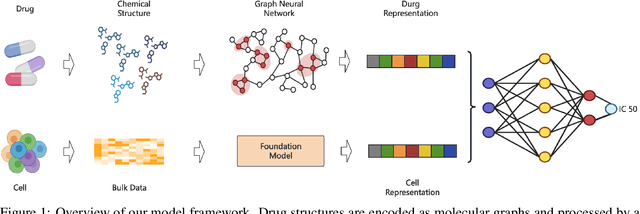
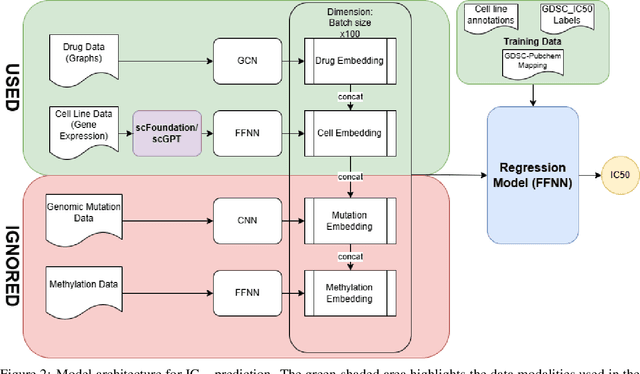
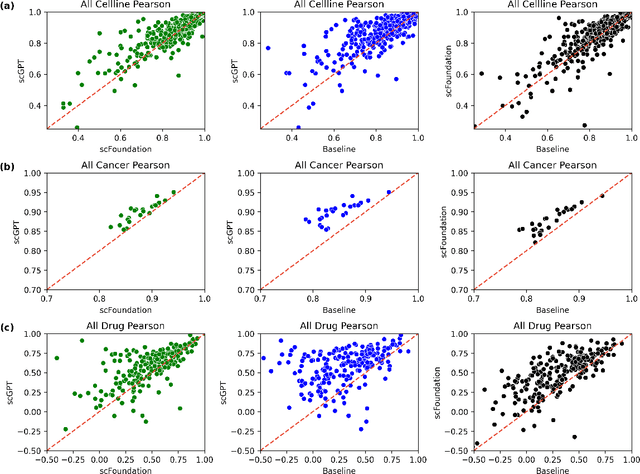
In this study, we propose an innovative methodology for predicting Cancer Drug Response (CDR) through the integration of the scGPT foundation model within the DeepCDR model. Our approach utilizes scGPT to generate embeddings from gene expression data, which are then used as gene expression input data for DeepCDR. The experimental findings demonstrate the efficacy of this scGPT-based method in outperforming previous related works, including the original DeepCDR model and the scFoundation-based model. This study highlights the potential of scGPT embeddings to enhance the accuracy of CDR predictions and offers a promising alternative to existing approaches.