 Add to Chrome
 Add to Firefox
 Add to Edge
Point Cloud Segmentation for Autonomous Clip Positioning in Laparoscopic Cholecystectomy on a Phantom
Jun 10, 2026
High-risk applications in robotics, such as robot-assisted surgery, present unique challenges. These systems must be both highly precise and interpretable in order to be deployed in environments with very low tolerance for error or unsafe exploration. We present the first robotic system to demonstrate autonomous clip positioning on a physical phantom in laparoscopic surgery, one of the most common interventions in general surgery. After segmentation of a colorless point cloud from a single camera, target positions for the clips are extracted using spline interpolation, and can then be adjusted by the human operator. The segmentation model is trained on only 60 hand-labeled real point clouds, reflecting data scarcity in the surgical domain. We overcome this with a combination of pre-training on 128,000 synthetic point clouds and two novel data augmentation techniques. The motion of the end-effector to each target is visualized for the operator, satisfying the unique motion constraints of minimally-invasive surgery while ensuring that the robot's actions are verifiable and interpretable. In real robot experiments, our system localizes targets with the required precision of 0.75mm at a 95% success rate and executes autonomous clip positioning with a 100% success rate. We provide insights that are applicable to many other surgical and non-surgical tasks that require identifying and navigating to a precise target. Source code and project page: https://github.com/balazsgyenes/kirurc
* 8 pages, 5 figures, accepted to IEEE Robotics and Automation Letters (RAL)

PointPatchRL -- Masked Reconstruction Improves Reinforcement Learning on Point Clouds
Oct 24, 2024
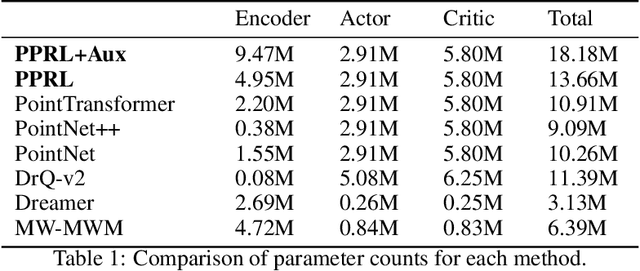

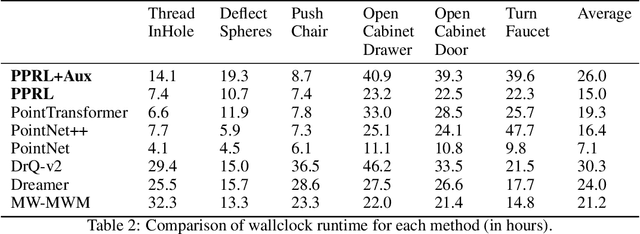
Perceiving the environment via cameras is crucial for Reinforcement Learning (RL) in robotics. While images are a convenient form of representation, they often complicate extracting important geometric details, especially with varying geometries or deformable objects. In contrast, point clouds naturally represent this geometry and easily integrate color and positional data from multiple camera views. However, while deep learning on point clouds has seen many recent successes, RL on point clouds is under-researched, with only the simplest encoder architecture considered in the literature. We introduce PointPatchRL (PPRL), a method for RL on point clouds that builds on the common paradigm of dividing point clouds into overlapping patches, tokenizing them, and processing the tokens with transformers. PPRL provides significant improvements compared with other point-cloud processing architectures previously used for RL. We then complement PPRL with masked reconstruction for representation learning and show that our method outperforms strong model-free and model-based baselines on image observations in complex manipulation tasks containing deformable objects and variations in target object geometry. Videos and code are available at https://alrhub.github.io/pprl-website