 Add to Chrome
 Add to Firefox
 Add to Edge
Macro--Micro Decision-Making in 6G Networks: An Agent-Based Framework for the Resource-Fungibility Landscape Resource-Fungibility Landscape
Jun 27, 2026
A defining feature of 6G networks is that performance depends not only on the quantity of available resources (e.g., spectrum, antennas, cache memory, compute, and fronthaul bandwidth) but also on their \emph{fungibility}, i.e., the ability of one resource to substitute for another under changing conditions. We argue that the fungibility landscape of a distributed 6G system is governed by two coupled decision scales: \emph{micro} decisions made locally by agents and \emph{macro} outcomes that emerge at the network level. Existing distributed-optimization approaches largely conflate these scales. To address this gap, we develop an agent-based-modeling (ABM) framework that separates macro and micro decisions through three operator-controllable macro choices, three micro hyperparameters, and three structural metrics. We establish six key results: (i) a two-timescale decomposition theorem, (ii) a structural-metric basis theorem, (iii) a macro--micro design rule with closed-form factorization of the emergent breakdown threshold, (iv) a fungibility--resilience monotonicity proposition, (v) a connectivity--substitutability duality theorem, and (vi) a multi-application generalization proposition. Numerical results visualize the macro fungibility landscape and the micro decision-sensitivity region for a representative 6G deployment.

Degeneracy-Aware Resilient Resource Allocation in Cell-Free Cache-Aided MU-MIMO Networks
Jun 23, 2026Cell-free cache-aided multi-user multiple-input-multiple-output (MIMO) (CF-CA-MU-MIMO) networks improve spectral efficiency through coded multicast delivery and distributed spatial multiplexing, but their distributed architecture introduces vulnerabilities to jamming, cache-aware eavesdropping, Byzantine corruption, and pilot-contamination attacks. This paper develops a degeneracy-aware resilient framework based on four vulnerability-mode partitions (subfile, edge node, multicast stream, and user) and three attack-aware structural metrics: Degeneracy-Weighted Path Robustness (DWPR$^{\mathrm{att}}$), trust-aware Functional Substitution Score (FSS$^{\mathrm{trust}}$), and a robust degeneracy index ($D_k^{\mathrm{rob}}$). These metrics are incorporated into a fully decentralized consensus-based agent framework (DC-ABM) using trust-weighted trimmed-mean aggregation and adaptive trust evolution. Five theoretical results are established: (i) a tight top-mass concentration lemma, (ii) matching memory--rate--resilience achievability and converse bounds, (iii) a robust-degeneracy bound with outage characterization, (iv) a secrecy--cache coupling theorem, and (v) a Byzantine-robust mean-square convergence result with an explicit breakdown threshold $f_{\max}$. Simulations validate the analytical bounds and demonstrate $1.8\times$ to $3\times$ faster convergence than distributed alternating direction method of multipliers (ADMM), multi-agent reinforcement learning (MARL)/graph neural network (GNN)-based control, and Su--Vaidya consensus while maintaining throughput up to the predicted threshold $f_{\max}\approx0.19$.
Optimal Illumination via Joint Movement and Phase Optimization for Movable Antenna-RIS Configuration
Jun 08, 2026Reconfigurable intelligent surfaces (RIS) enable programmable control of wireless propagation but remain vulnerable to persistent deep fades in static deployments. This paper introduces a Movable Antenna-enhanced RIS (MA-RIS) architecture where antenna elements physically reposition to sample independent spatial channels, enabling mobility-induced diversity. We model antenna motion using a Stochastic Differential Equation (SDE) framework capturing controlled drift and environmental diffusion. It^o calculus-based analysis characterizes steady-state antenna distributions, spatial decorrelation, and outage probability, revealing fundamental trade-offs between control strength and mobility randomness. To maximize long-term SNR while accounting for control overhead, we propose an overhead-aware Two-timescale framework separating slow antenna trajectory control from fast phase adaptation. The stochastic optimal control problem is solved via predictive approximation of the Hamilton-Jacobi-Bellman (HJB) formulation, enabling real-time implementation. Simulations validate theoretical predictions: the Two-timescale strategy achieves up to 36 dB steady-state SNR with remarkable stability, outperforming position-only control by up to 15 dB and uncontrolled baselines by over 30 dB. Despite experiencing a lower SNR than Active RIS, the proposed approach delivers up to 16 times higher energy efficiency (EE) across varying system scales, establishing a new paradigm of mobility-enabled channel adaptation for resilient wireless systems.
UAV-based Energy-Efficient Data Collection in Smart Grids with ISAC QoS Guarantees
May 21, 2026Dynamic line rating (DLR) is a methodology that requires timely monitoring data to determine the real-time ampacity of power lines. However, DLR monitoring devices (MD) are vulnerable to connectivity disruptions, leading to missing or delayed data. Although unmanned aerial vehicles (UAV) can enable resilient data collection from MD, their limited onboard energy challenges timely monitoring over extended transmission corridors with flight hazards. This paper proposes a cooperative UAV-based data collection framework with integrated sensing and communication (ISAC) to support timely DLR updates. In this framework, ISAC is employed to maintain the sensing and communication quality required for safe and cooperative UAV data collection. Accordingly, a joint energy minimization problem is formulated over UAV trajectories and collection scheduling under ISAC constraints. To solve it, a hybrid algorithm combining deep reinforcement learning (DRL) and semidefinite relaxation (SDR) is proposed, where DRL optimizes the trajectory and collection scheduling, while SDR is used to handle the non-convex ISAC constraints. Simulation results show that the proposed scheme reduces energy consumption by up to 34.6% compared with offline benchmarks and by about 2.2% compared with the separated sensing-and-communication baseline, while satisfying the minute-level timescale requirement of DLR.
Adaptive RSMA-OMA for Resilient MIMO Networks Under Imperfect CSI and SIC
May 12, 2026This paper addresses the challenge of power control in Rate-Splitting Multiple Access (RSMA) systems for downlink Multi-Input Multi-Output (MIMO) networks under practical impairments such as spatial correlation, imperfect Channel State Information (CSI), and residual Successive Interference Cancellation (SIC) errors. We propose a novel degeneracyaware framework that adaptively adjusts the power allocation between the common and private streams, ensuring optimal performance despite CSI uncertainty and imperfect SIC. Our approach incorporates a dynamic switching mechanism between RSMA and Orthogonal Multiple Access (OMA) to maintain system feasibility and resilience in the face of these impairments. Extensive analytical and simulation results demonstrate that the proposed framework significantly enhances power efficiency, mitigates outage probability, and improves overall system robustness, making RSMA a viable and efficient solution for modern wireless networks with realistic CSI and SIC conditions.
Degeneracy-Aware Agent-Based Resource Allocation for Multi-User MIMO RSMA Network
May 04, 2026This paper proposes a pilot-aware, degeneracy-driven Agent-Based Modelling (ABM) framework for distributed resource allocation in RSMA-enabled multi-user MIMO systems under imperfect Channel State Information (CSI) and residual Successive Interference Cancellation (SIC) error. The centralized RSMA power allocation problem is reformulated as a distributed multi-agent system, where users operate as autonomous agents that iteratively adapt transmit powers based on locally observed feasibility conditions. To capture the joint impact of interference coupling, CSI estimation errors, pilot overhead, and residual SIC error, a novel degeneracy index defined as the ratio of target to achieved signal-to-interference-plus-noise ratio (SINR) is introduced as a unified feasibility metric. This enables a scalable fixed-point power control mechanism that characterizes the feasible operating region without requiring global CSI. Analytical expressions for user-level and system-level outage probabilities are derived under spatially correlated fading, providing insights into reliability under practical impairments. The fundamental interplay between degeneracy, outage probability, and effective throughput is established, revealing that system performance is governed by the feasibility of the bottleneck user. To further enhance resilience, Degeneracy-Weighted Path Robustness (DWPR) and Functional Substitution Score (FSS) are incorporated to exploit path diversity and functional redundancy. Numerical results show that the proposed framework achieves near-centralized performance in sparse networks, while providing notable throughput gains and improved scalability in dense deployments, highlighting its effectiveness for robust and distributed resource management in next-generation wireless systems.
TSN-IoT: A Two-Stage NOMA-Enabled Framework for Prioritized Traffic Handling in Dense IoT Networks
Jan 20, 2026With the growing applications of the Internet of Things (IoT), a major challenge is to ensure continuous connectivity while providing prioritized access. In dense IoT scenarios, synchronization may be disrupted either by the movement of nodes away from base stations or by the unavailability of reliable Global Navigation Satellite System (GNSS) signals, which can be affected by physical obstructions, multipath fading, or environmental interference, such as such as walls, buildings, moving objects, or electromagnetic noise from surrounding devices. In such contexts, distributed synchronization through Non-Orthogonal Multiple Access (NOMA) offers a promising solution, as it enables simultaneous transmission to multiple users with different power levels, supporting efficient synchronization while minimizing the signaling overhead. Moreover, NOMA also plays a vital role for dynamic priority management in dense and heterogeneous IoT environments. In this article, we proposed a Two-Stage NOMA-Enabled Framework "TSN-IoT" that integrates the mechanisms of conventional Precision Time Protocol (PTP) based synchronization, distributed synchronization and data transmission. The framework is designed as a four-tier architecture that facilitates prioritized data delivery from sensor nodes to the central base station. We demonstrated the performance of "TSN-IoT" through a healthcare use case, where intermittent connectivity and varying data priority levels present key challenges for reliable communication. Synchronization speed and end-to-end delay were evaluated through a series of simulations implemented in Python. Results show that, compared to priority-based Orthogonal Frequency Division Multiple Access (OFDMA), TSN-IoT achieves significantly better performance by offering improved synchronization opportunities and enabling parallel transmissions over the same sub-carrier.
Blockage-aware Hierarchical Codebook Design for RIS-Assisted Movable Antenna Systems
Nov 14, 2025In this paper, we propose a novel blockage-aware hierarchical beamforming framework for movable antenna (MA) systems operating at millimeter-wave (mm-Wave) frequencies. While existing works on MA systems have demonstrated performance gains over conventional systems, they often neglect the design of specialized codebooks to leverage MA's unique capabilities and address the challenges of increased energy consumption and latency inherent to MA systems. To address these aspects, we first integrate blockage detection into the codebook design process based on the Gerchberg-Saxton (GS) algorithm, significantly reducing inefficiencies due to beam evaluations done in blocked directions. Then, we use a two-stage approach to reduce the complexity of the joint beamforming and Reconfigurable Intelligent Surfaces (RIS) optimization problem. The simulations demonstrate that the proposed adaptive codebook successfully improves the Energy Efficiency (EE) and reduces the beam training overhead, substantially boosting the practical deployment potential of RIS-assisted MA systems in future wireless networks.
Pattern and Polarization Diversity Multi-Sector Annular Antenna for IoT Applications
Jul 06, 2023
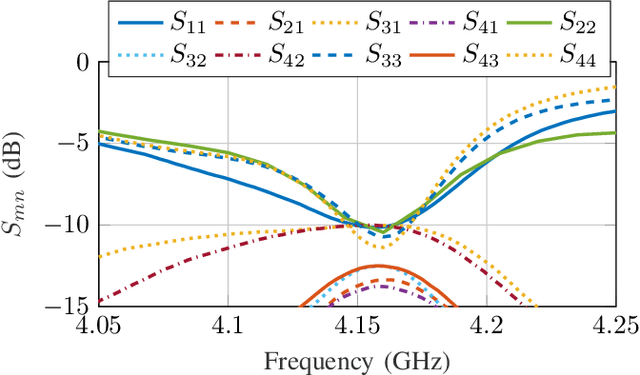
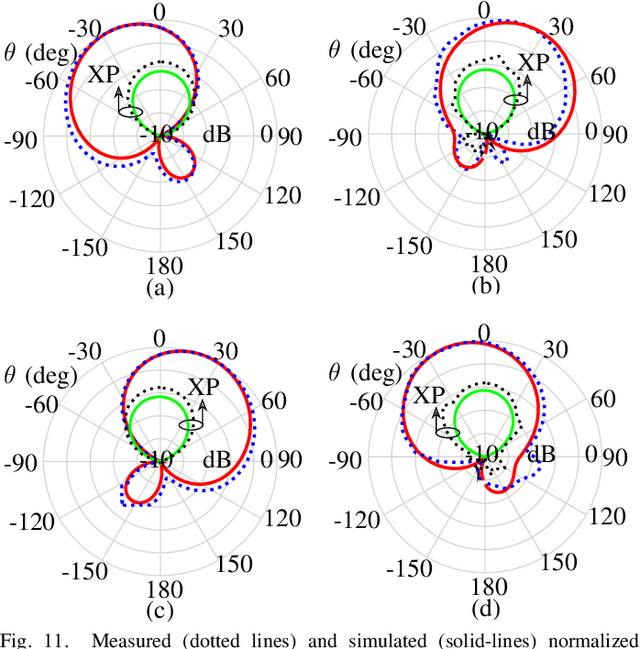
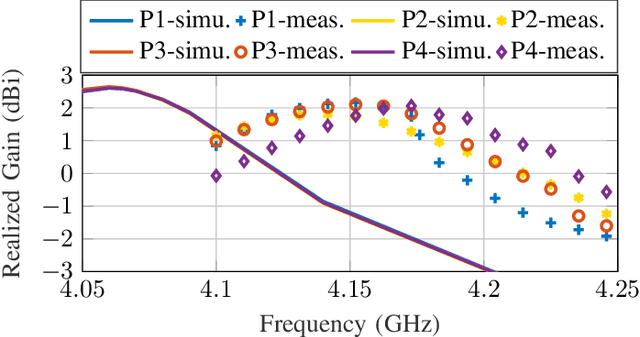
This work proposes a small pattern and polarization diversity multi-sector annular antenna with electrical size and profile of ${ka=1.2}$ and ${0.018\lambda}$, respectively. The antenna is planar and comprises annular sectors that are fed using different ports to enable digital beamforming techniques, with efficiency and gain of up to 78% and 4.62 dBi, respectively. The cavity mode analysis is used to describe the design concept and the antenna diversity. The proposed method can produce different polarization states (e.g. linearly and circularly polarized patterns), and pattern diversity characteristics covering the elevation plane. Owing to its small electrical size, low-profile and diversity properties, the solution shows good promise to enable advanced radio applications like wireless physical layer security in many emerging and size-constrained Internet of Things (IoT) devices.
Classical Capacity of Arbitrarily Distributed Noisy Quantum Channels
Jun 28, 2023With the rapid deployment of quantum computers and quantum satellites, there is a pressing need to design and deploy quantum and hybrid classical-quantum networks capable of exchanging classical information. In this context, we conduct the foundational study on the impact of a mixture of classical and quantum noise on an arbitrary quantum channel carrying classical information. The rationale behind considering such mixed noise is that quantum noise can arise from different entanglement and discord in quantum transmission scenarios, like different memories and repeater technologies, while classical noise can arise from the coexistence with the classical signal. Towards this end, we derive the distribution of the mixed noise from a classical system's perspective, and formulate the achievable channel capacity over an arbitrary distributed quantum channel in presence of the mixed noise. Numerical results demonstrate that capacity increases with the increase in the number of photons per usage.