 Add to Chrome
 Add to Firefox
 Add to Edge
Reasoning Through Chess: How Reasoning Evolves from Data Through Fine-Tuning and Reinforcement Learning
Apr 06, 2026
How can you get a language model to reason in a task it natively struggles with? We study how reasoning evolves in a language model -- from supervised fine-tuning (SFT) to reinforcement learning (RL) -- by analyzing how a set of theoretically-inspired datasets impacts language model performance in chess. We find that fine-tuning a model to directly predict the best move leads to effective RL and the strongest downstream performance -- however, the RL step elicits unfaithful reasoning (reasoning inconsistent with the chosen move). Alternatively, training on multi-move trajectories yields comparable downstream performance with faithful reasoning and more stable RL. We show that RL induces a substantial positive shift in the distribution of move quality and reduces hallucination rates as a side effect. Finally, we find several SFT-checkpoint metrics -- metrics spanning evaluation performance, hallucination rates, and reasoning quality -- to be predictive of post-RL model performance. We release checkpoints and final models as well as training data, evaluations, and code which allowed us to surpass leading open-source reasoning models in chess with a 7B-parameter model.

LaDiR: Latent Diffusion Enhances LLMs for Text Reasoning
Oct 06, 2025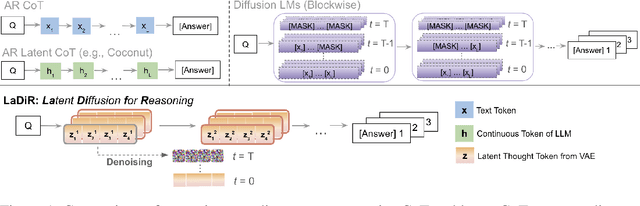
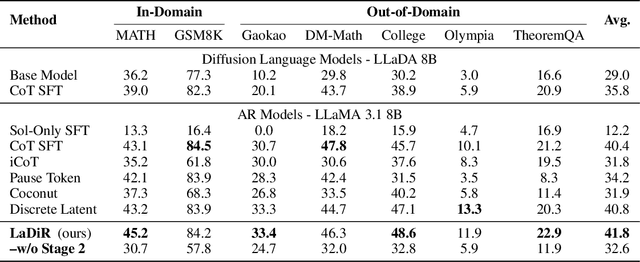
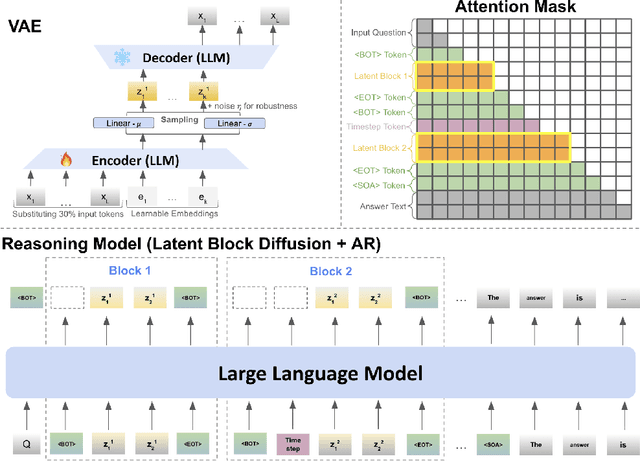

Large Language Models (LLMs) demonstrate their reasoning ability through chain-of-thought (CoT) generation. However, LLM's autoregressive decoding may limit the ability to revisit and refine earlier tokens in a holistic manner, which can also lead to inefficient exploration for diverse solutions. In this paper, we propose LaDiR (Latent Diffusion Reasoner), a novel reasoning framework that unifies the expressiveness of continuous latent representation with the iterative refinement capabilities of latent diffusion models for an existing LLM. We first construct a structured latent reasoning space using a Variational Autoencoder (VAE) that encodes text reasoning steps into blocks of thought tokens, preserving semantic information and interpretability while offering compact but expressive representations. Subsequently, we utilize a latent diffusion model that learns to denoise a block of latent thought tokens with a blockwise bidirectional attention mask, enabling longer horizon and iterative refinement with adaptive test-time compute. This design allows efficient parallel generation of diverse reasoning trajectories, allowing the model to plan and revise the reasoning process holistically. We conduct evaluations on a suite of mathematical reasoning and planning benchmarks. Empirical results show that LaDiR consistently improves accuracy, diversity, and interpretability over existing autoregressive, diffusion-based, and latent reasoning methods, revealing a new paradigm for text reasoning with latent diffusion.