 Add to Chrome
 Add to Firefox
 Add to Edge
Faster by Design: Interactive Aerodynamics via Neural Surrogates Trained on Expert-Validated CFD
Apr 20, 2026
Computational Fluid Dynamics (CFD) is central to race-car aerodynamic development, yet its cost -- tens of thousands of core-hours per high-fidelity evaluation -- severely limits the design space exploration feasible within realistic budgets. AI-based surrogate models promise to alleviate this bottleneck, but progress has been constrained by the limited complexity of public datasets, which are dominated by smoothed passenger-car shapes that fail to exercise surrogates on the thin, complex, highly loaded components governing motorsport performance. This work presents three primary contributions. First, we introduce a high-fidelity RANS dataset built on a parametric LMP2-class CAD model and spanning six operating conditions (map points) covering straight-line and cornering regimes, generated and validated by aerodynamics experts at Dallara to preserve features relevant to industrial motorsport. Second, we present the Gauge-Invariant Spectral Transformer (GIST), a graph-based neural operator whose spectral embeddings encode mesh connectivity to enhance predictions on tightly packed, complex geometries. GIST guarantees discretization invariance and scales linearly with mesh size, achieving state-of-the-art accuracy on both public benchmarks and the proposed race-car dataset. Third, we demonstrate that GIST achieves a level of predictive accuracy suitable for early-stage aerodynamic design, providing a first validation of the concept of interactive design-space exploration -- where engineers query a surrogate in place of the CFD solver -- within industrial motorsport workflows.

GIST: Gauge-Invariant Spectral Transformers for Scalable Graph Neural Operators
Mar 17, 2026Adapting transformer positional encoding to meshes and graph-structured data presents significant computational challenges: exact spectral methods require cubic-complexity eigendecomposition and can inadvertently break gauge invariance through numerical solver artifacts, while efficient approximate methods sacrifice gauge symmetry by design. Both failure modes cause catastrophic generalization in inductive learning, where models trained with one set of numerical choices fail when encountering different spectral decompositions of similar graphs or discretizations of the same mesh. We propose GIST (Gauge-Invariant Spectral Transformers), a new graph transformer architecture that resolves this challenge by achieving end-to-end $\mathcal{O}(N)$ complexity through random projections while algorithmically preserving gauge invariance via inner-product-based attention on the projected embeddings. We prove GIST achieves discretization-invariant learning with bounded mismatch error, enabling parameter transfer across arbitrary mesh resolutions for neural operator applications. Empirically, GIST matches state-of-the-art on standard graph benchmarks (e.g., achieving 99.50% micro-F1 on PPI) while uniquely scaling to mesh-based Neural Operator benchmarks with up to 750K nodes, achieving state-of-the-art aerodynamic prediction on the challenging DrivAerNet and DrivAerNet++ datasets.
The Danger of Overthinking: Examining the Reasoning-Action Dilemma in Agentic Tasks
Feb 12, 2025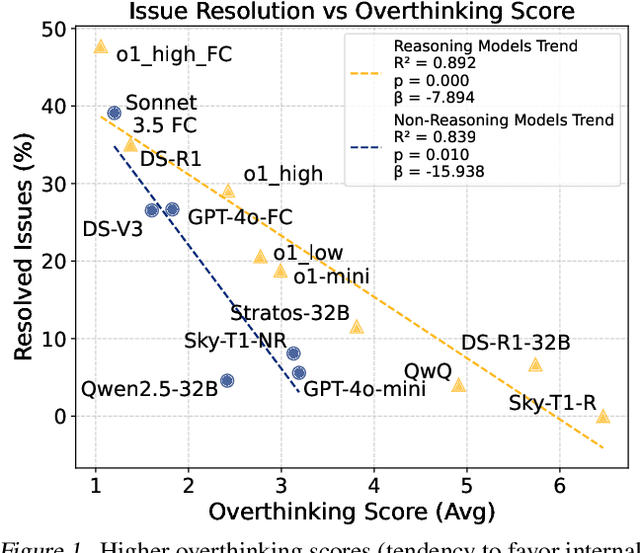
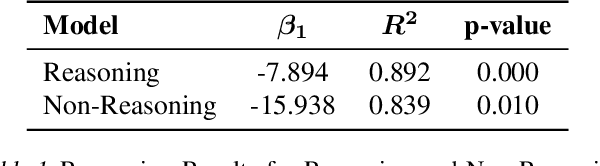
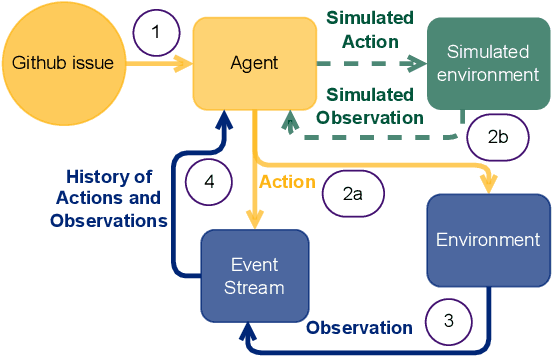
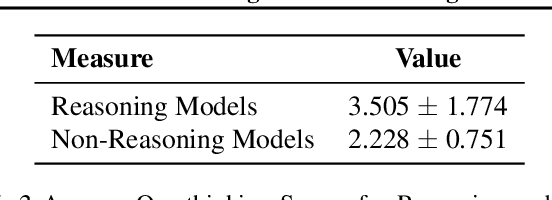
Large Reasoning Models (LRMs) represent a breakthrough in AI problem-solving capabilities, but their effectiveness in interactive environments can be limited. This paper introduces and analyzes overthinking in LRMs. A phenomenon where models favor extended internal reasoning chains over environmental interaction. Through experiments on software engineering tasks using SWE Bench Verified, we observe three recurring patterns: Analysis Paralysis, Rogue Actions, and Premature Disengagement. We propose a framework to study these behaviors, which correlates with human expert assessments, and analyze 4018 trajectories. We observe that higher overthinking scores correlate with decreased performance, with reasoning models exhibiting stronger tendencies toward overthinking compared to non-reasoning models. Our analysis reveals that simple efforts to mitigate overthinking in agentic environments, such as selecting the solution with the lower overthinking score, can improve model performance by almost 30% while reducing computational costs by 43%. These results suggest that mitigating overthinking has strong practical implications. We suggest that by leveraging native function-calling capabilities and selective reinforcement learning overthinking tendencies could be mitigated. We also open-source our evaluation framework and dataset to facilitate research in this direction at https://github.com/AlexCuadron/Overthinking.