 Add to Chrome
 Add to Firefox
 Add to Edge
SPHINX: First Explain, Then Explore
Jun 16, 2026
Generating adversarial driving scenarios is critical for evaluating and improving autonomous vehicle decision-making systems in simulation. Recent approaches, such as ChatScene and LLM-Attacker, rely primarily on the prior knowledge of Large Language Models and Vision-Language Models to generate driving scenarios procedurally. We argue that adversarial scenes should be generated based on the failure diagnosis (e.g., indecisiveness, multi-frame inconsistency) of the driving policy to specifically address the policy's weaknesses instead of relying on prior assumptions. In this paper, we propose SPHINX, a closed-loop framework for adversarial scenario synthesis guided by a simple principle: first explain, then explore. Beyond blindly exploring the scenario space, SPHINX leverages explainable artificial intelligence methods to analyze the policy, identifying key visual concepts and their influence on policy outputs, and the uncertainty of the decisions. Given the interpretable evidence extracted from the policy's own decision process, we use a vision language model to rationalize and criticize failure modes of the current policy. These critics are then used to generate targeted adversarial scenarios for policy retraining and improvement. We demonstrate that SPHINX can highlight an interpretable account of policy failures while other adversarial scene generation cannot. Across the evaluated benchmarks and test suites, SPHINX can be applied to diverse state-of-the-art autonomous vehicle architectures and yields consistent robustness improvements over existing scenario-generation methods.

Semantic Optimal Transport for Sparse Autoencoder Feature Matching and Circuit Compression
May 27, 2026Sparse autoencoders (SAEs) have become a central tool for interpreting language models. However, two key SAE analyses that remain difficult to scale are (1) matching semantically similar features across multi-layers and (2) compressing large feature circuits into interpretable supernodes. Although these have been treated as separate problems, we show that both are instances of a more fundamental challenge, which we frame as the estimation of semantic distances between SAE features that lie on different activation manifolds. We introduce a distributional framework for this problem, in which each feature is represented not by a single decoder vector like in the literature, but by an activation-weighted distribution over the hidden states that express it. By projecting these distributions into a shared reference space and comparing them with Wasserstein distance, our method provides a unified semantic metric for cross-layer feature comparison. We prove that our representation is invariant to activation rescaling, stable under perturbations, and recovers true matches under finite-sample margin conditions. Empirically, our method outperforms decoder-vector and LLM-based baselines and captures subtle functional distinctions between related features. Notably, our method compresses large feature circuits into interpretable supernodes automatically.
Q-ShiftDP: A Differentially Private Parameter-Shift Rule for Quantum Machine Learning
Feb 03, 2026Quantum Machine Learning (QML) promises significant computational advantages, but preserving training data privacy remains challenging. Classical approaches like differentially private stochastic gradient descent (DP-SGD) add noise to gradients but fail to exploit the unique properties of quantum gradient estimation. In this work, we introduce the Differentially Private Parameter-Shift Rule (Q-ShiftDP), the first privacy mechanism tailored to QML. By leveraging the inherent boundedness and stochasticity of quantum gradients computed via the parameter-shift rule, Q-ShiftDP enables tighter sensitivity analysis and reduces noise requirements. We combine carefully calibrated Gaussian noise with intrinsic quantum noise to provide formal privacy and utility guarantees, and show that harnessing quantum noise further improves the privacy-utility trade-off. Experiments on benchmark datasets demonstrate that Q-ShiftDP consistently outperforms classical DP methods in QML.
Swift Hydra: Self-Reinforcing Generative Framework for Anomaly Detection with Multiple Mamba Models
Mar 09, 2025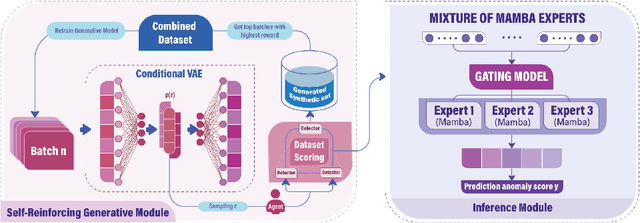
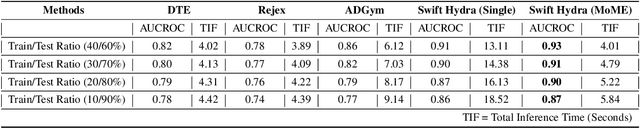
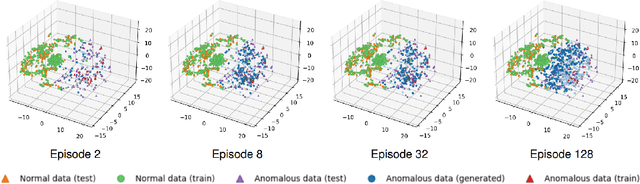
Despite a plethora of anomaly detection models developed over the years, their ability to generalize to unseen anomalies remains an issue, particularly in critical systems. This paper aims to address this challenge by introducing Swift Hydra, a new framework for training an anomaly detection method based on generative AI and reinforcement learning (RL). Through featuring an RL policy that operates on the latent variables of a generative model, the framework synthesizes novel and diverse anomaly samples that are capable of bypassing a detection model. These generated synthetic samples are, in turn, used to augment the detection model, further improving its ability to handle challenging anomalies. Swift Hydra also incorporates Mamba models structured as a Mixture of Experts (MoE) to enable scalable adaptation of the number of Mamba experts based on data complexity, effectively capturing diverse feature distributions without increasing the model's inference time. Empirical evaluations on ADBench benchmark demonstrate that Swift Hydra outperforms other state-of-the-art anomaly detection models while maintaining a relatively short inference time. From these results, our research highlights a new and auspicious paradigm of integrating RL and generative AI for advancing anomaly detection.
REM: A Scalable Reinforced Multi-Expert Framework for Multiplex Influence Maximization
Jan 01, 2025


In social online platforms, identifying influential seed users to maximize influence spread is a crucial as it can greatly diminish the cost and efforts required for information dissemination. While effective, traditional methods for Multiplex Influence Maximization (MIM) have reached their performance limits, prompting the emergence of learning-based approaches. These novel methods aim for better generalization and scalability for more sizable graphs but face significant challenges, such as (1) inability to handle unknown diffusion patterns and (2) reliance on high-quality training samples. To address these issues, we propose the Reinforced Expert Maximization framework (REM). REM leverages a Propagation Mixture of Experts technique to encode dynamic propagation of large multiplex networks effectively in order to generate enhanced influence propagation. Noticeably, REM treats a generative model as a policy to autonomously generate different seed sets and learn how to improve them from a Reinforcement Learning perspective. Extensive experiments on several real-world datasets demonstrate that REM surpasses state-of-the-art methods in terms of influence spread, scalability, and inference time in influence maximization tasks.
MIM-Reasoner: Learning with Theoretical Guarantees for Multiplex Influence Maximization
Mar 10, 2024

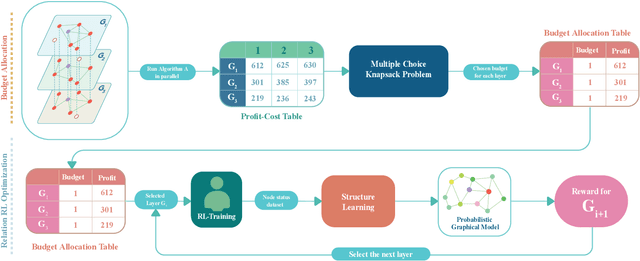
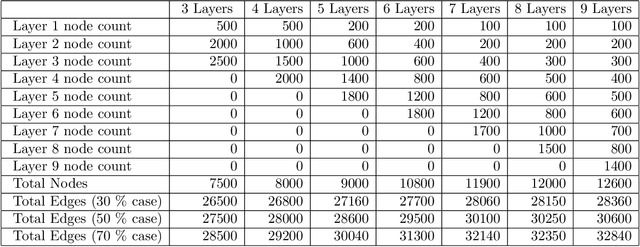
Multiplex influence maximization (MIM) asks us to identify a set of seed users such as to maximize the expected number of influenced users in a multiplex network. MIM has been one of central research topics, especially in nowadays social networking landscape where users participate in multiple online social networks (OSNs) and their influences can propagate among several OSNs simultaneously. Although there exist a couple combinatorial algorithms to MIM, learning-based solutions have been desired due to its generalization ability to heterogeneous networks and their diversified propagation characteristics. In this paper, we introduce MIM-Reasoner, coupling reinforcement learning with probabilistic graphical model, which effectively captures the complex propagation process within and between layers of a given multiplex network, thereby tackling the most challenging problem in MIM. We establish a theoretical guarantee for MIM-Reasoner as well as conduct extensive analyses on both synthetic and real-world datasets to validate our MIM-Reasoner's performance.