 Add to Chrome
 Add to Firefox
 Add to Edge
SPHINX: First Explain, Then Explore
Jun 16, 2026
Generating adversarial driving scenarios is critical for evaluating and improving autonomous vehicle decision-making systems in simulation. Recent approaches, such as ChatScene and LLM-Attacker, rely primarily on the prior knowledge of Large Language Models and Vision-Language Models to generate driving scenarios procedurally. We argue that adversarial scenes should be generated based on the failure diagnosis (e.g., indecisiveness, multi-frame inconsistency) of the driving policy to specifically address the policy's weaknesses instead of relying on prior assumptions. In this paper, we propose SPHINX, a closed-loop framework for adversarial scenario synthesis guided by a simple principle: first explain, then explore. Beyond blindly exploring the scenario space, SPHINX leverages explainable artificial intelligence methods to analyze the policy, identifying key visual concepts and their influence on policy outputs, and the uncertainty of the decisions. Given the interpretable evidence extracted from the policy's own decision process, we use a vision language model to rationalize and criticize failure modes of the current policy. These critics are then used to generate targeted adversarial scenarios for policy retraining and improvement. We demonstrate that SPHINX can highlight an interpretable account of policy failures while other adversarial scene generation cannot. Across the evaluated benchmarks and test suites, SPHINX can be applied to diverse state-of-the-art autonomous vehicle architectures and yields consistent robustness improvements over existing scenario-generation methods.

Error-Driven Prompt Optimization for Arithmetic Reasoning
Dec 15, 2025Recent advancements in artificial intelligence have sparked interest in industrial agents capable of supporting analysts in regulated sectors, such as finance and healthcare, within tabular data workflows. A key capability for such systems is performing accurate arithmetic operations on structured data while ensuring sensitive information never leaves secure, on-premises environments. Here, we introduce an error-driven optimization framework for arithmetic reasoning that enhances a Code Generation Agent (CGA), specifically applied to on-premises small language models (SLMs). Through a systematic evaluation of a leading SLM (Qwen3 4B), we find that while the base model exhibits fundamental limitations in arithmetic tasks, our proposed error-driven method, which clusters erroneous predictions to refine prompt-rules iteratively, dramatically improves performance, elevating the model's accuracy to 70.8\%. Our results suggest that developing reliable, interpretable, and industrially deployable AI assistants can be achieved not only through costly fine-tuning but also via systematic, error-driven prompt optimization, enabling small models to surpass larger language models (GPT-3.5 Turbo) in a privacy-compliant manner.
Efficient Learning of Model Weights via Changing Features During Training
Feb 21, 2020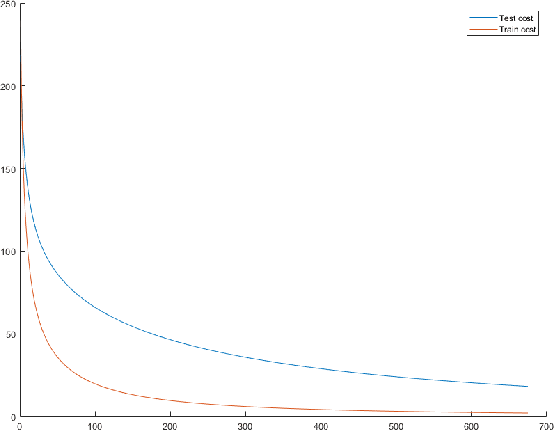
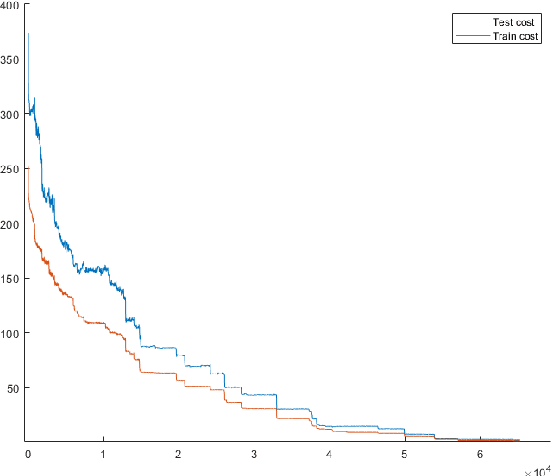
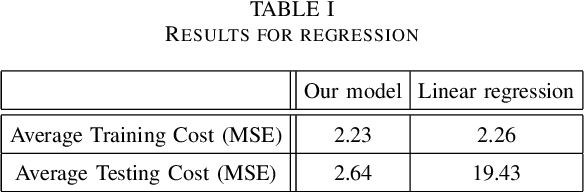
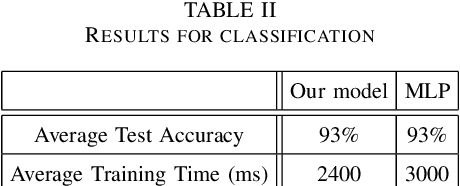
In this paper, we propose a machine learning model, which dynamically changes the features during training. Our main motivation is to update the model in a small content during the training process with replacing less descriptive features to new ones from a large pool. The main benefit is coming from the fact that opposite to the common practice we do not start training a new model from the scratch, but can keep the already learned weights. This procedure allows the scan of a large feature pool which together with keeping the complexity of the model leads to an increase of the model accuracy within the same training time. The efficiency of our approach is demonstrated in several classic machine learning scenarios including linear regression and neural network-based training. As a specific analysis towards signal processing, we have successfully tested our approach on the database MNIST for digit classification considering single pixel and pixel-pairs intensities as possible features.