 Add to Chrome
 Add to Firefox
 Add to Edge
Two AI Metrics Diverged: Will it Make All the Difference?
Jul 01, 2026
As exponential compute scaling continues, will the capabilities of frontier AI models outstrip what is accessible to developers on a small fixed budget? Or will capabilities converge, with "meek models inheriting the earth"? Building on Gundlach et al. (2025b), we show that the answer depends on how we value and measure AI capabilities. We discuss conventional performance measures and show that, while validation loss shows a shrinking gap, on other metrics frontier models grow their lead forever. Classifying performance metrics by their functional forms in relation to training (and inference) compute, we provide tight mathematical conditions for determining which metrics favor meek models, and show that bounded performance metrics always do. But careful interpretation of performance metrics is essential: we show that many common bounded metrics have closely-related counterpart metrics that are unbounded (and vice versa). Determining the apt metric in a domain is a prerequisite for policy, since bounded and unbounded metrics may suggest opposing policy responses. If a particular capability -- like software engineering, synthetic biology, or rhetorical persuasiveness -- is unbounded when measured in the terms we care about, frontier-level capability will likely be concentrated in the hands of a few wealthy actors. Conversely, if that capability is instead bounded, frontier-level capabilities proliferate through meek models into the hands of the many.

Crashing Waves vs. Rising Tides: Preliminary Findings on AI Automation from Thousands of Worker Evaluations of Labor Market Tasks
Apr 01, 2026We propose that AI automation is a continuum between: (i) crashing waves where AI capabilities surge abruptly over small sets of tasks, and (ii) rising tides where the increase in AI capabilities is more continuous and broad-based. We test for these effects in preliminary evidence from an ongoing evaluation of AI capabilities across over 3,000 broad-based tasks derived from the U.S. Department of Labor O*NET categorization that are text-based and thus LLM-addressable. Based on more than 17,000 evaluations by workers from these jobs, we find little evidence of crashing waves (in contrast to recent work by METR), but substantial evidence that rising tides are the primary form of AI automation. AI performance is high and improving rapidly across a wide range of tasks. We estimate that, in 2024-Q2, AI models successfully complete tasks that take humans approximately 3-4 hours with about a 50% success rate, increasing to about 65% by 2025-Q3. If recent trends in AI capability growth persist, this pace of AI improvement implies that LLMs will be able to complete most text-related tasks with success rates of, on average, 80%-95% by 2029 at a minimally sufficient quality level. Achieving near-perfect success rates at this quality level or comparable success rates at superior quality would require several additional years. These AI capability improvements would impact the economy and labor market as organizations adopt AI, which could have a substantially longer timeline.
Economics of Human and AI Collaboration: When is Partial Automation More Attractive than Full Automation?
Mar 31, 2026This paper develops a unified framework for evaluating the optimal degree of task automation. Moving beyond binary automate-or-not assessments, we model automation intensity as a continuous choice in which firms minimize costs by selecting an AI accuracy level, from no automation through partial human-AI collaboration to full automation. On the supply side, we estimate an AI production function via scaling-law experiments linking performance to data, compute, and model size. Because AI systems exhibit predictable but diminishing returns to these inputs, the cost of higher accuracy is convex: good performance may be inexpensive, but near-perfect accuracy is disproportionately costly. Full automation is therefore often not cost-minimizing; partial automation, where firms retain human workers for residual tasks, frequently emerges as the equilibrium. On the demand side, we introduce an entropy-based measure of task complexity that maps model accuracy into a labor substitution ratio, quantifying human labor displacement at each accuracy level. We calibrate the framework with O*NET task data, a survey of 3,778 domain experts, and GPT-4o-derived task decompositions, implementing it in computer vision. Task complexity shapes substitution: low-complexity tasks see high substitution, while high-complexity tasks favor limited partial automation. Scale of deployment is a key determinant: AI-as-a-Service and AI agents spread fixed costs across users, sharply expanding economically viable tasks. At the firm level, cost-effective automation captures approximately 11% of computer-vision-exposed labor compensation; under economy-wide deployment, this share rises sharply. Since other AI systems exhibit similar scaling-law economics, our mechanisms extend beyond computer vision, reinforcing that partial automation is often the economically rational long-run outcome, not merely a transitional phase.
Is there "Secret Sauce'' in Large Language Model Development?
Feb 06, 2026Do leading LLM developers possess a proprietary ``secret sauce'', or is LLM performance driven by scaling up compute? Using training and benchmark data for 809 models released between 2022 and 2025, we estimate scaling-law regressions with release-date and developer fixed effects. We find clear evidence of developer-specific efficiency advantages, but their importance depends on where models lie in the performance distribution. At the frontier, 80-90% of performance differences are explained by higher training compute, implying that scale--not proprietary technology--drives frontier advances. Away from the frontier, however, proprietary techniques and shared algorithmic progress substantially reduce the compute required to reach fixed capability thresholds. Some companies can systematically produce smaller models more efficiently. Strikingly, we also find substantial variation of model efficiency within companies; a firm can train two models with more than 40x compute efficiency difference. We also discuss the implications for AI leadership and capability diffusion.
How Much Progress Has There Been in NVIDIA Datacenter GPUs?
Jan 27, 2026Graphics Processing Units (GPUs) are the state-of-the-art architecture for essential tasks, ranging from rendering 2D/3D graphics to accelerating workloads in supercomputing centers and, of course, Artificial Intelligence (AI). As GPUs continue improving to satisfy ever-increasing performance demands, analyzing past and current progress becomes paramount in determining future constraints on scientific research. This is particularly compelling in the AI domain, where rapid technological advancements and fierce global competition have led the United States to recently implement export control regulations limiting international access to advanced AI chips. For this reason, this paper studies technical progress in NVIDIA datacenter GPUs released from the mid-2000s until today. Specifically, we compile a comprehensive dataset of datacenter NVIDIA GPUs comprising several features, ranging from computational performance to release price. Then, we examine trends in main GPU features and estimate progress indicators for per-memory bandwidth, per-dollar, and per-watt increase rates. Our main results identify doubling times of 1.44 and 1.69 years for FP16 and FP32 operations (without accounting for sparsity benefits), while FP64 doubling times range from 2.06 to 3.79 years. Off-chip memory size and bandwidth grew at slower rates than computing performance, doubling every 3.32 to 3.53 years. The release prices of datacenter GPUs have roughly doubled every 5.1 years, while their power consumption has approximately doubled every 16 years. Finally, we quantify the potential implications of current U.S. export control regulations in terms of the potential performance gaps that would result if implementation were assumed to be complete and successful. We find that recently proposed changes to export controls would shrink the potential performance gap from 23.6x to 3.54x.
Mapping AI Risk Mitigations: Evidence Scan and Preliminary AI Risk Mitigation Taxonomy
Dec 12, 2025Organizations and governments that develop, deploy, use, and govern AI must coordinate on effective risk mitigation. However, the landscape of AI risk mitigation frameworks is fragmented, uses inconsistent terminology, and has gaps in coverage. This paper introduces a preliminary AI Risk Mitigation Taxonomy to organize AI risk mitigations and provide a common frame of reference. The Taxonomy was developed through a rapid evidence scan of 13 AI risk mitigation frameworks published between 2023-2025, which were extracted into a living database of 831 AI risk mitigations. The mitigations were iteratively clustered & coded to create the Taxonomy. The preliminary AI Risk Mitigation Taxonomy organizes mitigations into four categories and 23 subcategories: (1) Governance & Oversight: Formal organizational structures and policy frameworks that establish human oversight mechanisms and decision protocols; (2) Technical & Security: Technical, physical, and engineering safeguards that secure AI systems and constrain model behaviors; (3) Operational Process: processes and management frameworks governing AI system deployment, usage, monitoring, incident handling, and validation; and (4) Transparency & Accountability: formal disclosure practices and verification mechanisms that communicate AI system information and enable external scrutiny. The rapid evidence scan and taxonomy construction also revealed several cases where terms like 'risk management' and 'red teaming' are used widely but refer to different responsible actors, actions, and mechanisms of action to reduce risk. This Taxonomy and associated mitigation database, while preliminary, offers a starting point for collation and synthesis of AI risk mitigations. It also offers an accessible, structured way for different actors in the AI ecosystem to discuss and coordinate action to reduce risks from AI.
Meek Models Shall Inherit the Earth
Jul 10, 2025The past decade has seen incredible scaling of AI systems by a few companies, leading to inequality in AI model performance. This paper argues that, contrary to prevailing intuition, the diminishing returns to compute scaling will lead to a convergence of AI model capabilities. In other words, meek models (those with limited computation budget) shall inherit the earth, approaching the performance level of the best models overall. We develop a model illustrating that under a fixed-distribution next-token objective, the marginal capability returns to raw compute shrink substantially. Given current scaling practices, we argue that these diminishing returns are strong enough that even companies that can scale their models exponentially faster than other organizations will eventually have little advantage in capabilities. As part of our argument, we give several reasons that proxies like training loss differences capture important capability measures using evidence from benchmark data and theoretical performance models. In addition, we analyze empirical data on the capability difference of AI models over time. Finally, in light of the increasing ability of meek models, we argue that AI strategy and policy require reexamination, and we outline the areas this shift will affect.
Neural Scaling Laws for Embodied AI
May 22, 2024Scaling laws have driven remarkable progress across machine learning domains like language modeling and computer vision. However, the exploration of scaling laws in embodied AI and robotics has been limited, despite the rapidly increasing usage of machine learning in this field. This paper presents the first study to quantify scaling laws for Robot Foundation Models (RFMs) and the use of LLMs in robotics tasks. Through a meta-analysis spanning 198 research papers, we analyze how key factors like compute, model size, and training data quantity impact model performance across various robotic tasks. Our findings confirm that scaling laws apply to both RFMs and LLMs in robotics, with performance consistently improving as resources increase. The power law coefficients for RFMs closely match those of LLMs in robotics, resembling those found in computer vision and outperforming those for LLMs in the language domain. We also note that these coefficients vary with task complexity, with familiar tasks scaling more efficiently than unfamiliar ones, emphasizing the need for large and diverse datasets. Furthermore, we highlight the absence of standardized benchmarks in embodied AI. Most studies indicate diminishing returns, suggesting that significant resources are necessary to achieve high performance, posing challenges due to data and computational limitations. Finally, as models scale, we observe the emergence of new capabilities, particularly related to data and model size.
Algorithmic progress in language models
Mar 09, 2024


We investigate the rate at which algorithms for pre-training language models have improved since the advent of deep learning. Using a dataset of over 200 language model evaluations on Wikitext and Penn Treebank spanning 2012-2023, we find that the compute required to reach a set performance threshold has halved approximately every 8 months, with a 95% confidence interval of around 5 to 14 months, substantially faster than hardware gains per Moore's Law. We estimate augmented scaling laws, which enable us to quantify algorithmic progress and determine the relative contributions of scaling models versus innovations in training algorithms. Despite the rapid pace of algorithmic progress and the development of new architectures such as the transformer, our analysis reveals that the increase in compute made an even larger contribution to overall performance improvements over this time period. Though limited by noisy benchmark data, our analysis quantifies the rapid progress in language modeling, shedding light on the relative contributions from compute and algorithms.
The Compute Divide in Machine Learning: A Threat to Academic Contribution and Scrutiny?
Jan 08, 2024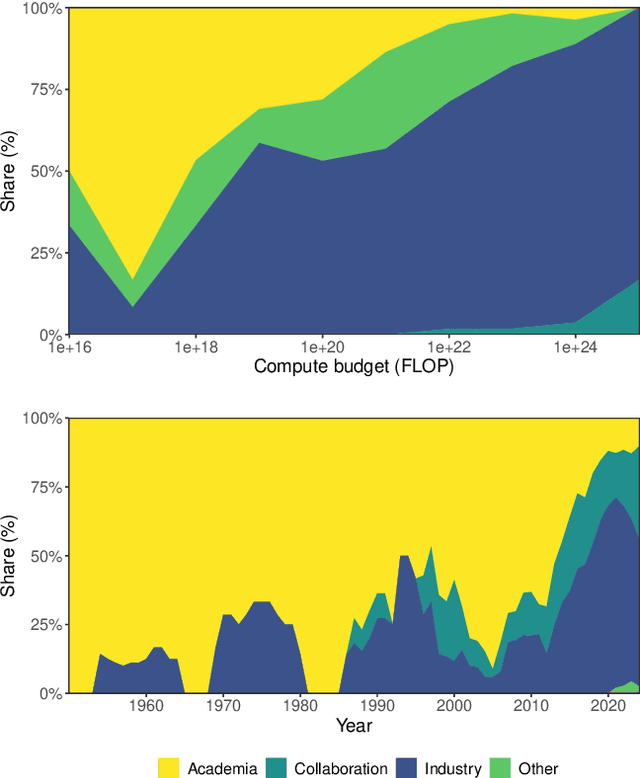
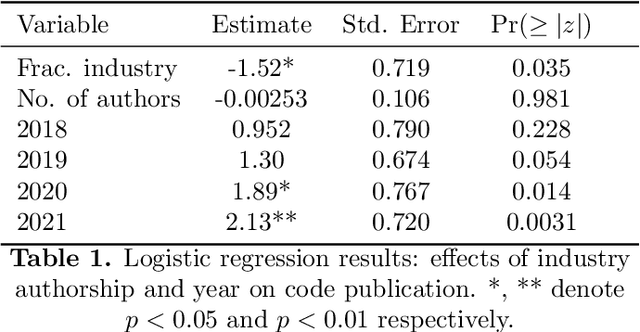
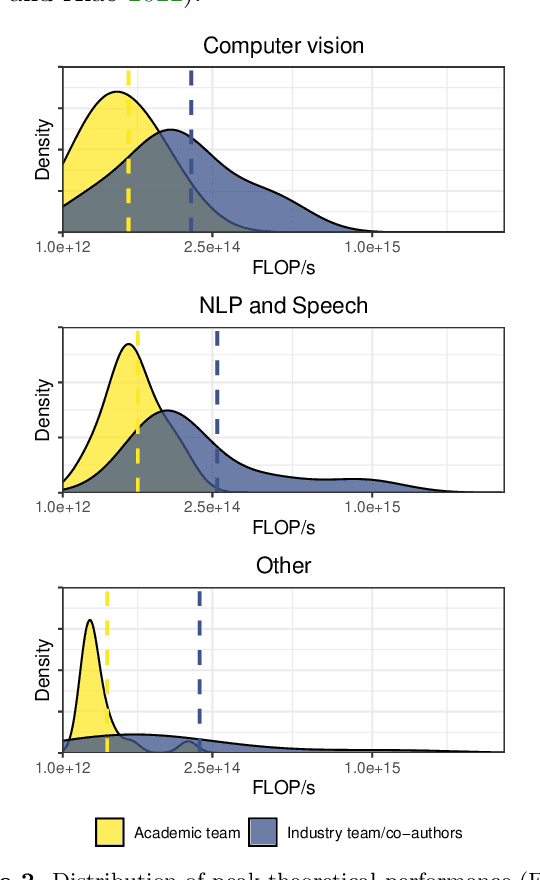
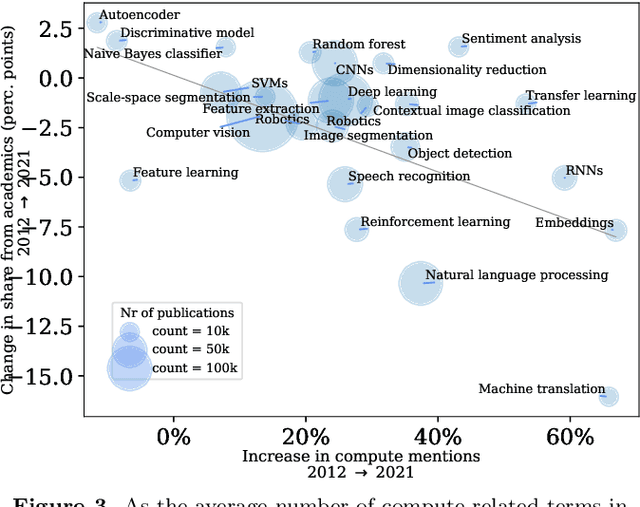
There are pronounced differences in the extent to which industrial and academic AI labs use computing resources. We provide a data-driven survey of the role of the compute divide in shaping machine learning research. We show that a compute divide has coincided with a reduced representation of academic-only research teams in compute intensive research topics, especially foundation models. We argue that, academia will likely play a smaller role in advancing the associated techniques, providing critical evaluation and scrutiny, and in the diffusion of such models. Concurrent with this change in research focus, there is a noticeable shift in academic research towards embracing open source, pre-trained models developed within the industry. To address the challenges arising from this trend, especially reduced scrutiny of influential models, we recommend approaches aimed at thoughtfully expanding academic insights. Nationally-sponsored computing infrastructure coupled with open science initiatives could judiciously boost academic compute access, prioritizing research on interpretability, safety and security. Structured access programs and third-party auditing may also allow measured external evaluation of industry systems.