 Add to Chrome
 Add to Firefox
 Add to Edge
The Computational Basis of Confidence in Large Language Models
Jul 14, 2026
Reliable confidence -- the probability that a model's own answer is correct -- is essential for the trustworthy deployment of language models. Existing work has largely evaluated confidence by how well it predicts correctness and whether it is calibrated, leaving open a more fundamental question: what does the confidence signal itself represent? Answer logits may reflect a latent decision variable sufficient to compute normative confidence, or instead a heuristic preference signal that combines the available evidence in a non-Bayesian manner. We address this using statistical decision confidence (SDC), a normative framework from computational neuroscience. Treating the answer-logit difference (LD) as a candidate readout of the latent decision variable, we test the qualitative signatures predicted by SDC. Across three perceptual discrimination tasks and a memory-based decision task, spanning three multimodal non-reasoning models and one reasoning model, LD satisfied these signatures -- including the diagnostic correct/error folded-X pattern -- showing that, in these settings, answer logits behave as monotonic readouts of a latent decision variable rather than heuristic preference scores. In complex visual reasoning, LD continued to predict correctness beyond objective task difficulty, but the full geometric signatures of SDC were absent, illustrating the current boundary of the framework when explicit normative process models are unavailable. These results provide a computational account of confidence in multimodal language models, delineate when answer logits behave as readouts of a latent decision variable, and establish SDC as a unifying framework for studying confidence across biological and artificial intelligence.

Closing the Loop to Discover Psychological Theories with an Automated Cognitive Scientist
Jun 24, 2026Across the sciences, autonomous systems are increasingly being used in closed-loop discovery, proposing new theories and designing and running experiments to test them. This approach is yet to be applied in the field of cognitive science, where the central bottleneck is theory-building: the creative step of turning the accumulated failures of existing models into better ones. Theory generation has remained manual even as data collection, modeling, and experiment design have been automated. We present the Automated Cognitive Scientist (AutoCog), a fully autonomous agentic-AI system that closes this loop. Large-language-model agents advocate competing theories, each expressed as an executable cognitive model, design experiments that best discriminate them, collect behavioral data from participants recruited online, score theories against collected data based on their generative performance, diagnose why they fail, and synthesize a better successor. Repeating this cycle allows them to search the space of theories, models, and experiments. In the domain of decision-making, AutoCog recovered known decision-making strategies from simulated behavior, including unconventional ones, showing that its discoveries are ultimately driven by the data rather than strictly bound by the priors of the underlying language models. When run with human participants, it produced theories that outperformed the established theories it was seeded with and generalized to held-out studies in two different experimental settings. It also surfaced a novel theory of multi-cue decision-making in which choices show diminishing sensitivity to feature values. The distinctive predictions of this theory were confirmed in a preregistered study with new participants. AutoCog demonstrates how an automated discovery system can be used to turn cognitive theory-building into an explicit, executable, and cumulative science.
How LLMs Detect and Correct Their Own Errors: The Role of Internal Confidence Signals
Apr 24, 2026Large language models can detect their own errors and sometimes correct them without external feedback, but the underlying mechanisms remain unknown. We investigate this through the lens of second-order models of confidence from decision neuroscience. In a first-order system, confidence derives from the generation signal itself and is therefore maximal for the chosen response, precluding error detection. Second-order models posit a partially independent evaluative signal that can disagree with the committed response, providing the basis for error detection. Kumaran et al. (2026) showed that LLMs cache a confidence representation at a token immediately following the answer (i.e. post-answer newline: PANL) -- that causally drives verbal confidence and dissociates from log-probabilities. Here we test whether this PANL signal extends beyond confidence to support error detection and self-correction. Here we test whether this signal supports error detection and self-correction, deriving predictions from the second-order framework. Using a verify-then-correct paradigm, we show that: (i) verbal confidence predicts error detection far beyond token log-probabilities, ruling out a first-order account; (ii) PANL activations predict error detection beyond verbal confidence itself; and (iii) PANL predicts which errors the model can correct -- where all behavioural signals fail. Causal interventions confirm that PANL signals rescue error detection behavior when answer information is corrupted. All findings replicate across models (Gemma 3 27B and Qwen 2.5 7B) and tasks (TriviaQA and MNLI). These results reveal that LLMs naturally implement a second-order confidence architecture whose internal evaluative signal encodes not only whether an answer is likely wrong but whether the model has the knowledge to fix it.
Causal Evidence that Language Models use Confidence to Drive Behavior
Mar 23, 2026Metacognition -- the ability to assess one's own cognitive performance -- is documented across species, with internal confidence estimates serving as a key signal for adaptive behavior. While confidence can be extracted from Large Language Model (LLM) outputs, whether models actively use these signals to regulate behavior remains a fundamental question. We investigate this through a four-phase abstention paradigm.Phase 1 established internal confidence estimates in the absence of an abstention option. Phase 2 revealed that LLMs apply implicit thresholds to these estimates when deciding to answer or abstain. Confidence emerged as the dominant predictor of behavior, with effect sizes an order of magnitude larger than knowledge retrieval accessibility (RAG scores) or surface-level semantic features. Phase 3 provided causal evidence through activation steering: manipulating internal confidence signals correspondingly shifted abstention rates. Finally, Phase 4 demonstrated that models can systematically vary abstention policies based on instructed thresholds.Our findings indicate that abstention arises from the joint operation of internal confidence representations and threshold-based policies, mirroring the two-stage metacognitive control found in biological systems. This capacity is essential as LLMs transition into autonomous agents that must recognize their own uncertainty to decide when to act or seek help.
Would I have gotten that reward? Long-term credit assignment by counterfactual contribution analysis
Jun 29, 2023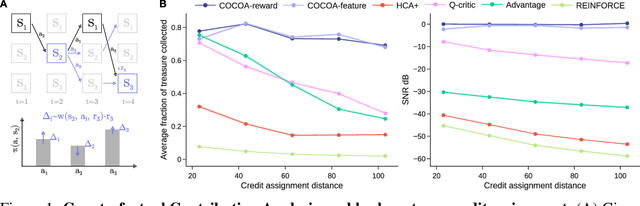
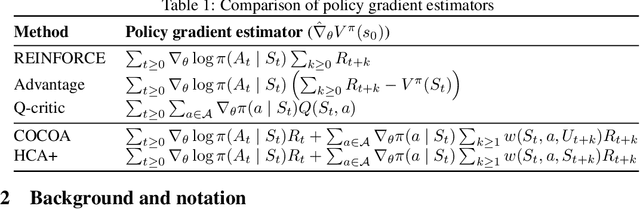
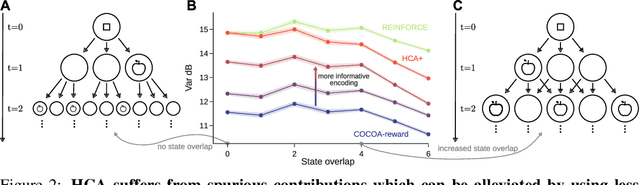
To make reinforcement learning more sample efficient, we need better credit assignment methods that measure an action's influence on future rewards. Building upon Hindsight Credit Assignment (HCA), we introduce Counterfactual Contribution Analysis (COCOA), a new family of model-based credit assignment algorithms. Our algorithms achieve precise credit assignment by measuring the contribution of actions upon obtaining subsequent rewards, by quantifying a counterfactual query: "Would the agent still have reached this reward if it had taken another action?". We show that measuring contributions w.r.t. rewarding states, as is done in HCA, results in spurious estimates of contributions, causing HCA to degrade towards the high-variance REINFORCE estimator in many relevant environments. Instead, we measure contributions w.r.t. rewards or learned representations of the rewarding objects, resulting in gradient estimates with lower variance. We run experiments on a suite of problems specifically designed to evaluate long-term credit assignment capabilities. By using dynamic programming, we measure ground-truth policy gradients and show that the improved performance of our new model-based credit assignment methods is due to lower bias and variance compared to HCA and common baselines. Our results demonstrate how modeling action contributions towards rewarding outcomes can be leveraged for credit assignment, opening a new path towards sample-efficient reinforcement learning.