 Add to Chrome
 Add to Firefox
 Add to Edge
Super-Resolution Experimental Validation and Polarimetric Extension of the Effective Roughness Diffuse Scattering Models
May 29, 2026
The experimental validation of diffuse scattering models has long been limited by the inability to spatially separate specular and diffuse contributions in measured channels. This paper overcomes this limitation by combining super-resolution multipath component (MPC) extraction, which resolves individual propagation paths including the specular component, with digital-twin-assisted geometry, enabling the spatial separation of specular and diffuse contributions from bistatic measurements at 28~GHz. Using this framework, we provide the first measurement-driven validation of the Effective Roughness (ER) model with independent characterization of diffuse scattering across ten common building materials, each measured over 266 angular configurations and all polarization combinations (HH, HV, VH, VV). Furthermore, we extend the ER framework by proposing a novel angle-dependent cross-polarization discrimination (XPD) model, capturing the geometry-dependent nature of depolarization that is neglected in existing approaches. The proposed method reproduces the measured diffuse power trends, achieving RMSE values as low as 3 dB across the tested materials, and improves XPD prediction over the baseline constant-XPD model for nearly all material-polarization cases. These results establish a physically consistent and practically viable approach for high-fidelity channel modeling in mmWave systems.

Evaluation of gNB Monostatic Sensing for UAV Use Case
Apr 02, 20263GPP Release 19 has initiated the standardization of integrated sensing and communications (ISAC), including a channel model for monostatic sensing, evaluation scenarios, and performance assessment methodologies. These common assumptions provide an important basis for ISAC evaluation, but reproducible end-to-end studies still require a transparent sensing implementation. This paper evaluates 5G New Radio (NR) base station (gNB)-based monostatic sensing for the Unmanned Aerial Vehicle (UAV) use case using a 5G NR downlink Cyclic Prefix-Orthogonal Frequency Division Multiplexing (CP-OFDM) waveform and positioning reference signals (PRS), following 3GPP Urban Macro-Aerial Vehicle (UMa-AV) scenario assumptions. We present an end-to-end processing chain for multi-target detection and 3D localization, achieving more than 70% detection probability with less than 5% false alarm rate, in the considered scenario. For correctly detected targets, localization errors are on the order of a few meters, with a 90th-percentile error of 4m and 6m in the vertical and horizontal directions, respectively. To support reproducible baseline studies and further research, we release the simulator 5GNRad, which reproduces our evaluation
Semantically Annotated Multimodal Dataset for RF Interpretation and Prediction
Apr 01, 2026Current limitations in wireless modeling and radio frequency (RF)-based AI are primarily driven by a lack of high-quality, measurement-based datasets that connect RF signals to their physical environments. RF heatmaps, the typical form of such data, are high-dimensional and complex but lack the geometric and semantic context needed for interpretation, constraining the development of supervised machine learning models. To address this bottleneck, we propose a new class of multimodal datasets that combines RF measurements with auxiliary modalities like high-resolution cameras and lidar to bridge the gap between RF signals and their physical causes. The proposed data collection will span diverse indoor and outdoor environments, featuring both static and dynamic scenarios, including human activities ranging from walking to subtle gestures. By achieving precise spatial and temporal co-registration and creating digital replicas for voxel-level annotation, this dataset will enable transformative AI research. Key tasks include the forward problem of predicting RF heatmaps from visual data to revolutionize wireless system design, and the inverse problem of inferring scene semantics from RF signals, creating a new form of RF-based perception.
Taming Vision Priors for Data Efficient mmWave Channel Modeling
Mar 11, 2026Accurately modeling millimeter-wave (mmWave) propagation is essential for real-time AR and autonomous systems. Differentiable ray tracing offers a physics-grounded solution but still facing deployment challenges due to its over-reliance on exhaustive channel measurements or brittle, hand-tuned scene models for material properties. We present VisRFTwin, a scalable and data-efficient digital-twin framework that integrates vision-derived material priors with differentiable ray tracing. Multi-view images from commodity cameras are processed by a frozen Vision-Language Model to extract dense semantic embeddings, which are translated into initial estimates of permittivity and conductivity for scene surfaces. These priors initialize a Sionna-based differentiable ray tracer, which rapidly calibrates material parameters via gradient descent with only a few dozen sparse channel soundings. Once calibrated, the association between vision features and material parameters is retained, enabling fast transfer to new scenarios without repeated calibration. Evaluations across three real-world scenarios, including office interiors, urban canyons, and dynamic public spaces show that VisRFTwin reduces channel measurement needs by up to 10$\times$ while achieving a 59% lower median delay spread error than pure data-driven deep learning methods.
Enabling Site-Specific Cellular Network Simulation Through Ray-Tracing-Driven ns-3
Aug 06, 2025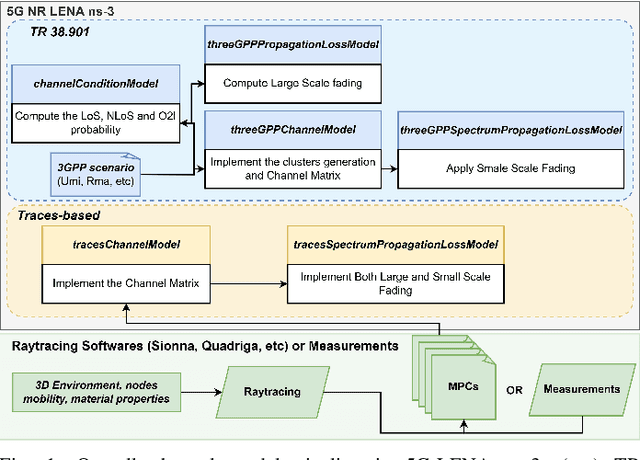
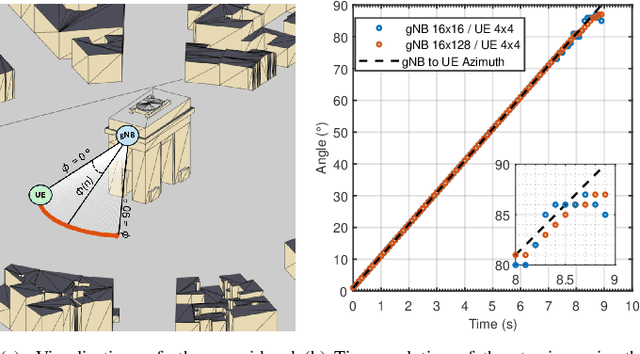
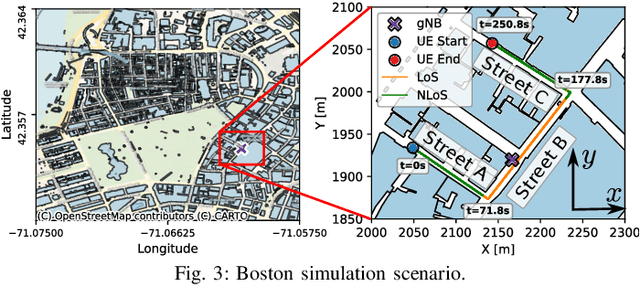
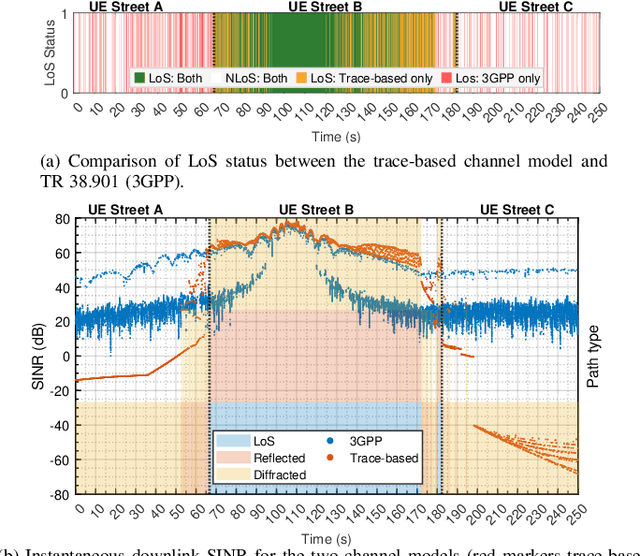
Evaluating cellular systems, from 5G New Radio (NR) and 5G-Advanced to 6G, is challenging because the performance emerges from the tight coupling of propagation, beam management, scheduling, and higher-layer interactions. System-level simulation is therefore indispensable, yet the vast majority of studies rely on the statistical 3GPP channel models. These are well suited to capture average behavior across many statistical realizations, but cannot reproduce site-specific phenomena such as corner diffraction, street-canyon blockage, or deterministic line-of-sight conditions and angle-of-departure/arrival relationships that drive directional links. This paper extends 5G-LENA, an NR module for the system-level Network Simulator 3 (ns-3), with a trace-based channel model that processes the Multipath Components (MPCs) obtained from external ray-tracers (e.g., Sionna Ray Tracer (RT)) or measurement campaigns. Our module constructs frequency-domain channel matrices and feeds them to the existing Physical (PHY)/Medium Access Control (MAC) stack without any further modifications. The result is a geometry-based channel model that remains fully compatible with the standard 3GPP implementation in 5G-LENA, while delivering site-specific geometric fidelity. This new module provides a key building block toward Digital Twin (DT) capabilities by offering realistic site-specific channel modeling, unlocking studies that require site awareness, including beam management, blockage mitigation, and environment-aware sensing. We demonstrate its capabilities for precise beam-steering validation and end-to-end metric analysis. In both cases, the trace-driven engine exposes performance inflections that the statistical model does not exhibit, confirming its value for high-fidelity system-level cellular networks research and as a step toward DT applications.
Detecting Airborne Objects with 5G NR Radars
May 30, 2025The integration of sensing capabilities into 5G New Radio (5G NR) networks offers an opportunity to enable the detection of airborne objects without the need for dedicated radars. This paper investigates the feasibility of using standardized Positioning Reference Signals (PRS) to detect UAVs in Urban Micro (UMi) and Urban Macro (UMa) propagation environments. A full 5G NR radar processing chain is implemented, including clutter suppression, angle and range estimation, and 3D position reconstruction. Simulation results show that performance strongly depends on the propagation environment. 5G NR radars exhibit the highest missed detection rate, up to 16%, in UMi, due to severe clutter. Positioning error increases with target distance, resulting in larger errors in UMa scenarios and at higher UAV altitudes. In particular, the system achieves a position error within 4m in the UMi environment and within 8m in UMa. The simulation platform has been released as open-source software to support reproducible research in integrated sensing and communication (ISAC) systems.