 Add to Chrome
 Add to Firefox
 Add to Edge
Taming Vision Priors for Data Efficient mmWave Channel Modeling
Mar 11, 2026
Accurately modeling millimeter-wave (mmWave) propagation is essential for real-time AR and autonomous systems. Differentiable ray tracing offers a physics-grounded solution but still facing deployment challenges due to its over-reliance on exhaustive channel measurements or brittle, hand-tuned scene models for material properties. We present VisRFTwin, a scalable and data-efficient digital-twin framework that integrates vision-derived material priors with differentiable ray tracing. Multi-view images from commodity cameras are processed by a frozen Vision-Language Model to extract dense semantic embeddings, which are translated into initial estimates of permittivity and conductivity for scene surfaces. These priors initialize a Sionna-based differentiable ray tracer, which rapidly calibrates material parameters via gradient descent with only a few dozen sparse channel soundings. Once calibrated, the association between vision features and material parameters is retained, enabling fast transfer to new scenarios without repeated calibration. Evaluations across three real-world scenarios, including office interiors, urban canyons, and dynamic public spaces show that VisRFTwin reduces channel measurement needs by up to 10$\times$ while achieving a 59% lower median delay spread error than pure data-driven deep learning methods.

NeRF$^\textbf{2}$: Neural Radio-Frequency Radiance Fields
May 10, 2023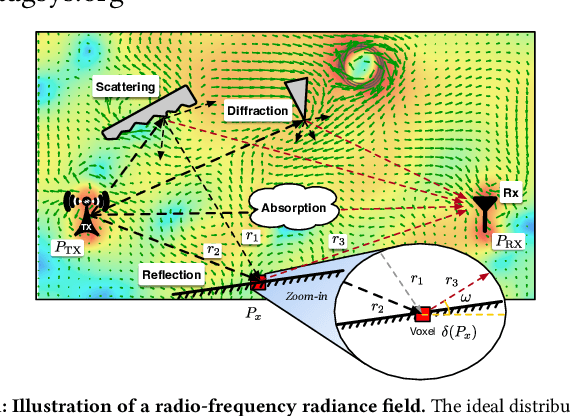
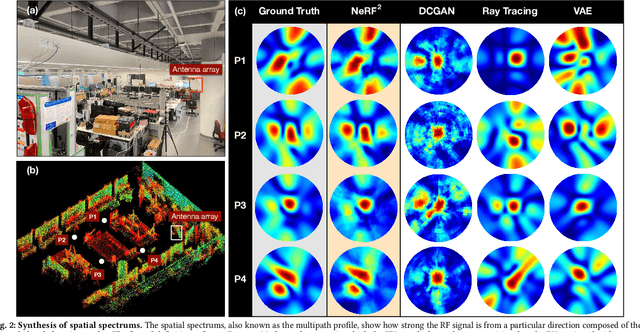
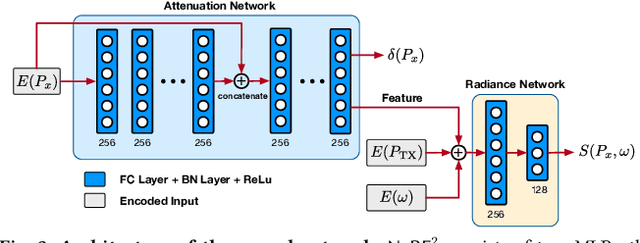
Although Maxwell discovered the physical laws of electromagnetic waves 160 years ago, how to precisely model the propagation of an RF signal in an electrically large and complex environment remains a long-standing problem. The difficulty is in the complex interactions between the RF signal and the obstacles (e.g., reflection, diffraction, etc.). Inspired by the great success of using a neural network to describe the optical field in computer vision, we propose a neural radio-frequency radiance field, NeRF$^\textbf{2}$, which represents a continuous volumetric scene function that makes sense of an RF signal's propagation. Particularly, after training with a few signal measurements, NeRF$^\textbf{2}$ can tell how/what signal is received at any position when it knows the position of a transmitter. As a physical-layer neural network, NeRF$^\textbf{2}$ can take advantage of the learned statistic model plus the physical model of ray tracing to generate a synthetic dataset that meets the training demands of application-layer artificial neural networks (ANNs). Thus, we can boost the performance of ANNs by the proposed turbo-learning, which mixes the true and synthetic datasets to intensify the training. Our experiment results show that turbo-learning can enhance performance with an approximate 50% increase. We also demonstrate the power of NeRF$^\textbf{2}$ in the field of indoor localization and 5G MIMO.