 Add to Chrome
 Add to Firefox
 Add to Edge
Small-Margin Preferences Still Matter-If You Train Them Right
Feb 01, 2026
Preference optimization methods such as DPO align large language models (LLMs) using paired comparisons, but their effectiveness can be highly sensitive to the quality and difficulty of preference pairs. A common heuristic treats small-margin (ambiguous) pairs as noisy and filters them out. In this paper, we revisit this assumption and show that pair difficulty interacts strongly with the optimization objective: when trained with preference-based losses, difficult pairs can destabilize training and harm alignment, yet these same pairs still contain useful supervision signals when optimized with supervised fine-tuning (SFT). Motivated by this observation, we propose MixDPO, a simple yet effective difficulty-aware training strategy that (i) orders preference data from easy to hard (a curriculum over margin-defined difficulty), and (ii) routes difficult pairs to an SFT objective while applying a preference loss to easy pairs. This hybrid design provides a practical mechanism to leverage ambiguous pairs without incurring the optimization failures often associated with preference losses on low-margin data. Across three LLM-judge benchmarks, MixDPO consistently improves alignment over DPO and a range of widely-used variants, with particularly strong gains on AlpacaEval~2 length-controlled (LC) win rate.

Token Cleaning: Fine-Grained Data Selection for LLM Supervised Fine-Tuning
Feb 04, 2025
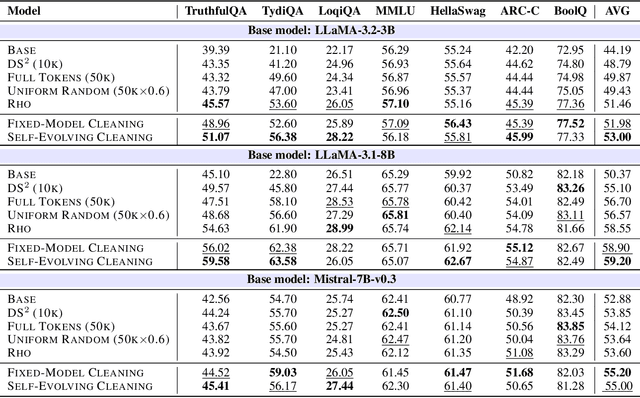


Recent studies show that in supervised fine-tuning (SFT) of large language models (LLMs), data quality matters more than quantity. While most data cleaning methods concentrate on filtering entire samples, the quality of individual tokens within a sample can vary significantly. After pre-training, even in high-quality samples, patterns or phrases that are not task-related can be redundant or uninformative. Continuing to fine-tune on these patterns may offer limited benefit and even degrade downstream task performance. In this paper, we investigate token quality from a noisy-label perspective and propose a generic token cleaning pipeline for SFT tasks. Our method filters out uninformative tokens while preserving those carrying key task-specific information. Specifically, we first evaluate token quality by examining the influence of model updates on each token, then apply a threshold-based separation. The token influence can be measured in a single pass with a fixed reference model or iteratively with self-evolving reference models. The benefits and limitations of both methods are analyzed theoretically by error upper bounds. Extensive experiments show that our framework consistently improves performance across multiple downstream tasks.